
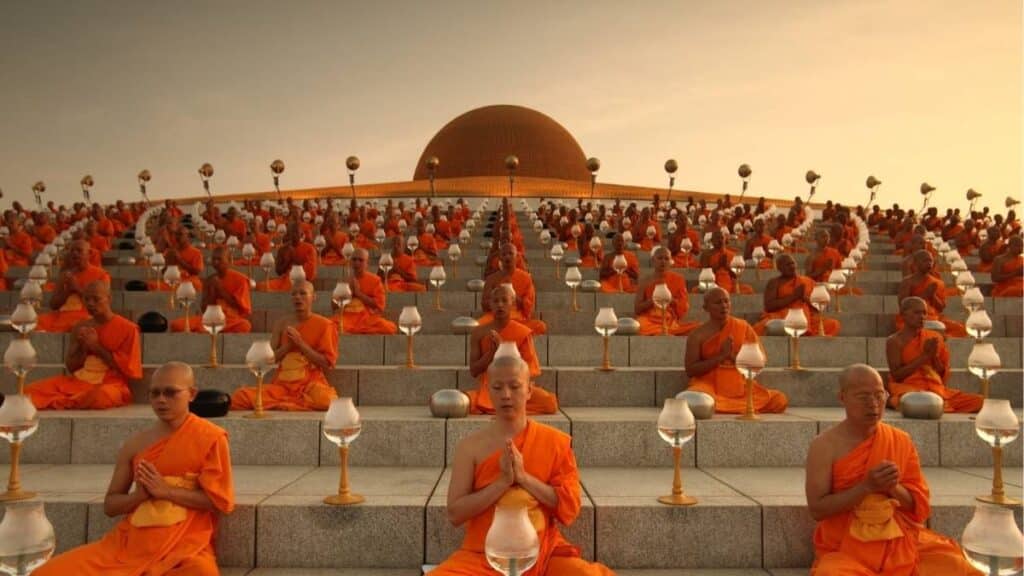
Magha Puja, also known as Sangha Day or the Festival of the Fourfold Assembly, is one of the most significant festivals in Theravada Buddhism. Celebrated on the full moon day of the third lunar month, it commemorates the spontaneous gathering of 1,250 enlightened disciples who assembled without prior summons to hear the Buddha deliver his core teachings.
The spiritual significance of Magha Puja comes from this extraordinary event that occurred nine months after the Buddha’s enlightenment at Veluvana Bamboo Grove in Rajgir, India. On this day, the Buddha presented the Ovada Patimokkha—a concise summary of Buddhist ethics: “To abstain from all evil, to cultivate good, and to purify one’s mind.”
The festival is marked by candlelit processions, meditation, alms-giving to monks, and the observance of the Eight Precepts. Devotees circumambulate temples or stupas three times while holding candles, incense, and lotus flowers to honor the Triple Gem (Buddha, Dharma, and Sangha).
Magha Puja is primarily observed by Theravada Buddhists across Southeast Asia and at major Buddhist pilgrimage sites in India, but today it is celebrated worldwide in countries such as Thailand, Myanmar, Sri Lanka, the USA, UK, Canada, and Australia.
When Is Magha Puja Celebrated in 2026?
Magha Puja is celebrated on the full moon day (Purnima) of the Hindu lunar month of Magha (the third lunar month), which typically falls in February or March.
Magha Puja In India 2026 Dates
- Day 1: March 3, 2026 (Tuesday) – The main festival day featuring dawn-to-dusk observances, alms-giving, Dharma talks, meditation sessions, and evening candlelight processions.
- Timing: Morning alms-giving begins around 6:00 AM IST, with the sacred Wian Tian (candlelight procession) typically starting around 7:00 PM IST.
The exact timing of ceremonies varies by temple and tradition, with rituals following the lunar calendar and local Buddhist customs.
Table of Contents
Why Magha Puja Dates Change Every Year?
Magha Puja is celebrated based on the Buddhist lunar calendar, not the Gregorian calendar.
It falls on the Full Moon (Purnima) of Magha month (the third lunar month), which usually occurs in late February or early March.
Since lunar months are shorter than solar months:
- Magha Puja’s date shifts every year
- Timing depends on moon position and local astronomical calculations
- Different Buddhist traditions (Thai, Burmese, Sri Lankan calendars) may calculate the date slightly differently, occasionally resulting in one-day variations
- The date typically ranges between mid-February and early March
The festival always honors the same historical event—the spontaneous assembly of 1,250 enlightened disciples—but the lunar calendar determines when it is observed each year.
Magha Puja Other Names & Regional Identities
These are general or widely used names for Magha Puja:
- Magha Puja / Māgha Pūjā — Standard name in Pali, Sanskrit, and English.
- Sangha Day — Emphasizes the celebration of the monastic community.
- Fourfold Assembly Day — Refers to the four special qualities of the gathering.
North & East India
- Magha Purnima — Used in some Hindu-Buddhist contexts in Bihar and Uttar Pradesh.
- Sangha Diwas — Hindi translation meaning “Sangha Day.”
Southeast Asia
- Makha Bucha / Makha Busa (มาฆบูชา) — Thailand and Laos (public holiday).
- Meak Bochea — Cambodia (public holiday).
- Tabaung Pwe / Full Moon Day of Tabaung — Myanmar.
- Navam Poya — Sri Lanka (observance of the full moon in the third lunar month).
Diaspora / International Naming
- Sangha Celebration Day — Common in Western Buddhist communities.
- Māgha Pūjā Festival — Formal name used in international Buddhist organizations.
- Buddhist All Saints Day — Occasionally used to explain the concept to non-Buddhists, though not an official name.
In multicultural contexts (USA, UK, Australia, Europe), the festival is often referred to simply as Magha Puja or Sangha Day, with explanatory descriptions for broader audiences.
The Origins, History, and Legends of Magha Puja
Magha Puja is one of the most sacred observances in Theravada Buddhism, with its origins traced to an extraordinary event that occurred nine months after the Buddha’s enlightenment. The festival finds mention in the Pali Canon’s Ovada Patimokkha Gatha and various Buddhist chronicles, which describe it as a celebration of the sangha (monastic community) and the Buddha’s core ethical teachings.
The most significant legend associated with Magha Puja is the Fourfold Assembly. On the full moon day of Magha month, 1,250 enlightened disciples (Arahants) spontaneously gathered at Veluvana Bamboo Grove in Rajgaha (modern-day Rajgir, Bihar) without any prior arrangement. This gathering possessed four miraculous qualities:
- All 1,250 attendees were Arahants (fully enlightened beings)
- All had been ordained directly by the Buddha himself
- All assembled spontaneously without being summoned
- The gathering occurred on the full moon day
During this assembly, the Buddha delivered the Ovada Patimokkha—a concise summary of Buddhist teachings containing three fundamental principles:
“To abstain from all evil, to cultivate good, and to purify one’s mind—this is the teaching of all Buddhas.”
This teaching, found in verse 183 of the Dhammapada, became the ethical foundation of Buddhism. The Buddha also announced rules of monastic discipline (Vinaya) that continue to guide Buddhist monks today.
Scripturally, Magha Puja represents the perfect unity of the sangha, the importance of ethical conduct, and the transmission of Buddhist wisdom through ordained disciples. Over centuries, it evolved from a monastic observance into a festival that emphasizes community, purification, and spiritual renewal. Today, Magha Puja continues to symbolize the timeless message that spiritual growth happens through ethical living, meditation, and the support of like-minded practitioners.
Magha Puja: Cultural and Spiritual Significance
Magha Puja is a festival that celebrates the sangha (monastic community), ethical conduct, and the unity of Buddhist practitioners. Spiritually, it represents the transmission of Buddhist wisdom from the Buddha to his enlightened disciples, emphasizing that spiritual development requires both individual practice and supportive community.
The Ovada Patimokkha’s three principles—abstaining from evil, cultivating good, and purifying the mind—serve as a practical guide for ethical living that transcends religious boundaries. The candlelight procession symbolizes the illumination of wisdom dispelling the darkness of ignorance.
Culturally, Magha Puja brings Buddhist communities together in shared practice, promoting values of generosity (through alms-giving), compassion (through loving-kindness meditation), and discipline (through precept observance). The festival reinforces the importance of the sangha as the living embodiment of Buddhist teachings, creating continuity between ancient wisdom and contemporary practice.
More than a religious observance, Magha Puja is a celebration of ethical values, spiritual community, and the timeless relevance of the Buddha’s teachings in promoting peace, harmony, and mental purification.
Magha Puja Prayers and Religious Observances
Magha Puja prayers and rituals are performed to cultivate merit, seek spiritual purification, and honor the Triple Gem (Buddha, Dharma, and Sangha). Religious observances span the entire day, from dawn alms-giving to evening candlelight processions.
Home Observance
Devotees begin the day with meditation before their home shrine, reciting the Three Refuges: “I take refuge in the Buddha, I take refuge in the Dharma, I take refuge in the Sangha.” Offerings of flowers, incense, and candles are made to Buddha images, symbolizing respect and devotion.
Dedicated practitioners observe the Eight Precepts for the day, which include abstaining from killing, stealing, sexual activity, lying, intoxicants, eating after noon, entertainment, and luxurious bedding. This practice reflects the monastic lifestyle and deepens spiritual commitment.
Temple Observance
Morning Dana (Alms-Giving): The day begins with devotees offering food and necessities to monks in a ceremonial procession. This act of generosity is considered the highest form of merit-making and supports the monastic community.
Dharma Talks: Monks deliver sermons on the Ovada Patimokkha and the qualities of the sangha, explaining how Buddhist ethics apply to daily life.
Group Meditation: Extended meditation sessions focus on loving-kindness (metta), mindfulness, and mental purification, allowing practitioners to experience inner peace.
Evening Wian Tian (Candlelight Procession): The day’s pinnacle ritual occurs after sunset. Devotees carry three symbolic items:
- A candle (representing the Buddha and wisdom)
- Three incense sticks (representing the Triple Gem)
- A lotus flower (symbolizing purity and enlightenment)
Participants walk clockwise around the temple or stupa three times while chanting Pali verses honoring the Buddha, Dharma, and Sangha. This circumambulation symbolizes the cyclical nature of existence and the path toward enlightenment.
Key Mantras and Chants
Namo Tassa: “Homage to the Blessed One, the Arahant, the Supremely Enlightened One”
Ti-sarana (Three Refuges): Recited to reaffirm commitment to Buddhist principles
Ovada Patimokkha Gatha: Chanted to remember the Buddha’s core teachings
Whether observed at home or in temples, Magha Puja rituals emphasize devotion, ethical reflection, community participation, and the cultivation of wisdom and compassion.
How Magha Puja Is Celebrated Across India
While Magha Puja is primarily a Theravada Buddhist festival celebrated in Southeast Asia, India observes it with deep reverence at major Buddhist pilgrimage sites, particularly in locations connected to the Buddha’s life.
Major Buddhist Pilgrimage Sites
- Rajgir, Bihar: The original site of the Fourfold Assembly at Veluvana Bamboo Grove. Grand processions and ceremonies take place at Griddhakuta (Vulture’s Peak), attracting international Buddhist pilgrims and monks from various traditions.
- Bodh Gaya, Bihar: Elaborate observances at the Mahabodhi Temple complex include all-day meditation sessions and candlelight vigils around the sacred Bodhi Tree, where the Buddha attained enlightenment.
- Sarnath, Uttar Pradesh: Ceremonies at the Dhamek Stupa commemorate the Buddha’s first sermon. The Thai temple and other international monasteries host multi-national sangha gatherings.
- Kushinagar, Uttar Pradesh: Observances at the Mahaparinirvana Temple focus on the Buddha’s final teachings and monastic discipline.
- Sanchi, Madhya Pradesh: Devotees circumambulate the Great Stupa with traditional chanting and meditation practices.
Regional Observances
- Maharashtra (Mumbai, Pune, Nagpur): Significant celebrations by the Ambedkarite Buddhist community (descendants of Dr. B.R. Ambedkar’s mass conversion movement), with community halls hosting day-long programs including Dharma talks, meditation, and communal meals.
- Ladakh and Sikkim: Himalayan Buddhist regions incorporate elements from Tibetan Mahayana traditions while honoring the festival’s Theravada origins.
- Northeast India: Buddhist communities in Arunachal Pradesh and Tripura observe the day with temple ceremonies and cultural programs.
- Urban Centers: Delhi, Bengaluru, Kolkata, and Chennai host interfaith gatherings at Buddhist centers, attracting both traditional Buddhists and contemporary mindfulness practitioners.
Despite regional variations in scale and style, the core elements—alms-giving, meditation, Dharma study, and candlelight processions—remain consistent across India’s Buddhist communities.e.
Participation Across Religions in India
While Magha Puja is primarily a Buddhist observance, it reflects India’s syncretic spiritual culture and attracts participation from people of various faiths.
- Hindu Participation: Many Hindus, recognizing the Buddha as the ninth avatar of Vishnu in Vaishnava tradition, visit Buddhist temples during Magha Puja, particularly in Bihar and Uttar Pradesh’s Buddhist circuit. The festival’s emphasis on ethical conduct resonates with Hindu dharma concepts.
- Interfaith Respect: Government officials, academic leaders, and community representatives from various religious backgrounds often attend major ceremonies at Bodh Gaya and Sarnath as gestures of India’s pluralistic values and religious harmony.
- Academic and Cultural Interest: Universities across India organize seminars on Buddhist philosophy, meditation workshops, and cultural programs during Magha Puja week, attracting students and scholars of all backgrounds interested in Buddhist thought.
- Shared Ethical Values: The Ovada Patimokkha’s teaching—abstaining from evil, cultivating good, and purifying the mind—transcends religious boundaries and aligns with universal spiritual principles found across Indian traditions, creating natural interfaith appreciation.
By promoting values of peace, compassion, non-violence, and mental purification, Magha Puja serves as a bridge between different faith communities, demonstrating that festivals can foster mutual respect and shared spiritual exploration.
How Magha Puja Is Celebrated Outside India
Buddhist diaspora communities and convert Buddhists across the globe celebrate Magha Puja through temple observances, meditation retreats, and community gatherings, often adapting traditional practices to local contexts.
Southeast Asia (Primary Observance Regions)
- Thailand: National public holiday with massive celebrations. Hundreds of thousands gather at major temples in Bangkok (Wat Phra Kaew, Wat Benchamabophit) for candlelight processions. The King traditionally participates in royal merit-making ceremonies.
- Myanmar: Known as Tabaung Full Moon Day, observed with all-night meditation vigils at Shwedagon Pagoda and other sacred sites.
- Cambodia: Public holiday featuring grand processions at Angkor Wat and Silver Pagoda, with traditional Khmer chanting and royal participation.
- Sri Lanka: Celebrated as Navam Poya with the famous Gangaramaya Temple perahera (procession) in Colombo, featuring elephants, dancers, and illuminated floats.
Western Countries (Diaspora Adaptations)
- USA & Canada: Buddhist temples in cities with significant Asian populations (Los Angeles, San Francisco, New York, Toronto, Vancouver) hold weekend observances to accommodate work schedules. Many offer English-language Dharma talks and introductory meditation sessions for Western convert Buddhists.
- United Kingdom: London’s Buddhist Society coordinates with Thai, Burmese, and Sri Lankan temples for community gatherings, often scheduling programs on the nearest Saturday for broader participation.
- Australia & New Zealand: Major celebrations in Sydney, Melbourne, Brisbane, and Auckland blend traditional temple ceremonies with multicultural festivals, attracting both diaspora communities and non-Buddhist Australians interested in mindfulness.
- Europe: Buddhist centers in Germany (Berlin, Munich), France (Plum Village), Netherlands, and Switzerland observe the day with meditation retreats, interfaith dialogues, and public talks on Buddhist ethics.
These celebrations help diaspora communities maintain cultural and spiritual connections while introducing Buddhist values to multicultural societies.
Magha Puja Gifting Traditions
Unlike gift-centric festivals, Magha Puja emphasizes dana (generosity) directed toward spiritual practice and monastic support rather than material exchange between individuals.
Traditional Offerings to Monks (Primary Gift-Giving)
The Four Requisites:
- Robes (civara)
- Alms food (pindapata)
- Shelter/lodging support
- Medicine
Other Merit-Making Offerings:
- Candles and incense for temple use
- Religious texts (particularly the Dhammapada or Pali scriptures)
- Meditation cushions and mats
- Monetary donations for monastery maintenance
Symbolic Gifts Among Lay Community
While not traditionally a gift-exchanging festival, contemporary practices include:
Spiritual Items:
- Buddha statues or images for home shrines
- Buddhist prayer beads (mala/rosary)
- Dharma books and inspirational texts
- Lotus-themed items symbolizing purity and enlightenment
The essence of Magha Puja gifting reflects Buddhism’s Middle Way philosophy—gifts support spiritual development rather than material accumulation, emphasizing non-attachment and the cultivation of wisdom and compassion.
Traditional Magha Puja Foods
Food plays a meaningful role in Magha Puja celebrations, emphasizing vegetarianism, simplicity, and mindful consumption in accordance with Buddhist principles of non-harming and moderation.
Vegetarian/Vegan Emphasis
Most devotees observe strict vegetarianism (often veganism) on Magha Puja, adhering to the first Buddhist precept of not taking life. Meals emphasize plant-based ingredients prepared with awareness and gratitude.
Traditional Temple Foods by Region
Thailand:
- Khao tom mat (sweet sticky rice with banana in bamboo leaves)
- Kaeng chud (clear vegetable soup)
- Pad pak ruam (stir-fried mixed vegetables)
- Fresh tropical fruits (mangoes, dragon fruit, longans, rambutans)
Sri Lanka:
- Kiribath (milk rice offered as temple blessing)
- Parippu (lentil curry)
- Coconut sambol and vegetable curries
- Kavum (deep-fried sweet rice cakes)
Myanmar:
- Mohinga (vegetarian version of rice noodle soup)
- Shan tofu curry
- Laphet thoke (fermented tea leaf salad)
India (Buddhist Communities):
- Khichdi (simple rice-lentil dish symbolizing purity)
- Vegetable pulao and dal
- Fresh seasonal fruits as temple offerings
- Halwa or barfi distributed as prasad (blessed food)
Symbolic Foods
Lotus seeds: Representing purity, enlightenment, and spiritual awakening
White foods: Symbolizing moral purity (white rice, coconut-based dishes, milk-based sweets)
Simple preparations: Reflecting monastic simplicity and mindfulness in food preparation and consumption
Fasting Practices
Devoted practitioners observing the Eight Precepts abstain from solid food after midday (noon), consuming only water, juice, or tea until the following dawn. This practice mirrors monastic discipline and cultivates mental clarity for meditation.
Community Meals
Temples often provide free vegetarian meals to all visitors regardless of background, embodying the Buddhist values of generosity, equality, and compassion. These communal meals strengthen sangha bonds and welcome newcomers to Buddhist practice.
Magha Puja: Music, Art, and Cultural Expression
Music, chanting, and visual arts form integral parts of Magha Puja celebrations, creating sacred atmosphere and transmitting Buddhist teachings through cultural expression.
Traditional Chanting
Pali Chants: Ancient verses recited in the Buddha’s language include:
- Vandana (Salutation to the Triple Gem)
- Mangala Sutta (Discourse on Blessings)
- Metta Sutta (Loving-kindness Discourse)
- Ovada Patimokkha Gatha (The Core Teachings)
Musical Characteristics: Meditative, slow-paced recitation with call-and-response patterns between monks and laypeople. Traditional instruments include wooden clappers, bells, gongs, and singing bowls that mark ritual transitions and deepen meditative states.
Visual Arts
Traditional:
- Thangka paintings depicting the Fourfold Assembly
- Sand mandalas created and dissolved during the festival, symbolizing impermanence
- Elaborate flower arrangements (lotus flowers predominant) decorating temple altars
- Buddhist flags and banners displaying sacred symbols
Contemporary:
- Digital projection art at urban temples
- Photography exhibitions of global Magha Puja celebrations
- Buddhist-themed street art in Thailand and Myanmar
- Documentary films about monastic life and sangha traditions
Performance Traditions
Classical Dance:
- Cambodian Apsara classical dance with Buddhist themesared freely with neighbors, friends, and guests.
- Thai Khon (masked dance-drama depicting Buddhist jatakas/birth stories)
- Sri Lankan Kandyan dance performances at temple ceremonies
Together, these artistic expressions make Buddhist teachings accessible across generations and cultures, transforming sacred wisdom into lived cultural experience.
Magha Puja’s Modern Relevance and Cultural Continuity
In today’s rapidly changing world, Magha Puja continues to hold profound relevance as a festival celebrating ethical living, spiritual community, and mental well-being. While celebration formats have evolved—from traditional candlelight processions to livestreamed global gatherings—the core spirit remains unchanged: honoring the sangha, practicing generosity, and cultivating wisdom.
Magha Puja plays a vital role in preserving Buddhist cultural continuity across generations and geographies. For traditional Buddhist communities in Asia, the festival maintains connections to ancestral practices and religious identity. For diaspora communities abroad, it serves as a powerful link to heritage, helping transmit Buddhist values, meditation practices, and ethical teachings to younger generations growing up in multicultural environments.
The Ovada Patimokkha’s teaching—abstain from evil, cultivate good, purify the mind—offers remarkably universal and timeless guidance. In an age of environmental crisis, social division, and mental health challenges, these principles provide practical frameworks for ethical decision-making, sustainable living, and psychological well-being.
Beyond temples and traditional observances, Magha Puja’s influence extends into contemporary mindfulness movements, secular meditation programs, and interfaith dialogue initiatives. The festival reminds us that spiritual development requires both personal practice and supportive community—a message particularly resonant in our digitally connected yet often isolated modern lives.
Magha Puja’s enduring significance lies in its ability to adapt without compromising essence—celebrating 2,500 years of unbroken Buddhist wisdom while remaining relevant to contemporary seekers. Whether through candlelit temple circumambulations in Rajgir or virtual meditation sessions connecting practitioners across continents, Magha Puja continues fulfilling its original purpose: honoring the living tradition of Buddhist teachings and the sangha that preserves them for future generations.