
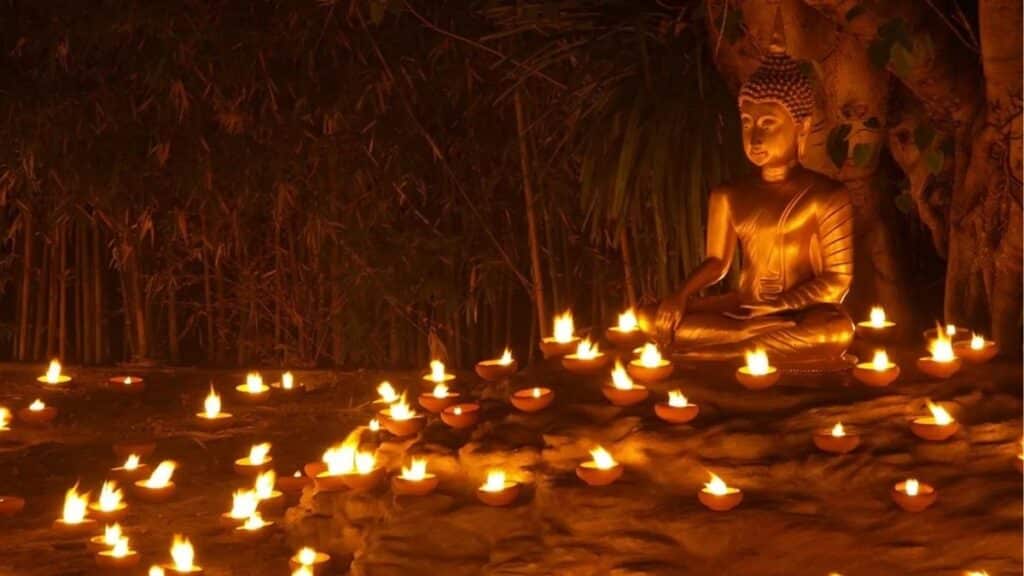
Asalha Puja, also known as Dhamma Day, is one of the most sacred festivals in Theravada Buddhism. Observed on the full moon of the lunar month of Āsādha, it commemorates the Buddha’s first sermon — the moment his teachings entered the world and the Buddhist tradition was born. Rooted in ancient Pali scripture and celebrated across Asia and the global Buddhist diaspora, Asalha Puja is a day of deep spiritual reflection, merit-making, and joyful reverence for the Triple Gem: the Buddha, the Dhamma, and the Sangha.
Asalha Puja — also called Dhamma Day or Dharma Day — celebrates the occasion when the Buddha Shakyamuni delivered his very first discourse to five disciples at the Deer Park in Sarnath, near Varanasi. This sermon, the Dhammacakkappavattana Sutta (Setting the Wheel of Dhamma in Motion), introduced the Four Noble Truths and the Noble Eightfold Path — the cornerstone teachings of all Buddhist traditions.
The day is considered the founding moment of Buddhism as a living religion. It is the first time all three elements of the Triple Gem — the Buddha (the Enlightened One), the Dhamma (the Teaching), and the Sangha (the Community) — were present in the world together. Asalha Puja is observed primarily by Theravada Buddhists in Thailand, Sri Lanka, Cambodia, Laos, Myanmar, and Indonesia, as well as by diaspora communities across the UK, USA, Canada, Australia, and beyond.
When Is Asalha Puja Celebrated in 2026?
Asalha Puja falls on the full moon (Purnima) of the lunar month of Āsādha, which typically occurs in July. In 2026, Asalha Puja is observed on Wednesday, July 29.
The following day, July 30, marks the beginning of Vassa — the three-month monastic rains retreat observed by Theravada monks worldwide.
Table of Contents
Asalha Puja In USA, Canada, Australia, New Zealand, UK, UAE, Singapore 2026 Dates
Asalha Puja is observed on Wednesday, July 29
Asalha Puja is observed on Wednesday, July 29
Asalha Puja is observed on Wednesday, July 29
Asalha Puja is observed on Wednesday, July 29
Asalha Puja is observed on Wednesday, July 29
Asalha Puja is observed on Wednesday, July 29
Why Does the Date Change Every Year?
Asalha Puja follows the lunisolar calendar, falling on the full moon of Āsādha — the eighth lunar month. Because the lunar cycle does not align with the Gregorian calendar, the date shifts each year, generally between late June and late July. In years when an intercalary (leap) month is added to the lunar calendar, the date may fall later than usual.
Other Names and Regional Identities
Asalha Puja is recognized by many names across South and Southeast Asia, reflecting the rich diversity of Buddhist communities:
General Names: Asalha Puja / Āsāḷha Pūjā (Pali, liturgical); Dhamma Day / Dharma Day (English, international)
Regional Names:
- Thai: อาสาฬหบูชา — Asanha Bucha
- Sinhala (Sri Lanka): Esala Poya
- Burmese (Myanmar): ဓမ္မစကြာအခါတော်နေ့ — Dhammasekkya Ne
- Khmer (Cambodia): ពិធីបុណ្យអាសាឡ្ហបូជា
- Lao: ບຸນອາສາລະຫະບູຊາ — Asalha Buxa
- Indonesian: Hari Asadha
In India, particularly around Sarnath, the day is often referenced as Dhamma Chakra Pravartan Diwas — the Day of Turning the Wheel of Dhamma. Among diaspora communities in the West, Dhamma Day is the most widely used term, emphasizing the universal significance of the Buddha’s first teaching beyond any single national tradition.
Origins, History, and Legends
The historical basis for Asalha Puja is the first sermon of the Buddha, delivered approximately 2,500 years ago in the Isipatana Deer Park in Sarnath, shortly after Siddhartha Gautama attained enlightenment in Bodh Gaya.
Following his enlightenment, the Buddha initially hesitated to teach, uncertain whether such profound wisdom could be communicated. According to the Pali Canon, the deity Brahma Sahampati descended and entreated him to share his realization, recognizing that there were beings who would understand. The Buddha traveled to Sarnath and found five former companions — ascetics who had once practiced austerities with him. There, he delivered the Dhammacakkappavattana Sutta, teaching the Middle Way and the Four Noble Truths:
- Dukkha — Life involves suffering and dissatisfaction
- Samudaya — Suffering arises from craving and attachment
- Nirodha — There is a state beyond suffering — Nibbana
- Magga — The Noble Eightfold Path leads to liberation
At the end of the discourse, one of the five ascetics — Kondanna — understood the teaching and asked to be ordained. The Buddha granted his request, making Kondanna the first Buddhist monk and establishing the foundational Sangha. From this moment, the Triple Gem was complete and Buddhism came into being as a living tradition. The event is described in Theravada texts as “the turning of the wheel of Dhamma” — a metaphor for the setting in motion of a teaching that would reach across centuries and continents.
Cultural and Spiritual Significance
Asalha Puja holds a defining place in Theravada Buddhism — comparable in gravity to Christmas, Eid, or Diwali in their respective traditions. But its meaning reaches beyond commemoration. The Buddha’s choice to teach rather than remain in solitary enlightenment is understood as the first great act of compassion — a turning toward the suffering of others. Each year, Asalha Puja invites Buddhists to reflect on that choice and renew their commitment to the path.
The festival simultaneously honors all three elements of the Triple Gem, making it unique among Buddhist observances. It also marks the beginning of Vassa — the three-month rains retreat — encouraging deeper practice and spiritual focus for both monks and lay communities. For Buddhists across Asia and the diaspora, Asalha Puja is a time to reconnect with the foundational teachings, cultivate generosity, and reaffirm the values of non-violence, compassion, and mindful living.
Prayers and Religious Observances
At Temples: Devotees arrive at dawn to offer alms to monks — a practice called dana — presenting food, robes, candles, incense, and flowers. Monks lead chanting of the Dhammacakkappavattana Sutta in Pali, followed by Dhamma talks. The most visually striking ritual is the evening wian tian — a three-fold candlelit circumambulation of the temple’s main shrine or stupa, honoring the Triple Gem.
At Home: Many Buddhist families create a small altar with a Buddha image, candles, incense, and flower offerings. Household prayers include recitation of the Three Refuges (Buddham saranam gacchami / Dhammam saranam gacchami / Sangham saranam gacchami) and the Five Precepts. Some families observe a partial fast or adopt vegetarian eating for the day as an expression of mindful living.
Chants and Mantras: The Namo Tassa verse (homage to the Buddha) opens all formal observances. The Tisarana (Triple Refuge) and Panca Sila (Five Precepts) are recited by lay devotees at every gathering. The Dhammacakkappavattana Sutta itself, chanted in Pali, forms the ritual heart of the festival.
Celebrations in India
India holds the most historically significant site connected to Asalha Puja — Sarnath in Uttar Pradesh, where the first sermon was actually delivered. The Mulagandha Kuti Vihara, maintained by the Maha Bodhi Society, hosts large-scale puja ceremonies and Dhamma talks. The ancient Dhamek Stupa, believed to mark the exact spot of the first discourse, becomes a focal point for offerings and circumambulation by pilgrims from Sri Lanka, Thailand, Myanmar, Japan, and beyond.
Bodh Gaya, Bihar observes additional ceremonies at the Mahabodhi Temple complex, connecting the Buddha’s enlightenment and first teaching as linked chapters of the same story.
Nagpur, Maharashtra has a large Ambedkarite Buddhist community — followers of Navayana Buddhism founded by Dr. B.R. Ambedkar — who observe Asalha Puja as a day of both spiritual meaning and social significance. Delhi, Mumbai, and Pune also have active Buddhist viharas and Maha Bodhi Society branches that mark the occasion with prayers and community gatherings.
Participation Across Religions in India
Asalha Puja’s observance at Sarnath — located just outside Varanasi, one of Hinduism’s holiest cities — naturally invites cross-community reflection. Pilgrims of different faiths often visit this ancient site together, drawn by its spiritual gravity. The Buddha’s teachings on ahimsa (non-violence), compassion, and the impermanence of suffering resonate deeply within the Hindu, Jain, and Sikh traditions, creating natural common ground.
In India’s pluralistic cultural life, many non-Buddhist visitors come to Sarnath on this day, moved by the universal ethical message of the first sermon. The Ambedkarite Buddhist revival has also given Asalha Puja a social dimension that transcends religious boundaries, emphasizing dignity, equality, and human rights — values that speak across communities.
Global and Diaspora Celebrations
Thailand observes Asanha Bucha as a national public holiday, with morning alms-giving, Dhamma talks, and candlelit evening processions at temples across the country. The following day begins Khao Phansa (Buddhist Lent), when many Thai men traditionally ordain temporarily as monks.
Sri Lanka celebrates Esala Poya as a public holiday. The Kandy Esala Perahera — one of Asia’s most spectacular processions, featuring ornamented elephants, Kandyan drummers, and fire dancers — takes place during this lunar month, with deep ceremonial ties to Asalha Puja.
Myanmar marks Dhammasekkya Ne with temple offerings and the launch of monks’ rains retreat. Cambodia and Laos observe the day with merit-making at temples, Pali chanting, and community meals. Indonesia centers celebrations at the Mendut and Borobudur temple complexes in Central Java, where thousands of pilgrims gather for outdoor ceremonies.
Diaspora communities in the UK, USA, Canada, Germany, Australia, and Singapore observe Asalha Puja at local Thai, Sri Lankan, Burmese, and pan-Buddhist temples. Many centers hold weekend observances when the date falls on a weekday, making participation accessible to working communities.
Gifting Traditions
Gift-giving on Asalha Puja is centered on dana — the Buddhist practice of generosity — rather than reciprocal exchange. Offerings to monks and temples are the primary form: monks’ requisites such as robes, alms bowls, and candles; prepared vegetarian food; fruits and sweets; and Dhamma books or printed teachings. Gifting a copy of the Tipitaka or a Buddhist meditation guide to a friend is considered a meaningful act of spiritual generosity.
Among diaspora communities, gifting has evolved to include donations to Buddhist charities, sponsorship of novice ordinations, and support for Dhamma schools for children. Digital dana — online donations to monasteries and Buddhist educational foundations — is now common in Western Buddhist communities.
Asalha Puja Foods and Culinary Traditions
Food on Asalha Puja reflects Buddhist values of purity, simplicity, and compassion. Vegetarian and vegan fare is the norm, with many Buddhists abstaining from meat entirely for the day.
In Thailand, offerings to temples include rice porridge (khao tom), stir-fried vegetables, and clear soups. Mango sticky rice and coconut-based sweets are popular both as temple offerings and family treats. In Sri Lanka, kiribath (milk rice) is prepared on every full moon poya day, including Esala Poya — it is considered auspicious and shared at home and temple alike. Traditional sweets like kokis and kavum are also prepared. In Myanmar, mild rice-based dishes are preferred on days of heightened religious observance, and vegetarian adaptations of everyday meals are common.
Music, Art, and Cultural Expression
Pali chanting is the shared musical heart of Asalha Puja across all Theravada cultures. The Dhammacakkappavattana Sutta, chanted by monks in ancient Pali, fills temple halls with a sound unchanged for centuries. Lay devotees join in responsive chanting, creating a communal experience that connects individual practice to the wider Sangha.
The visual iconography of Asalha Puja centers on the Wheel of Dhamma (Dhammacakka) and representations of the first sermon — the Buddha in the Deer Park, five disciples before him, a deer often visible in the background. This imagery appears on temple murals, thangkas, painted scrolls, and contemporary Buddhist art worldwide.
Sri Lanka’s Kandy Esala Perahera is the festival’s grandest cultural expression — a ten-day procession of costumed elephants, Kandyan drummers, fire dancers, and flag bearers, honoring the Buddha’s Tooth Relic and representing centuries of Sri Lankan heritage. In Thailand and Cambodia, Jataka tale performances and traditional music are held at temples, linking the occasion to the broader cultural calendar.
Modern Observance and Evolving Practices
Asalha Puja is evolving alongside the communities that observe it. Online and hybrid observances have become mainstream — many temples now stream Dhamma talks and puja ceremonies live, enabling diaspora Buddhists worldwide to participate meaningfully regardless of location. Meditation platforms and apps see significant engagement around Dhamma Day, reflecting a broader interest in the Buddha’s teachings beyond traditional temple-going.
Eco-conscious celebration is a growing priority, particularly in Thailand, where campaigns promoting “green Asanha Bucha” encourage natural offerings and Bodhi tree planting as merit-making alternatives to resource-heavy rituals.
In Western Buddhist communities, Dhamma Day is increasingly observed as an occasion for mindfulness workshops, public Dhamma talks, and community service — honoring the spirit of the first teaching through action rather than ritual alone.
How to wish someone on Asalha Puja:
- “Wishing you peace and clarity on Dhamma Day.”
- “May the wisdom of the Dhamma light your path.”
- In Thai: วันอาสาฬหบูชามงคล — “Auspicious Asanha Bucha Day.”
Cultural Reflection
Asalha Puja carries a question at its heart that reaches beyond any single tradition: what does it mean to turn toward the suffering of others? The Buddha’s choice to teach — to share the path rather than remain in solitary realization — was the original act of compassion from which an entire world religion grew. Every year on this full moon, in temples from Sarnath to Sydney, those first words spoken in the Deer Park echo again: that there is suffering, that it has a cause, and that there is a way through.
For Buddhists in India and across the global diaspora, Asalha Puja is not only a religious observance — it is a moment of return to what matters most: the teaching, the community, and the ongoing human effort to live with greater wisdom and kindness.