
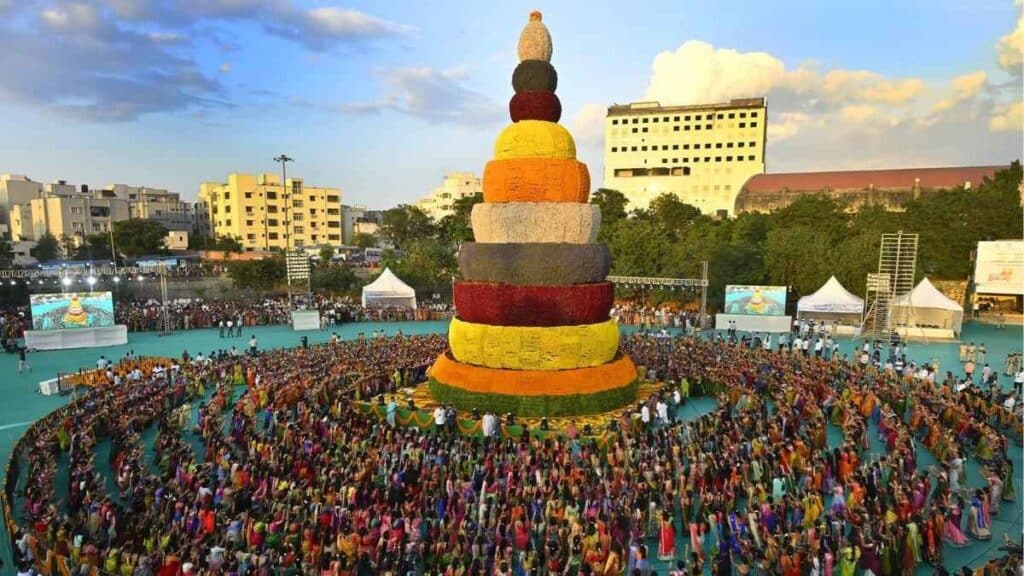
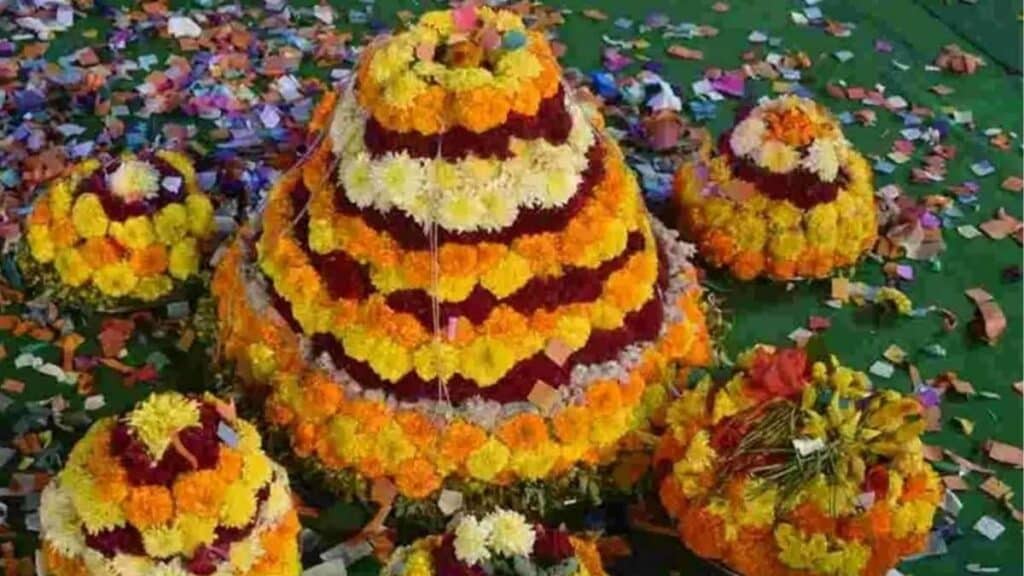
Bathukamma is one of the most beloved festivals of Telangana, celebrated as a nine-day floral tribute to Goddess Gauri (Parvati). Known as the Festival of Flowers, Bathukamma is observed by Telugu Hindu women who arrange towering, cone-shaped stacks of wildflowers and gather each evening to sing and dance around them. The name means “Mother Goddess, Come Alive” — a prayer for the divine feminine to return to the world.
Rooted in Telangana’s agrarian traditions, Bathukamma marks the transition from the monsoon season (Varsha Ruthu) to autumn (Sharad Ruthu). As the rains retreat, wildflowers bloom across the plains of Telangana, and women collect these blooms — most of them medicinal — to build the Bathukamma. The flower stack, arranged in seven concentric layers resembling a temple gopuram, is an offering of nature back to the Goddess who made it flourish.
The festival culminates on Saddula Bathukamma, when women carry their floral arrangements in procession to a nearby lake or tank and immerse them in the water — a symbolic farewell to the Goddess and a ritual act of environmental care. Bathukamma is both a state festival of Telangana and a living symbol of its distinct cultural identity.
When Is Bathukamma Celebrated in 2026?
Bathukamma is a nine-day festival observed from Mahalaya Amavasya (Pitru Amavasya) to Durgashtami, running simultaneously with Sharad Navratri. In 2026, the festival falls in October.
Bathukamma 2026 Dates in India:
| Day | Date | Name |
|---|---|---|
| Day 1 | October 10, 2026 | Engili Pula Bathukamma |
| Day 2 | October 11, 2026 | Atkula Bathukamma |
| Day 3 | October 12, 2026 | Muddapappu Bathukamma |
| Day 4 | October 13, 2026 | Nanabiyyam Bathukamma |
| Day 5 | October 14, 2026 | Atla Bathukamma |
| Day 6 | October 15, 2026 | Aligina Bathukamma |
| Day 7 | October 16, 2026 | Vepakayala Bathukamma |
| Day 8 | October 17, 2026 | Vennamuddala Bathukamma |
| Day 9 | October 18, 2026 | Saddula Bathukamma ⭐ Main Day |
Celebrations begin in the late afternoon and continue into the evening each day. The immersion (visarjan) on Day 9 takes place at sunset.
Table of Contents
Bathukamma In USA, Canada, Australia, New Zealand, UK, UAE, Singapore 2026 Dates
- Day 1 — October 9, 2026 | Engili Pula Bathukamma
- Day 9 — October 17, 2026 | Saddula Bathukamma (Main Day)
- Day 1 — October 9, 2026 | Engili Pula Bathukamma
- Day 9 — October 17, 2026 | Saddula Bathukamma (Main Day)
- Day 1 — October 10, 2026 | Engili Pula Bathukamma
- Day 9 — October 18, 2026 | Saddula Bathukamma (Main Day)
- Day 1 — October 10, 2026 | Engili Pula Bathukamma
- Day 9 — October 18, 2026 | Saddula Bathukamma (Main Day)
- Day 1 — October 10, 2026 | Engili Pula Bathukamma
- Day 9 — October 18, 2026 | Saddula Bathukamma (Main Day)
- Day 1 — October 10, 2026 | Engili Pula Bathukamma
- Day 9 — October 18, 2026 | Saddula Bathukamma (Main Day)
Why Do Bathukamma Dates Change Every Year?
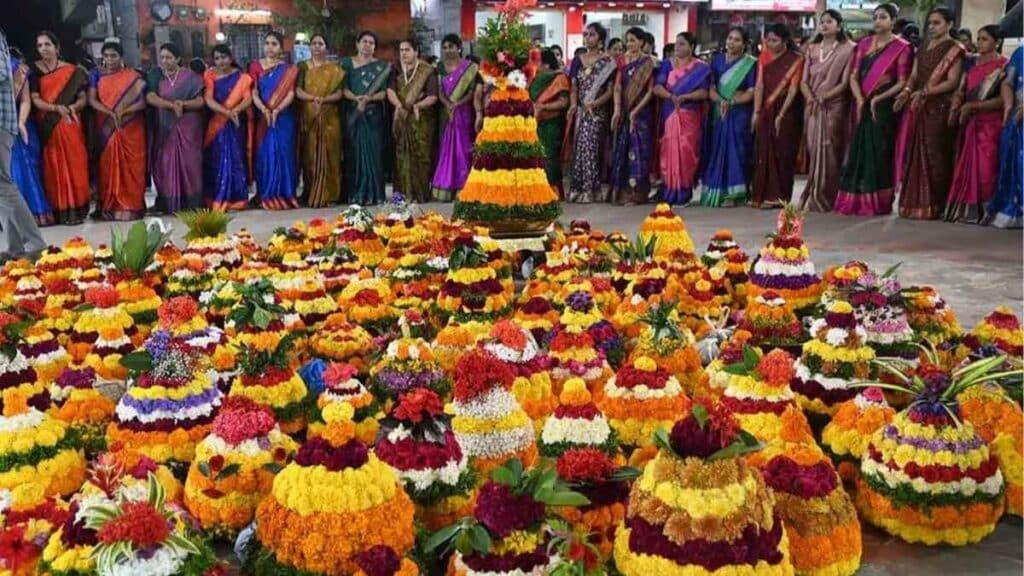
Bathukamma follows the Hindu lunar calendar, beginning on Mahalaya Amavasya of the Bhadrapada or Ashwayuja month. Since lunar months are shorter than solar months, the Gregorian dates shift each year, falling anywhere between mid-September and mid-October.
Bathukamma Overview
Bathukamma is the defining cultural festival of Telangana, celebrated by Telugu Hindu women across nine evenings with flowers, song, and dance. Each day, women arrange seasonal and medicinal wildflowers into a layered floral stack, place a small turmeric idol of Goddess Parvati (Gauramma) on top, and gather in their neighbourhoods to circle the Bathukamma singing traditional folk songs.
Every day of the festival has a distinct name corresponding to the food offering (Naivedyam) made to the Goddess — from sesame and rice flour on Day 1 to five types of rice and the sweet Maleeda on the final day. On Saddula Bathukamma, the ninth and most celebrated day, all the floral stacks are immersed in a nearby water body, and married women apply turmeric paste from Gauramma onto their Mangalsutra as a blessing for their family’s wellbeing.
Bathukamma was declared an official state festival of Telangana after statehood was achieved in 2014. Along with Bonalu, it serves as the most powerful cultural symbol of Telangana’s identity.sunrise/sunset while maintaining the four-day lunar calendar sequence.
Other Names and Regional Identities
Bathukamma (బతుకమ్మ) — Primary Telugu name, used universally across Telangana Batukamma — Common alternate English transliteration Pedda Bathukamma — “Grand Bathukamma,” another name for the ninth day Saddula Bathukamma — The formal name of the festival’s culminating day Telangana Flower Festival — How it is referred to in national and international media
In diaspora communities across the USA, UK, Australia, and the Gulf, it is commonly known as Bathukamma or the Telugu Flower Festival. The closely related pre-festival, Boddemma (a 7-day observance), marks the closing of the monsoon and directly precedes Bathukamma.
Origins, History, and Legends
Bathukamma is believed to be over a thousand years old, rooted in Telangana’s tank irrigation culture and agrarian way of life. Historians connect its origins to rituals of gratitude to the Goddess for monsoon rains and a bountiful harvest — offerings of wildflowers that bloomed in abundance after the rains.
Several legends explain the festival’s meaning:
The Legend of King Dharmangada: A Chola king and his queen lost all one hundred of their sons in battle. After years of prayer, Goddess Lakshmi was born as their daughter. She survived many life-threatening incidents, and the sages blessed her with immortality, calling out “Bathukamma” — live, O child. The festival honours her memory and the Goddess within her.
The Legend of Goddess Durga: After nine days of fierce battle, Goddess Durga slew the demon Mahishasura and fell into exhausted sleep. Devotees prayed for nine days with medicinal flowers for her to awaken. She rose on the tenth day, now celebrated as Vijayadashami. Bathukamma commemorates these nine days of prayer.
The Legend of Goddess Sati: When Sati immolated herself after being insulted by her father Daksha, the sages and devotees pleaded “Bathukamma” — asking the Goddess to return to life. She was reborn as Parvati, and the festival celebrates that divine return.
The Chalukya-Chola Historical Legend: When Raja Raja Chola carried away the sacred Shivalinga from Vemulawada, the grieving people arranged flowers like the Meru mountain and placed Gauramma on top, singing for nine days — a practice that gradually became Bathukamma.
Cultural and Spiritual Significance
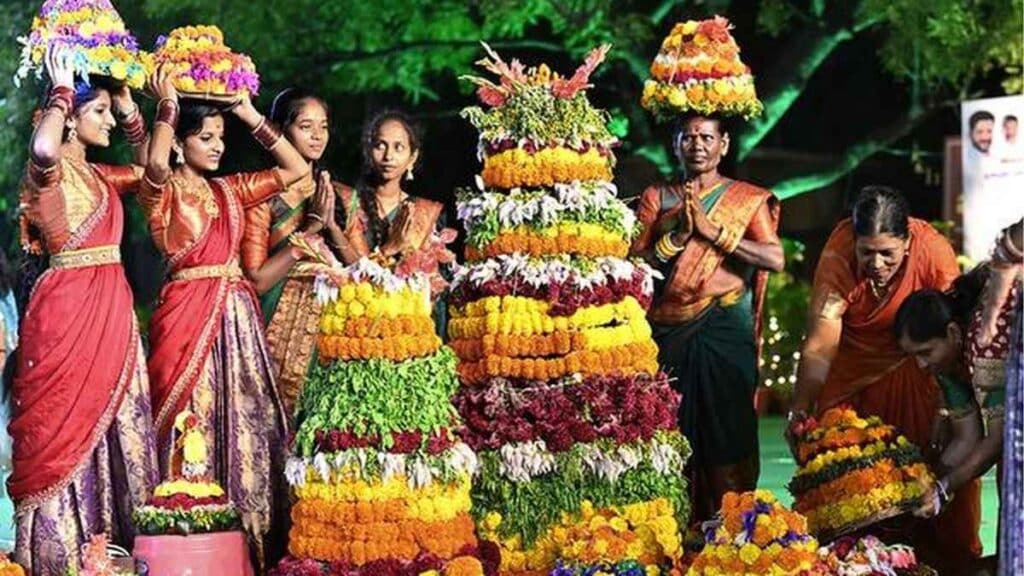
Bathukamma holds significance across multiple dimensions — spiritual, cultural, ecological, and social.
Spiritually, the festival is a nine-day act of devotion to Goddess Parvati in her most life-affirming form. The Gauramma idol, the Naivedyam offerings, and the traditional songs are all expressions of this devotion.
Culturally, Bathukamma became the defining symbol of Telangana’s identity during the statehood movement. Alongside Bonalu, it served as a marker of the region’s distinct heritage, distinct from Andhra Pradesh. After statehood in 2014, it was formally declared a state festival.
Ecologically, the wildflowers used — Tangedu (Senna), Gunugu (Celosia), Chamanti (Chrysanthemum), and others — are all naturally growing medicinal plants. Immersing them in tanks and ponds was traditionally understood to purify water. The Boddemma ritual of immersing clay idols was believed to reinforce pond embankments and improve water retention — an act of environmental stewardship embedded in ritual.
Socially, Bathukamma is entirely women-led. It is a space where women from across caste and community gather as equals, dress in their finest attire, and celebrate together in a spirit of sisterhood.
Prayers and Religious Observances
Bathukamma is observed through communal song and daily ritual rather than formal temple puja. Each evening, women wash and decorate the Bathukamma, place Gauramma on top, offer the day’s Naivedyam, and sing traditional Telugu folk songs while circling the floral arrangement. These songs — passed down through generations — invoke Goddess Gauri, Saraswati, Lakshmi, and Durga, and narrate stories of love, harvest, devotion, and everyday life.
On Saddula Bathukamma, the grandest day, five types of rice and the sweet Maleeda are offered. The evening culminates in a mass procession to the nearest water body for visarjan. Before the flowers are immersed, Gauramma is retrieved, and married women apply its turmeric paste to their Mangalsutra — a sacred prayer for their husband’s protection and the family’s prosperity.
How Bathukamma Is Celebrated Across India
Bathukamma is celebrated primarily across Telangana, where it is the most important state festival, with government-organised events at every district headquarters and mass celebrations in Hyderabad. The Hussain Sagar lake in Hyderabad sees thousands of women immersing Bathukammas simultaneously every year.
In September 2025, the Telangana government set two Guinness World Records at the state Bathukamma celebrations — for the largest Bathukamma floral decoration (over seven tonnes of flowers, standing over 63 feet tall) and for the most women performing a synchronised Bathukamma dance (1,354 participants).
Beyond Telangana, the festival is celebrated in parts of Andhra Pradesh, and by Telugu communities in Maharashtra, Chhattisgarh, and other states where the diaspora has settled.
Participation Across Religions in India
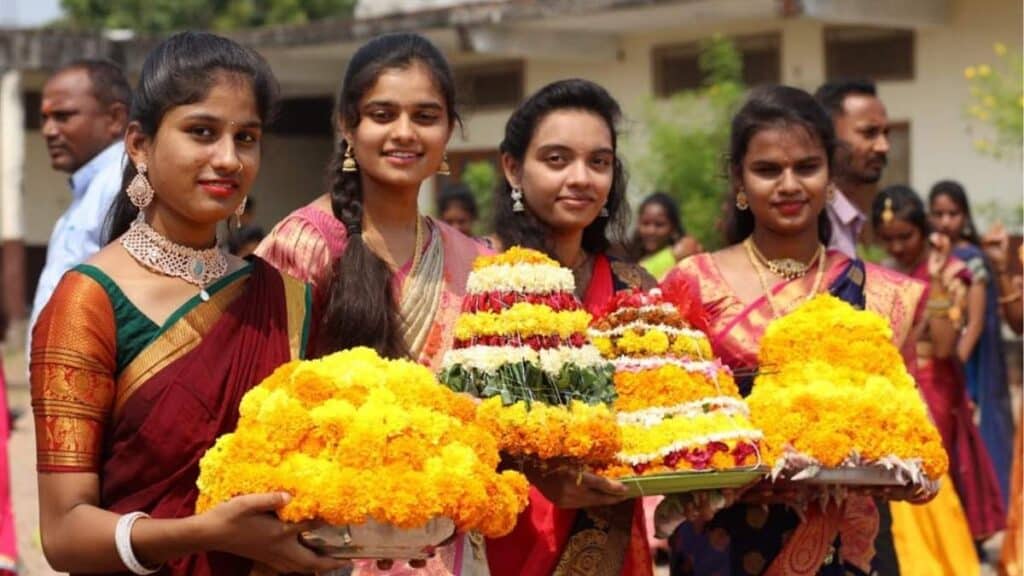
Bathukamma is a Hindu festival, but its character as a folk, community, and nature celebration gives it an inclusive spirit. In many villages and towns across Telangana, Muslim and Christian neighbours participate in the evening gatherings, join processions, and share in the festive food. The communal nature of the celebration — women from all backgrounds gathering in neighbourhood open grounds — has historically made Bathukamma a space of social harmony and interfaith goodwill.
How Bathukamma Is Celebrated Outside India
The Telugu diaspora has carried Bathukamma to every continent. Telangana Cultural Associations and Telugu organisations across the world organise annual celebrations, typically on the weekend closest to Saddula Bathukamma.
USA — Events held in New Jersey, Texas, California, Atlanta, Chicago, and Washington DC, with traditional saree-clad circle dances, flower arrangements, and festive food
UK — The Telangana Association of United Kingdom (TAUK) organises London celebrations; community halls in Birmingham and Leicester also host events
UAE — Large Telugu communities in Dubai, Abu Dhabi, and Sharjah celebrate through cultural associations
Australia — Events in Sydney, Melbourne, and Brisbane organised by Telugu associations
Canada — Community celebrations in Toronto, Vancouver, and Calgary, often coinciding with the Canadian Thanksgiving long weekend
Germany and Singapore — Smaller gatherings by Telugu community organisations
Bathukamma Gifting Traditions
The most cherished gifting tradition of Bathukamma is brothers bringing flowers to their mothers and sisters for the preparation of the Bathukamma — a gesture of love and family bond that is central to the festival’s spirit.
Traditional gifts include new sarees (especially silk sarees in vibrant festive colours), glass bangles, traditional jewellery, kumkum and turmeric sets, and packets of festival sweets and dry fruits. In diaspora communities, gifting has expanded to include ordering traditional Telugu sarees online, sending sweet hampers to family in India, and gifting Bathukamma-themed décor items.
Bathukamma Foods and Culinary Traditions
Each of the nine days of Bathukamma has a specific Naivedyam (food offering) made to Gauramma. These dishes are simple, wholesome, and deeply rooted in the seasonal produce of Telangana — sesame seeds, jaggery, lentils, rice, and butter feature prominently across the nine days.
The festival’s most beloved dish is Maleeda — a traditional sweet made by mixing roti or cornbread with raw jaggery (bellam). It is prepared on Saddula Bathukamma and distributed among all the women after the puja, marking the joyful close of the festival.
Other key ingredients across the nine days include corn, sorghum, bajra, black gram, Bengal gram, green gram, groundnuts, sesame, wheat, milk, and coconut.
Music, Art, and Cultural Expression
Music is inseparable from Bathukamma. The festival’s traditional folk songs — Bathukamma Paatalu — are sung by women as they circle the floral arrangement each evening. These songs carry the oral history of Telangana’s women, weaving together mythology, personal stories, harvest celebrations, and social commentary. New songs are composed each generation, keeping the tradition alive and contemporary.
The circle dance itself is a meditative, communal act of prayer through movement — women of all ages joining hands around the Bathukamma in a shared expression of devotion and joy.
The preparation of the Bathukamma is also a revered folk art. The seven-layer arrangement of flowers — Tangedu at the base, Gunugu in the middle layers, and a single Lotus at the crown — follows generations of aesthetic and spiritual knowledge, shaping an offering that is both beautiful and sacred.
Community events during the nine days include folk and classical dance performances, traditional music programs, and Jataras (street plays), especially at government-organised celebrations.
Modern Observance and Evolving Practices
Bathukamma has entered the modern era with remarkable vitality. The Telangana government has invested in scaling the festival as a cultural landmark, with record-breaking public events and growing global visibility. Social media has transformed how the festival is shared — women worldwide post videos of their Bathukamma preparations, sarees, and visarjan moments, creating a global digital community around the festival. Hashtags like #Bathukamma trend widely each year.
Sustainability has become an important theme. Growing awareness of the festival’s ecological philosophy — medicinal wildflowers, water purification, strengthening ponds — has renewed community commitment to using naturally grown, chemical-free flowers.
To wish someone on Bathukamma, say: “Bathukamma Subhakankshalu” (బతుకమ్మ శుభాకాంక్షలు) in Telugu, or simply “Happy Bathukamma.”
Cultural Reflection
Bathukamma is a living festival — not a relic of the past but a tradition that breathes and grows with the women who carry it forward. For Telugu women across Telangana and the diaspora, it is a moment of homecoming — to their culture, their Goddess, and each other.
In a world increasingly disconnected from nature and roots, Bathukamma remains a joyful and profound act of remembering: that the wildflower blooming on a barren plain is sacred, that a woman’s song carries history, and that calling the Goddess back to life is something worth doing together, every year, as long as there are flowers to offer.