
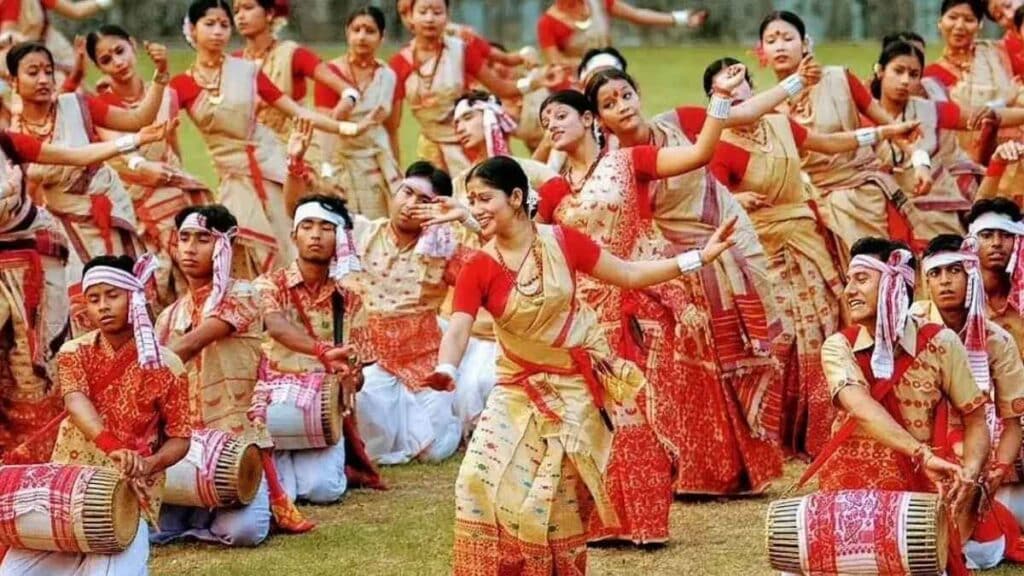
Bohag Bihu, also known as Rongali Bihu, is one of the most vibrant and culturally significant festivals of Northeast India. Celebrated as the Assamese New Year, it marks the arrival of spring, the beginning of the sowing season, and a time of communal joy and renewal. The word “Rongali” comes from the Assamese rong, meaning joy — and the festival lives up to that name in every sense.
Unlike many Hindu festivals centered on temple rituals, Bohag Bihu belongs to everyone. Its roots are deeply agrarian and aboriginal, drawing from the Tibeto-Burman and Tai traditions of Assam’s indigenous communities. The festival honors the earth, livestock, elders, and kin — celebrating the bonds that hold communities together as the new year begins.
Bohag Bihu is one of three annual Bihu festivals, each marking a phase of the paddy cultivation cycle. Bohag Bihu signals sowing time, Kati Bihu marks the growth period, and Magh Bihu celebrates the harvest. Together, they reflect Assam’s intimate relationship with the land and the rhythm of agriculture. The festival coincides with other South Asian solar new year celebrations including Baisakhi, Vishu, and Tamil New Year (Puthandu), all rooted in the same astronomical event.
When Is Bohag Bihu Celebrated in 2026?
Bohag Bihu falls on the first day of Bohag, the first month of the Assamese solar calendar, which corresponds to the Sun’s transit into Aries (Mesha Sankranti). Unlike lunar calendar festivals, this date is astronomically fixed and falls on or around 14 April every year.
Bohag Bihu 2026 Dates in India:
Day 1 — Tuesday, 14 April 2026: Goru Bihu — Cattle worship; livestock bathed and blessed at rivers
Day 2 — Wednesday, 15 April 2026: Manuh Bihu — Human celebrations; turmeric baths, new clothes, blessings from elders
Day 3 — Thursday, 16 April 2026: Gosai Bihu — Worship of household deities at the Gohai Ghor
Day 4 — Friday, 17 April 2026: Kutum Bihu — Visits to family and relatives; shared meals and celebrations
Day 5 — Saturday, 18 April 2026: Senehi Bihu — Day of love, friendship, and community warmth
Day 6 — Sunday, 19 April 2026: Mela Bihu — Community fairs, Bihu dance competitions, cultural programs
Day 7 — Monday, 20 April 2026: Chera Bihu — Final day; exchange of pithas, reflection, and farewell to the festivities
The official public holiday in Assam and Arunachal Pradesh falls on Wednesday, 15 April 2026.
Table of Contents
Bohag Bihu In USA, Canada, Australia, New Zealand, UK, UAE, Singapore 2026 Dates
- Bohag Bihu on Tue, 14 Apr, 2026 – Mon, 20 Apr, 2026
- Bohag Bihu on Tue, 14 Apr, 2026 – Mon, 20 Apr, 2026
- Bohag Bihu on Tue, 14 Apr, 2026 – Mon, 20 Apr, 2026
- Bohag Bihu on Tue, 14 Apr, 2026 – Mon, 20 Apr, 2026
- Bohag Bihu on Tue, 14 Apr, 2026 – Mon, 20 Apr, 2026
- Bohag Bihu on Tue, 14 Apr, 2026 – Mon, 20 Apr, 2026
Why Does Bohag Bihu Fall on the Same Date Every Year?
Bohag Bihu is a solar festival, not a lunar one. It is fixed to the astronomical event of Mesha Sankranti — the Sun’s transit into the zodiac sign of Aries — which occurs on or around 14 April each year in the Indian solar calendar.
Because it follows the solar rather than the lunar cycle, the date remains consistent on the Gregorian calendar, unlike movable festivals such as Diwali or Holi.xth”) because it occurs on the sixth day (Shashthi) of Kartik Shukla Paksha.
Bohag Bihu Other Names and Regional Identities
Bohag Bihu is known by several names that reflect its regional and cultural diversity:
Rongali Bihu — the most widely used name in Assam, meaning the “joyful Bihu,” emphasizing the festive and celebratory spirit of the occasion.
Xaat Bihu / Haat Bihu — referring to the seven ceremonial days of the festival (xaat meaning seven in Assamese).
Assamese New Year — the name used in national and international contexts to describe the cultural and civic significance of the festival.
In the broader context of South Asian solar new year celebrations, Bohag Bihu shares its heritage with Baisakhi (Punjab), Vishu (Kerala), Puthandu (Tamil Nadu), and Pohela Boishakh (Bengal). The word “Bihu” itself is believed by some scholars to derive from the Sanskrit “Vishu,” reflecting this shared astronomical origin.
In Caribbean and overseas Assamese communities, the festival is sometimes simply referred to as Bihu or Assamese Bihu to distinguish it from other regional celebrations.
The Origins, History, and Legends of Bohag Bihu
Bohag Bihu’s roots reach deep into the pre-Hindu agrarian culture of Assam, drawing from the traditions of the many indigenous tribes of the Brahmaputra Valley. The festival is believed to have originated among the Dimasa Kachari people, one of Assam’s ancient tribes. In the Dimasa language, Bi means “to ask” and Shu means “peace and prosperity.” The offering of the first crop to the supreme deity Brai Shibrai, along with prayers for wellbeing, is considered one of Bihu’s foundational acts.
Over centuries, as Assam absorbed Vaishnavite Hindu influences and the traditions of successive ruling dynasties including the Ahom kingdom, Bohag Bihu evolved into a grand multi-day festival uniting all communities. The Ahom kings participated in Bihu Melas, mingling with ordinary people at community fairs — a democratic tradition that continues to this day.
Scripturally, the festival is referenced in classical texts describing spring celebrations and agricultural rites across the Indian subcontinent. Its three-part structure — Bohag, Kati, and Magh Bihu — reflects the complete paddy cultivation cycle and shows how deeply the festival is woven into the logic of Assamese agrarian life.
Bohag Bihu: Cultural and Spiritual Significance
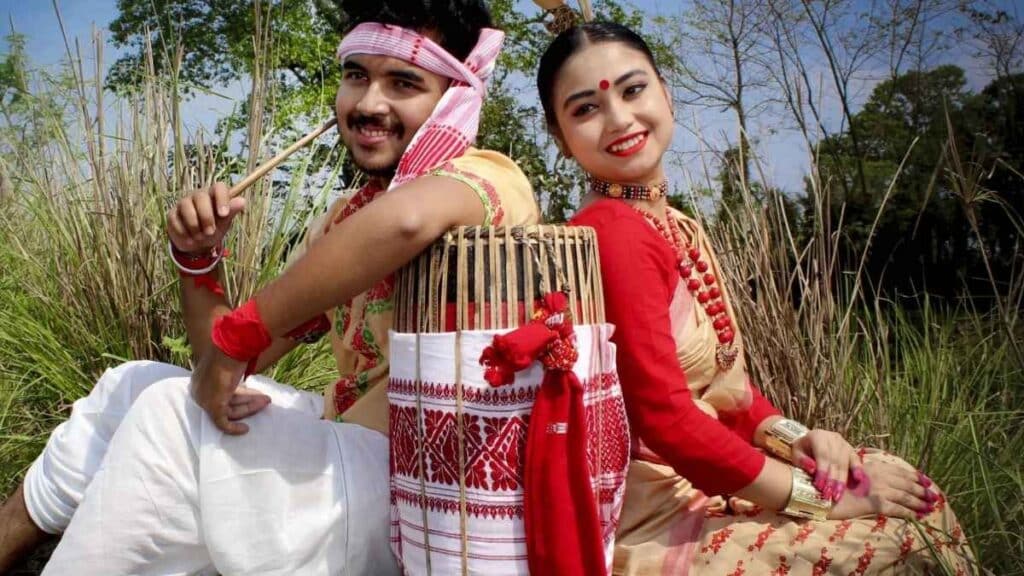
Bohag Bihu is a celebration of renewal in the deepest sense. It honors the earth that sustains life, the animals that work the land, the elders who carry wisdom, and the community that makes life meaningful. The Gamusa — a hand-woven white cloth with red embroidery — is its most potent symbol, presented to elders and guests as an act of love, respect, and cultural pride. Receiving a Gamusa is considered a great honor, and gifting one is a gesture of the deepest warmth.
The cattle rituals of Goru Bihu reflect Assam’s agrarian soul. Livestock were not merely farm animals but partners in cultivation, and the ceremony of bathing and blessing them with herbs, singing verses of gratitude, and feeding them festive foods expresses a philosophy of reciprocity between humans and the natural world.
The Raati Bihu phase — performed by torchlight under ancient trees — preserves some of the most archaic aspects of the festival. Young people gathered to sing folk songs expressing love, longing, and the beauty of the landscape. This tradition speaks to Bihu as a space for community, courtship, and artistic expression outside the formal religious calendar.
Bohag Bihu Prayers and Religious Observances
While Bohag Bihu has strong pre-Hindu roots, devotional practices are an integral part of the modern festival. On Gosai Bihu, the third day, households worship their Kuldevi — the family or clan deity — at the Gohai Ghor, the household prayer space. Lamps are lit, offerings are made, and prayers seek blessings for the coming year.
The traditional Manuh Bihu bath with maah-halodhi (black gram and turmeric paste) is both a purification ritual and a health practice. Wearing new clothes and seeking the blessings of elders — presenting them with a Gamusa — is a deeply reverential act connecting present generations to the past.
The Husori tradition, in which groups visit homes singing Bihu songs and blessings, functions as a community benediction. Receiving a Husori group and gifting them with betel nuts or food is considered auspicious and marks the home as open to joy in the new year.
Unlike many Hindu festivals, Bohag Bihu is not temple-centric. The sacred spaces are the home, the courtyard, the riverbank, and the community field — reflecting the festival’s roots in nature and community worship rather than formal religion.
How Bohag Bihu Is Celebrated Across India
Assam is the heart of Bohag Bihu. Guwahati hosts the annual Rongali Utsav, where tribal cultural troupes, competitive Bihu dance programs, and folk music performances draw visitors from across India. In Majuli, the world’s largest river island, Bihu celebrations merge with the Sattriya classical dance tradition. In the tea-growing belts, plantation workers celebrate in the gardens with communal dancing and feasting.
Arunachal Pradesh shares close cultural ties with Assam and observes Bohag Bihu as a public holiday. Deori, Mising, and Bodo tribal communities have spring festival traditions that align closely with Bihu.
In Meghalaya, Nagaland, and Manipur, Assamese communities celebrate alongside their own spring festivals, creating a rich intercultural festival season across the Northeast.
In Delhi, Mumbai, and Bengaluru, large Assamese communities organize Bihu Melas and cultural programs, bringing the dance, music, and food of the festival to metropolitan audiences.
Participation Across Religions in India
One of Bohag Bihu’s most remarkable qualities is its inclusivity. It does not require specific religious rites or caste-based observances — it belongs to all people of Assam. Assamese Muslims celebrate Bihu with full enthusiasm, joining Husori groups, community feasts, and Bihu dance performances. Christian tribal communities in the Northeast participate in Bihu as a cultural festival, seeing it as a celebration of community and season rather than a religious obligation. Tribal communities whose traditions predate any of the major world religions find Bihu continuous with their own nature-worship practices.
This interfaith participation reflects the festival’s core identity: a celebration of the land, the seasons, and the bonds between people — values that transcend religious boundaries.
How Bohag Bihu Is Celebrated Outside India
The Assamese diaspora has carried Bohag Bihu to cities across the world, where it has become a powerful expression of cultural identity and community continuity. Indian diaspora communities celebrate Bihu through community cultural events and Bihu dance performances, temple gatherings and Assamese association programs, traditional food festivals featuring pitha and jolpan, Bihu Geet concerts and folk music evenings, and children’s Bihu dance classes that pass the tradition to the next generation.
These celebrations serve a dual purpose: connecting first-generation migrants with their homeland while introducing the next generation, born abroad, to their cultural heritage.
Bohag Bihu Gifting Traditions
The Gamusa is the quintessential Bihu gift — a hand-woven white cloth with red embroidery, presented to elders, guests, and loved ones as a token of respect, love, and cultural pride. Receiving a Gamusa is considered a great honor; gifting one is among the most heartfelt gestures in Assamese culture.
Traditional gifts also include homemade Bihu pithas (rice cakes), larus (sweet coconut or sesame balls), betel nuts, and seasonal fruits. In the diaspora, gifting has evolved to include Muga silk accessories, brass bell-metal items, bamboo crafts, and artisanal hampers containing authentic Assamese products like Joha rice, black sesame, and traditional sweets. Online gifting has made it easy for diaspora families to send Bihu hampers directly to loved ones in Assam.
Bohag Bihu Foods and Culinary Traditions
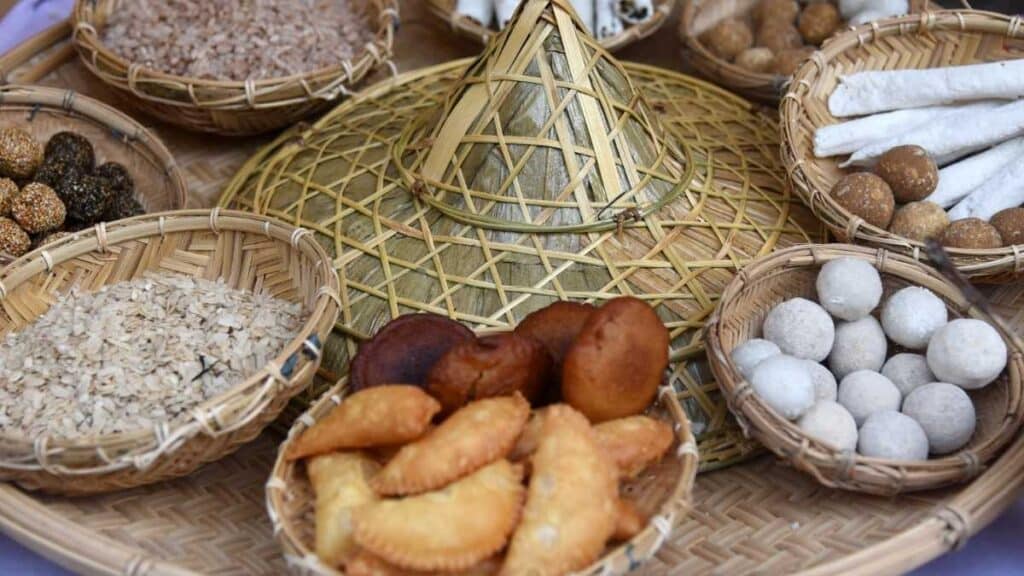
Food is central to Bohag Bihu, and the kitchen becomes a site of cultural expression in the days leading up to the festival.
Pitha — rice cakes made in many regional varieties — are the signature food of Bihu. Popular types include Til Pitha (sesame and jaggery in a rice roll), Ghila Pitha (fried rice cakes), and Sunga Pitha (rice cooked in bamboo). Laru — sweet coconut or sesame balls — are prepared in large batches and distributed among neighbors and relatives.
Jolpan is the traditional Assamese light breakfast served on Manuh Bihu morning: sticky rice (bora saul), curd, jaggery, flattened rice, and puffed rice. Simple and nourishing, it carries deep symbolic meaning as the first meal of the new year.
Duck meat curry with ash gourd is a beloved Bihu feast dish, as are various fish preparations and seasonal greens. The custom of collecting 101 types of wild vegetables (exho ebidh haak) on Goru Bihu reflects an ancient knowledge of edible plants and a spirit of abundance and gratitude.
Bohag Bihu: Music, Art, and Cultural Expression
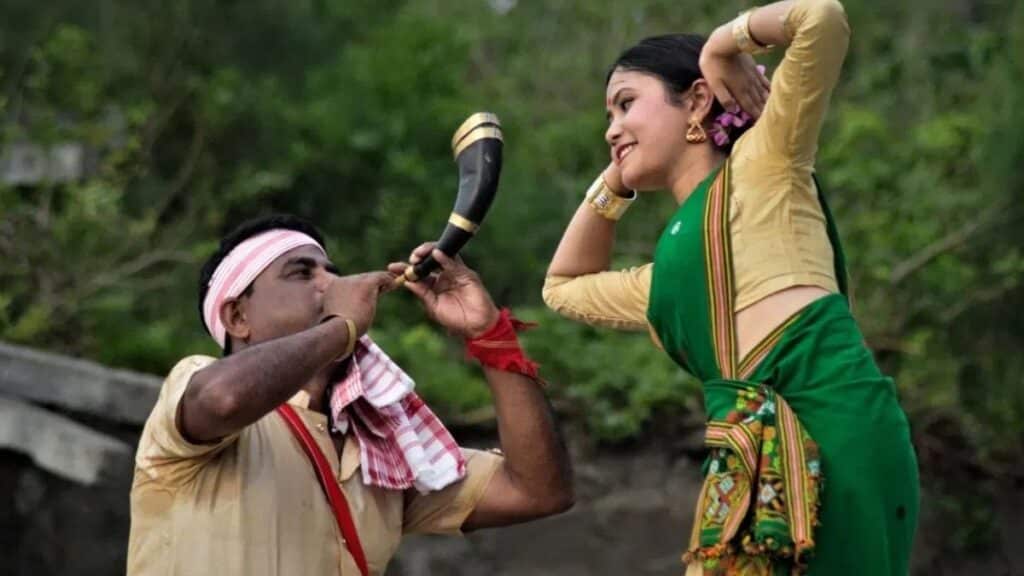
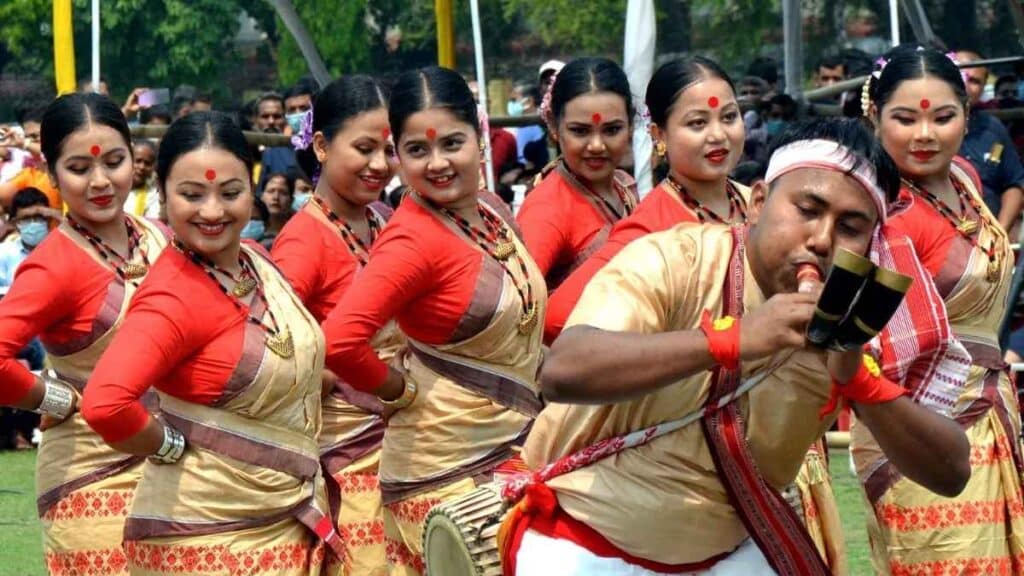
Bihu Geet (Bihu songs) are among the most celebrated folk music traditions of India, known for their lyrical themes of love, nature, longing, and the beauty of the Assamese landscape. Traditional instruments include the pepa (buffalo hornpipe), dhol (barrel drum), gogona (jaw harp), toka (bamboo clapper), and bahi (bamboo flute).
Bihu Dance is the festival’s most iconic expression — performed in groups by young men and women, characterized by energetic footwork and expressive hand movements. Women wear the traditional mekhela chador, while men wear dhoti and gamusa. UNESCO inscribed Bihu on its Representative List of Intangible Cultural Heritage of Humanity in 2023, recognizing it as a living heritage of outstanding global value.
Competitive Bihu dance programs are held across Assam and in diaspora communities worldwide, drawing top performers and generating enormous community pride.
Bohag Bihu in the Modern World
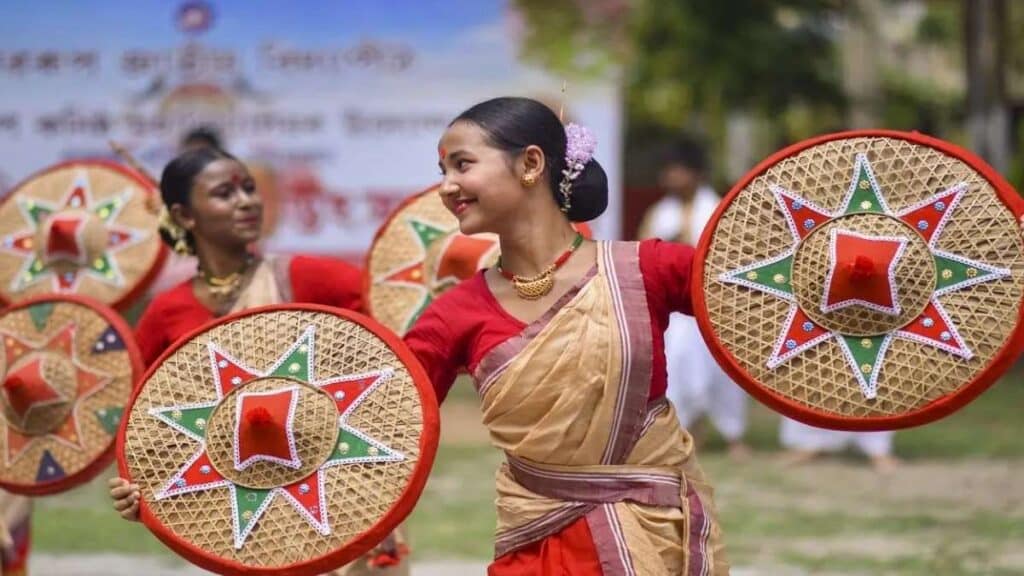
Bohag Bihu has adapted gracefully to contemporary life without losing its cultural core. In cities, apartment-dwelling families maintain Bihu traditions through community events, social media greetings, and shared meals. The Gamusa has become a fashion symbol, worn as stoles and accessories by young Assamese people across the country and the world. Digital Bihu — live-streamed performances, online pitha recipes, and Bihu dance reels — has made the festival accessible to the global Assamese community.
Environmental consciousness has entered the celebrations too, with community groups organizing river clean-ups and tree-planting drives during Bihu week, reconnecting the festival’s ecological roots with present-day values.
How to wish someone on Bohag Bihu: “Subho Bohag Bihu!” is the most common Assamese greeting. In English: “Happy Bohag Bihu!” or “Happy Assamese New Year!”
Cultural Reflection
Bohag Bihu endures because it is not merely a holiday but a living celebration of identity. It belongs to the farmer who still ploughs the Brahmaputra plain, to the young professional in Guwahati, and to the Assamese family celebrating thousands of miles away in London or Houston. In its dance, its songs, its ceremonial gifting of a hand-woven cloth, and its reverence for cattle and earth, it carries forward a way of being in the world that values community, gratitude, and continuity. As spring arrives once more, Bohag Bihu remains what it has always been: Assam’s most joyful greeting to the new year.