
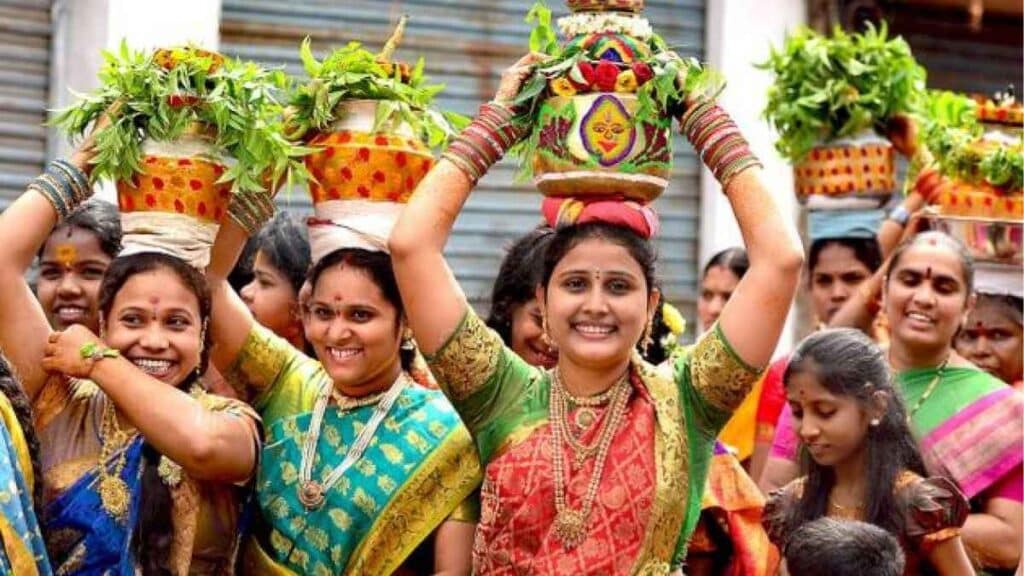
Bonalu is one of the most vibrant and deeply rooted folk festivals of Telangana, celebrated in honor of Goddess Mahakali — the fierce and protective mother deity of the Deccan. Observed during the Hindu month of Ashada Masam (July–August), Bonalu is a festival of thanksgiving, devotion, and community — a time when neighborhoods come alive with the thunder of Thaswa drums, the fragrance of neem and turmeric, and the sight of women carrying glowing offering pots on their heads.
The word Bonalu comes from the Telugu contraction of the Sanskrit Bhojanam, meaning “food offering.” At the heart of the festival is the Bonam — a pot of sweet rice offered to the Goddess as a sacred act of gratitude for fulfilling vows, protecting families, and warding off disease and misfortune. More than a religious ritual, Bonalu is a declaration of identity — Telangana’s most distinctive and beloved cultural celebration.
When Is Bonalu Celebrated in 2026?
Bonalu is observed across four consecutive Sundays during the Hindu lunar month of Ashada Masam, progressing temple by temple through Hyderabad and Secunderabad. In 2026, the festival’s peak celebrations fall on Monday, August 10, 2026 — declared a Telangana State General Holiday.
Bonalu 2026 Festival Schedule – India
| Date | Celebration | Key Temple / Location |
|---|---|---|
| Sunday, July 19, 2026 | Golkonda Bonalu (Opening) | Jagadamba Temple, Golkonda Fort |
| Sunday, July 26, 2026 | Secunderabad / Lashkar Bonalu | Ujjaini Mahankali Temple, Secunderabad |
| Sunday, August 2, 2026 | Old City Bonalu | Lal Darwaza Simhavahini Mahankali Temple |
| Monday, August 10, 2026 | Grand Concluding Bonalu (State Holiday) | Akkanna Madanna Temple, Haribowli |
Celebrations begin from early morning (around 6:00 AM IST). The Rangam (oracle) ritual takes place at dawn before the main procession. The Ghatam immersion at Nayapul concludes each day’s festivities in the evening.
Table of Contents
Bonalu In USA, Canada, Australia, New Zealand, UK, UAE, Singapore 2026 Dates
Bonalu on Monday, August 10, 2026
Bonalu on Monday, August 10, 2026
Bonalu on Monday, August 10, 2026
Bonalu on Monday, August 10, 2026
Bonalu on Monday, August 10, 2026
Bonalu on Monday, August 10, 2026
Why Do Bonalu Dates Change Every Year?
Bonalu is observed based on the Telugu Hindu lunar calendar, not the Gregorian calendar. It falls on the Sundays of Ashada Masam, the fourth month of the Telugu calendar, which shifts by weeks each year depending on lunar cycles — typically landing between mid-July and mid-August. The temple sequence always follows the same order: Golkonda → Secunderabad → Old City → Grand Finale, ensuring every major shrine is honored in turn.
Bonalu – Other Names and Regional Identities
The word Bonam (singular of Bonalu) is a Telugu contraction of the Sanskrit Bhojanam, meaning “meal” or “food offering.” The plural Bonalu refers to the collective offering ceremonies at temples.
Regional and location-specific names include:
- Golkonda Bonalu — Celebrations at the Jagadamba Temple within Golkonda Fort, traditionally marking the festival’s opening
- Lashkar Bonalu / Secunderabad Bonalu — The most prominent celebrations, centered at the Ujjaini Mahankali Temple in the former cantonment area
- Maisamma Bonalu — In rural Telangana, where local folk goddess Maisamma is worshipped alongside or in place of Mahakali
- Mahakali Bonalu — A common reference across diaspora communities in the USA, UK, UAE, and Australia
- Mahakali ka Utsav — Informal name used in Hyderabad’s Urdu-speaking neighborhoods
In Telugu script: బోనాలు | In diaspora contexts, commonly called “Bonalu” or “Telangana’s Mahakali Festival.”
Origins, History, and Legends of Bonalu
The origins of Bonalu trace back to the 18th century in the erstwhile Hyderabad State. In 1813, a devastating plague swept through the twin cities of Hyderabad and Secunderabad, claiming thousands of lives. At the time, a military battalion from Hyderabad was stationed in Ujjaini (modern-day Ujjain, Madhya Pradesh) — home to the sacred Mahakaleshwara Jyotirlinga and a powerful Mahakali temple.
Upon receiving news of the epidemic, the soldiers fervently prayed to Goddess Mahakali at the Ujjaini temple, vowing that if she protected their families and destroyed the plague, they would install her idol in Hyderabad upon their return. The Goddess is believed to have answered their prayers. True to their vow, the soldiers established the Ujjaini Mahankali Temple in Secunderabad — the most sacred Bonalu temple to this day. The food offering — Bonam — became the festival’s living symbol of that ancient gratitude.
Over generations, Bonalu grew from a regimental tradition into the defining folk festival of all Telangana, expanding to hundreds of Mahakali, Yellamma, and Pochamma temples across the region. The festival’s roots in community survival, gratitude, and the power of collective prayer continue to shape its meaning today.
Cultural and Spiritual Significance of Bonalu
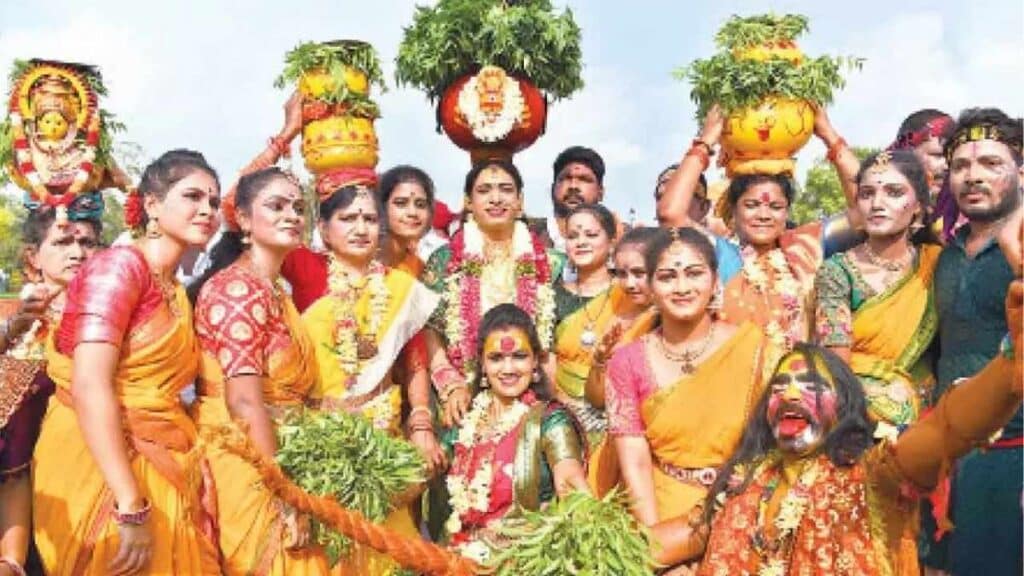
Bonalu is far more than a religious observance — it is a living expression of Telangana’s identity and the Deccan Shakti-Shaivite tradition. The festival honors Shakti — the cosmic feminine force — in her most fierce and protective form. Mahakali is venerated not as a distant deity but as the mother of the streets, the neighborhoods, and the people.
Spiritually, Bonalu embodies the principle of vow fulfillment (Nerchakodam). When a devotee’s wish is granted — recovery from illness, safe childbirth, survival of hardship — they return to the Goddess with the Bonam offering as a sacred expression of gratitude. This cycle of prayer, protection, and thanksgiving is the festival’s spiritual core.
Socially, Bonalu is one of India’s few major festivals where women hold undisputed center stage — as carriers of the offering pots, as trance dancers (Shigam), and as the oracle performer (Rangam). It celebrates feminine power, community resilience, and grassroots culture in a deeply democratic way, transcending class and social barriers.
Prayers and Religious Observances
Bonalu’s religious observances are participatory, communal, and viscerally alive. The festival begins with preparations at home, where women cook the Bonam and adorn the offering pot with neem leaves, turmeric, vermilion, and a lit oil lamp.
At dawn on the day of the temple procession, the Rangam oracle ritual opens the festivities. A woman invokes Mahakali, enters a trance state atop an earthen pot, and delivers prophecies for the community for the year ahead — one of the most spiritually significant moments in the Telangana religious calendar.
Prayers offered during Bonalu seek the Goddess’s protection from disease, misfortune, and evil, and express gratitude for blessings received. Offerings include the Bonam rice, turmeric, vermilion, bangles, and saris — materials associated with feminine auspiciousness and the Goddess’s grace. Many families observe a hereditary tradition of Bonam offering, with the ritual passed from mothers to daughters across generations as a living inheritance.
How Bonalu Is Celebrated Across India
Telangana is the heartland of Bonalu. Hyderabad and Secunderabad see the grandest celebrations — the four-Sunday sequence across Golkonda, Secunderabad, and the Old City draws hundreds of thousands of devotees. Every neighborhood has its local Mahakali or Yellamma temple with its own Bonam offering ceremony.
In Andhra Pradesh, communities with Telangana roots celebrate Bonalu at Mahakali temples, particularly in border districts. Chennai, Bengaluru, Mumbai, and Delhi — wherever significant Telugu-speaking communities live — also see temple Bonalu celebrations organized by local cultural associations.
In rural Telangana, the festival carries an even stronger folk character. Local goddesses like Maisamma, Pochamma, and Yellamma are honored, reflecting the rich tapestry of Deccan folk religion. The Pothuraju dance, Shigam trance performers, and Ghatam processions are as central to village celebrations as they are to Hyderabad’s grand events.
Participation Across Religions in India
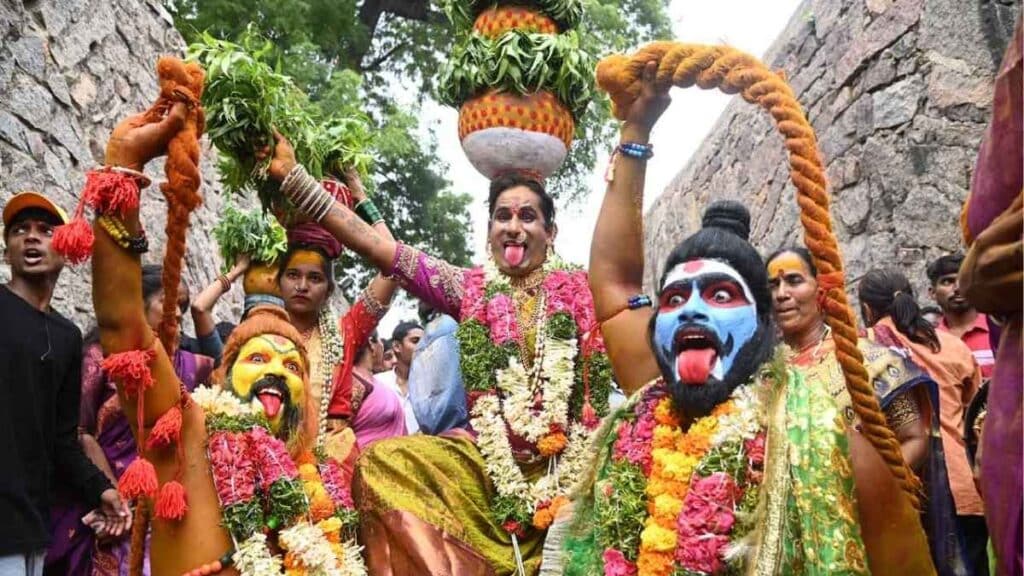
Bonalu’s folk character makes it remarkably inclusive. In Hyderabad’s diverse social fabric, neighbors of all communities — Muslim, Christian, Sikh — often join the festivities as enthusiastic participants, supporters, and guests at the community feast that follows the offering. Many Muslim traders are key suppliers of festival materials — earthen pots, turmeric, vermilion, and neem leaves — and consider Bonalu season integral to their livelihoods.
Hyderabad’s spirit of Ganga-Jamuni tehzeeb (the city’s historic composite culture) means that Bonalu, while deeply Hindu in its devotional content, is experienced as a shared neighborhood celebration. Local governments and civic bodies across communities support festival infrastructure, reflecting Bonalu’s status as a unifying cultural event for all of Hyderabad.
How Bonalu Is Celebrated Outside India
The Telugu diaspora has carried Bonalu’s spirit to every continent. Telugu cultural organizations and Hindu temples in major cities worldwide organize Bonalu celebrations, transforming the festival into a global affirmation of Telangana identity. For second-generation Telugu communities abroad, Bonalu serves as a powerful link to cultural heritage — helping pass traditions, stories, and values to younger generations.
In the USA, Telugu associations in Dallas, Houston, Atlanta, New Jersey, and Chicago organize weekend Bonalu events featuring the Bonam offering ceremony, Pothuraju performances, and Thaswa drumming. In the UK, Birmingham, London, and Leicester see community hall events with cultural programs. In Australia and Singapore, temple Bonalu events draw large community participation. In the UAE, where a significant Telugu workforce is based, temple events in Dubai and Abu Dhabi are especially well-attended.
Celebrations outside India typically shift to the nearest weekend for practical convenience, and often include a community feast (Anna Danam) — replicating the spirit of collective offering that is central to the festival.
Bonalu Gifting Traditions
Bonalu is primarily a festival of offering rather than gift exchange — the Bonam itself is the most sacred gift, given to the Goddess. However, meaningful gifting customs surround the festival. Women receive new bangles, saris, and turmeric-vermilion sets from family members as part of festival preparation, as these materials are used in the Bonam ritual. Gifting a new brass or copper pot to a woman observing her first Bonalu is considered especially auspicious.
In the diaspora, Bonalu gifting takes on a cultural preservation dimension — traditional Telangana jewelry, Kondapalli or Nirmal handicrafts, and festive sweets like Pootharekulu and Ariselu are popular gifts among Telugu families celebrating abroad.
Bonalu Foods and Culinary Traditions
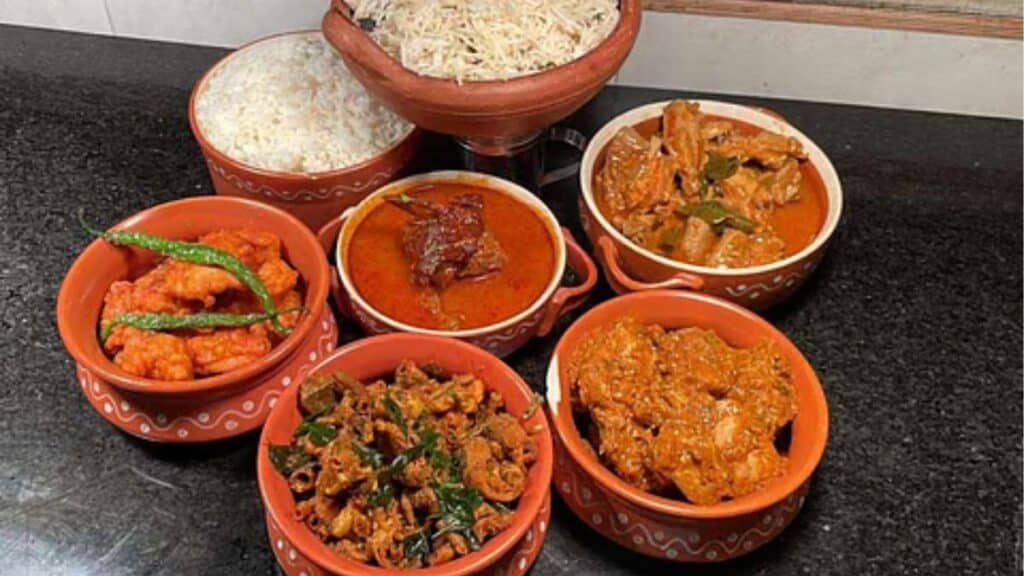
The centerpiece of Bonalu’s culinary tradition is the Bonam itself — sweet rice (a form of Pongal) cooked with milk and jaggery, prepared in a new pot and offered to the Goddess. After the offering, the Prasad is distributed to all devotees as divine blessing. Large-scale community feasts (Anna Danam) are central to major temple Bonalu events, where thousands of devotees are fed.
Common Bonalu foods and festival dishes include:
Bonam (Sweet Pongal), Pulihora (Tamarind Rice), Daddojanam (Curd Rice), Kobbari Annam (Coconut Rice), Garelu (Medu Vada), Chegodilu, Ariselu (Sweet Fritters), Pootharekulu (Paper Sweet), Sarva Pindi, and Jaggery Payasam.
The act of feeding — both Goddess and community — is inseparable from Bonalu’s spiritual meaning. Food here is not just nourishment; it is devotion made edible.
Music, Art, and Cultural Expression
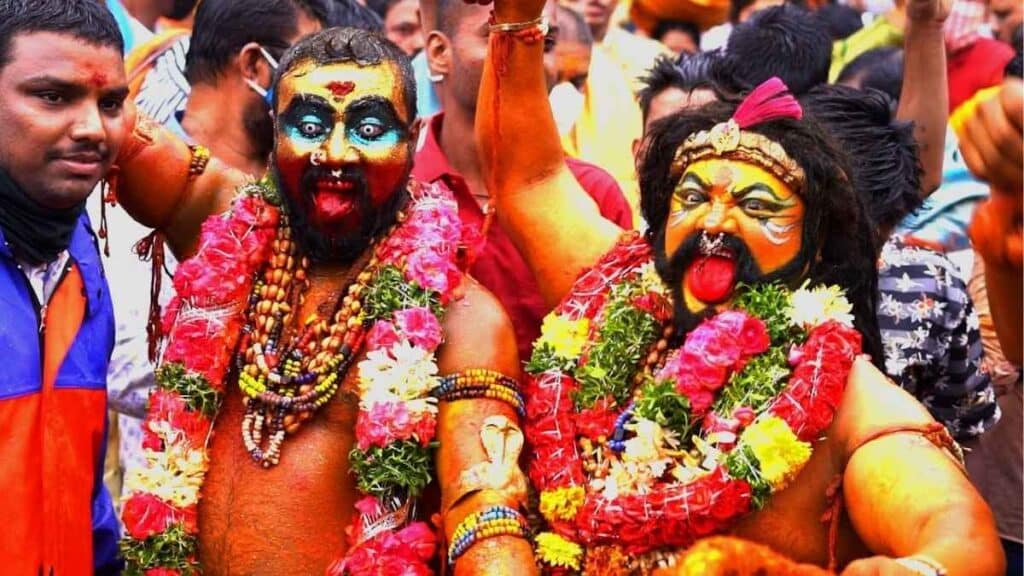
Bonalu is defined by its sound. The thunderous Thaswa drums drive the procession’s energy, while trumpets (Kommu) and the Shehnai create an atmosphere of both reverence and ecstasy. The Pothuraju’s fierce rhythmic dance is inseparable from the drumbeat — together they announce the Goddess’s presence to the entire neighborhood.
Oggu Katha — the traditional Telangana folk ballad tradition — is performed at temples and gatherings during Bonalu, recounting the stories of Mahakali and local deities through song and narration. Perini Shivatandavam, the ancient warrior dance of Telangana, is performed at major venues as part of cultural programs.
Bonalu inspires remarkable visual spectacle too — intricate Rangoli in temple courtyards, women in vibrant traditional dress and gold jewelry with jasmine garlands, and the blazing colors of the procession. In recent years, Hyderabadi artists have created Bonalu-inspired murals and street art, bringing global attention to the festival’s rich aesthetic character.
Modern Observance and Evolving Practices
Bonalu has experienced a powerful revival since Telangana’s formation as a separate state in 2014, with the festival becoming an emblem of regional pride and cultural identity. Younger generations in Hyderabad actively participate, document, and share Bonalu on social media, bringing global visibility to what was once considered a purely local tradition.
Sustainability has entered the conversation — eco-friendly earthen pots are preferred over plastic, and natural colors (turmeric, kumkum) over synthetic dyes. Several temple committees now organize post-festival clean-up drives and use eco-conscious Ghatam immersion methods.
How to wish someone on Bonalu: The warmest greeting is “Bonalu Subhakankshalu!” (బోనాలు శుభాకాంక్షలు) — meaning “Bonalu Greetings!” You can also say “Jai Mahakali!” (జై మహాకాళి) to honor the Goddess at the heart of the festival.
Cultural Reflection
In an age of rapid change and global mobility, Bonalu stands as a powerful reminder that culture is not inherited passively — it is actively chosen, renewed, and celebrated. For Telugu communities in Hyderabad and across the world, Bonalu is more than a festival; it is an annual homecoming of identity and an affirmation that the Goddess walks among her people.
The women who carry the Bonam on their heads, the drummer lost in the Thaswa’s rhythm, the child watching the Pothuraju dance for the first time — they are all part of an unbroken chain stretching back to 1813 and beyond. Bonalu is Telangana’s living heartbeat, and its message — gratitude, protection, and community — is as urgent and universal as ever.