
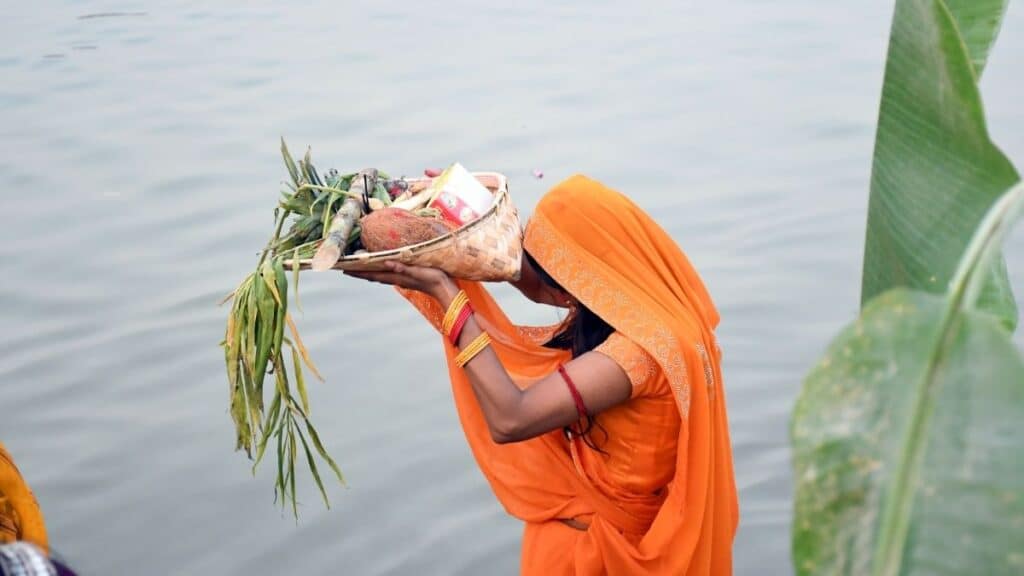
Chhath Puja is one of the most rigorous and eco-friendly Indian festivals, dedicated to worshipping the Sun God (Surya) and Chhathi Maiya (Goddess Shashthi). Celebrated primarily in Bihar, Jharkhand, Eastern Uttar Pradesh, and Nepal’s Terai region, this ancient Vedic festival represents gratitude toward nature for sustaining life on Earth.
The spiritual essence of Chhath lies in its purity and discipline. Over four days, devotees observe strict fasting—including a challenging 36-hour waterless fast—ritual bathing, and offering arghya (prayers) to both the setting and rising sun while standing in water. This unique practice of worshipping the sun at both sunset and sunrise distinguishes Chhath from all other Hindu festivals.
Rooted in folk tradition rather than Brahminical rituals, Chhath requires no priests, elaborate temples, or wealth. It emphasizes community participation, environmental consciousness, and devotion. The festival celebrates the sun as the fundamental source of life, acknowledging nature’s role in human existence. Women (called Parvaitins) primarily observe the fast for family welfare and children’s well-being, though men also participate equally.
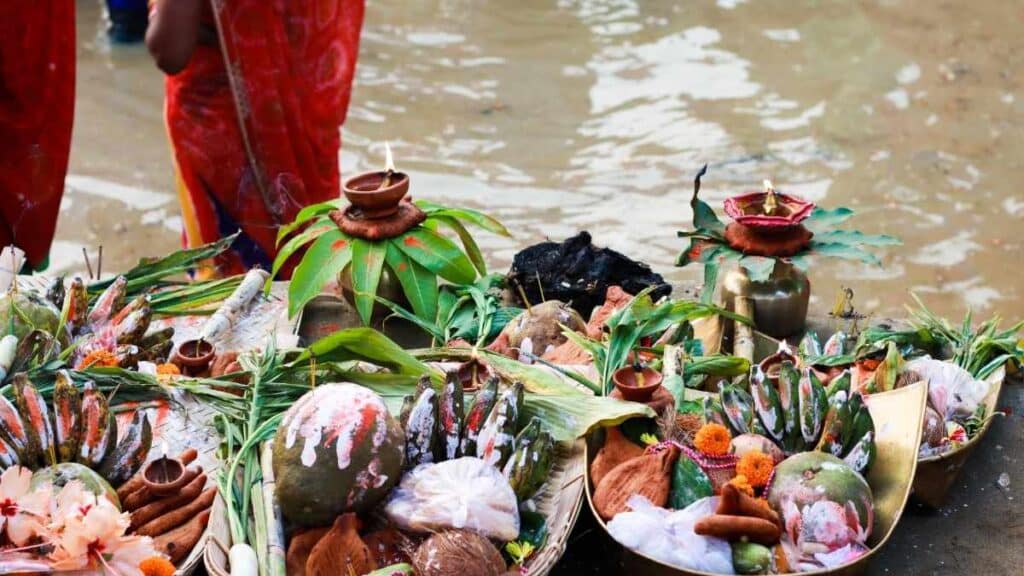
Environmentalists recognize Chhath as the most eco-friendly Hindu festival, using only biodegradable materials—bamboo baskets, clay pots, and natural offerings—with zero waste or pollution.
When Is Chhath Puja Celebrated in 2026?
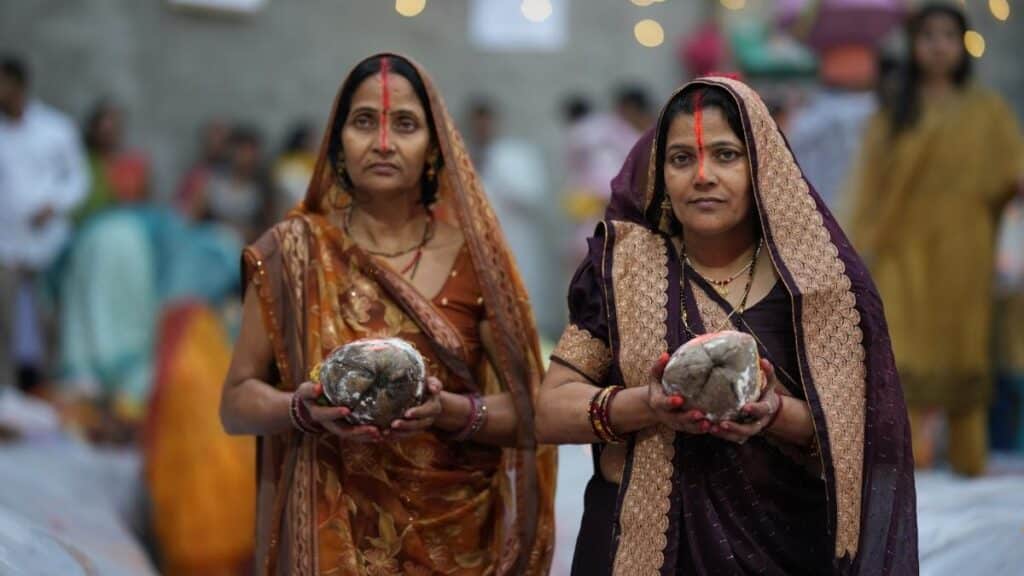
Chhath Puja is celebrated on Kartik Shukla Shashthi (the sixth day of the bright fortnight) following Diwali. The festival spans four days, each with specific rituals and significance.
Chhath Puja In India 2026 Dates
Day 1: Nahay Khay – Friday, November 13, 2026
The first day involves holy bathing and consuming a single pure vegetarian meal.
- Sunrise at 06:42 AM
- Sunset at 05:28 PM
Day 2: Kharna (Lohanda) – Saturday, November 14, 2026
Devotees observe a sunrise-to-sunset waterless fast, breaking it after offering kheer to the Sun God.
- Sunrise at 06:43 AM
- Sunset at 05:28 PM
Day 3: Sandhya Arghya (Main Chhath) – Sunday, November 15, 2026
The main day features offering arghya to the setting sun—a unique practice found only in Chhath.
- Sunrise at 06:44 AM
- Sunset at 05:28 PM
Day 4: Usha Arghya (Parana) – Monday, November 16, 2026
The final day involves offering arghya to the rising sun and breaking the 36-hour fast.and is considered the most sacred time for worship and puja.
- Sunrise at 06:44 AM
- Sunset at 05:27 PM
Table of Contents
Chhath Puja In USA, Canada, Australia, New Zealand, UK, UAE, Singapore 2026 Dates
Chhath Puja on Sunday, November 15, 2026
- Sunrise on Chhath Puja Day – 06:43 AM
- Sunset on Chhath Puja Day – 04:38 PM
Chhath Puja on Sunday, November 15, 2026
- Sunrise on Chhath Puja Day – 07:12 AM
- Sunset on Chhath Puja Day – 04:52 PM
Chhath Puja on Sunday, November 15, 2026
- Sunrise on Chhath Puja Day – 05:49 AM
- Sunset on Chhath Puja Day – 07:47 PM
Chhath Puja on Sunday, November 15, 2026
- Sunrise on Chhath Puja Day – 07:18 AM
- Sunset on Chhath Puja Day – 04:11 PM
Chhath Puja on Sunday, November 15, 2026
- Sunrise on Chhath Puja Day – 06:36 AM
- Sunset on Chhath Puja Day – 05:32 PM
Chhath Puja on Sunday, November 15, 2026
- Sunrise on Chhath Puja Day – 06:47 AM
- Sunset on Chhath Puja Day – 06:51 PM
Why Chhath Puja Dates Change Every Year?
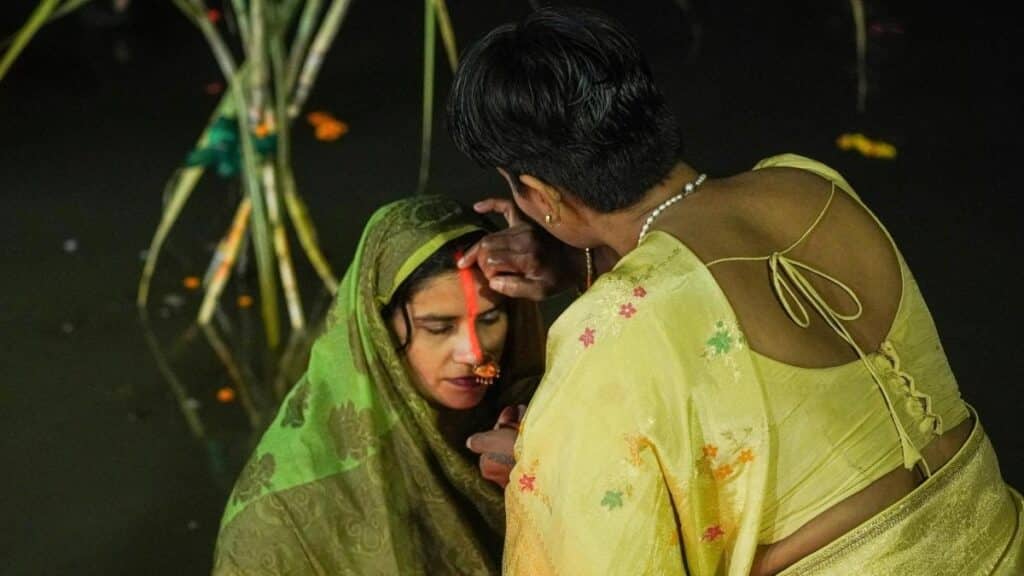
Chhath Puja is celebrated based on the Hindu lunar calendar, not the Gregorian calendar.
It falls on Kartik Shukla Shashthi (sixth day of the bright fortnight in Kartik month), which always occurs six days after Diwali.
Since lunar months are shorter than solar months:
- Chhath Puja’s date shifts every year
- The festival timing depends on moon position and lunar tithi
- Ritual timings align with specific astronomical configurations
The festival is called “Chhath” (meaning “sixth”) because it occurs on the sixth day (Shashthi) of Kartik Shukla Paksha.
How Are Chhath Puja Timings Decided?
Chhath Puja timings are based on sunrise and sunset, which vary by location. The key rituals are:
- Sandhya Arghya (Day 3): Must be performed during sunset, standing in water
- Usha Arghya (Day 4): Must be performed at sunrise, standing in water
The exact Panchang timings for Nahay Khay and Kharna are calculated based on:
- Chaturthi and Panchami Tithi duration
- Local sunrise/sunset times
- Astronomical positions of the Sun and Moon
Devotees worldwide follow their local sunrise/sunset while maintaining the four-day lunar calendar sequence.
Chhath Puja Other Names & Regional Identities

Standard Names:
- Chhath / Chhathi — Most common name across regions
- Surya Shashthi — Emphasizes sun worship aspect
- Chhath Parv / Chhath Mahaparva — Festival designation
North & East India
- Dala Chhath — Bihar, Jharkhand
- Pratihar — Traditional name in Mithila region
- Chhath Puja — Standard Hindi/English usage
Regional Variants
- Chhathi Vrat — Emphasizing the fasting aspect
- Surya Shashthi — Used in religious texts
- Chhathi Maiya Puja — Focusing on Goddess Shashthi worship
Names for the Goddess
- Chhathi Maiya — Bihar, Jharkhand, Uttar Pradesh
- Ranbe Mai / Ranbe — Mithila region
- Sabita Mai — Bhojpuri-speaking areas
- Ranbe Thakur — Bengali communities
- Shashthi Devi — Sanskrit/scriptural name
Diaspora / International Naming
- Chhath Festival — English-speaking countries
- Sun Worship Festival — Explanatory name for non-Indian audiences
- Chhath Puja — Retained universally by diaspora communities
The Origins, History, and Legends of Chhath Puja
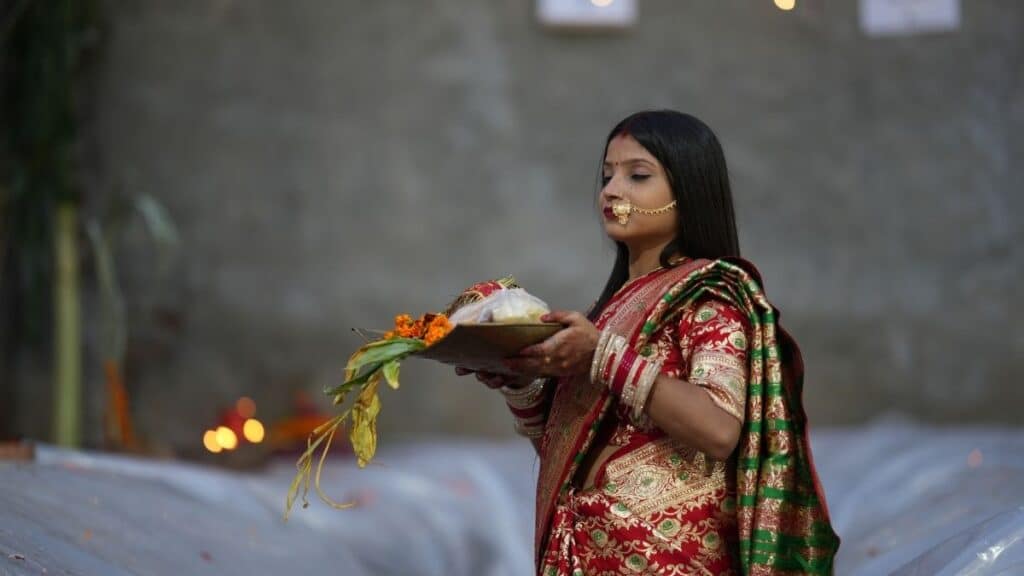
Chhath Puja stands as the only Hindu festival continuously celebrated since the Vedic period, with its roots in the Rigveda. Ancient Vedic texts describe sun worship as fundamental to human existence, establishing the theological foundation for this millennia-old tradition.
Historical Background
The Rigveda contains elaborate hymns dedicated to Surya (Sun God), recognizing him as the source of life and energy. Chhath evolved from these Vedic practices, developing into a systematic folk festival by the medieval period. Unlike temple-based Brahminical traditions, Chhath was shaped by farming communities who directly depended on solar cycles for agriculture.
The festival’s association with Munger, Bihar traces to the Sita Charan Temple located on a Ganges rock, where Goddess Sita reportedly celebrated Chhath, establishing the tradition’s sacred geography.
Mythological Legends
The Story of Goddess Aditi:
When gods faced defeat by demons in the first Deva-Asura war, Goddess Aditi sought blessings from her daughter Chhathi Maiya at the Dev Surya Temple. Pleased with her devotion, Chhathi Maiya granted her a divine son—Lord Aditya (Sun God embodying the Tridev)—who led the gods to victory.
From the Ramayana:
After conquering Lanka and establishing Ramrajya, Lord Rama and Sita observed a fast on Kartik Shukla Shashthi, worshipping the Sun God. At sunrise on Saptami, they performed arghya and received divine blessings, establishing the ritual precedent.
From the Mahabharata:
Karna, son of Surya, pioneered the practice of standing waist-deep in water offering prayers to the Sun God. Through solar grace, he became an invincible warrior. This tradition of water-based arghya continues in Chhath.
Draupadi worshipped the Sun for her family’s welfare. When the Pandavas lost their kingdom in gambling, she observed Chhath fast at Lord Krishna’s suggestion, and her wishes were fulfilled.
Puranic Legend – King Priyavad:
Childless King Priyavad’s wife Malini conceived through Maharishi Kashyapa’s ritual but delivered a stillborn son. At the cremation ground, Goddess Devasena (Shashthi) appeared, revealing herself as the sixth form of creation. Following her guidance, the king worshipped her on Kartik Shukla Shashthi and was blessed with a healthy child.
Chhath Puja: Cultural and Spiritual Significance
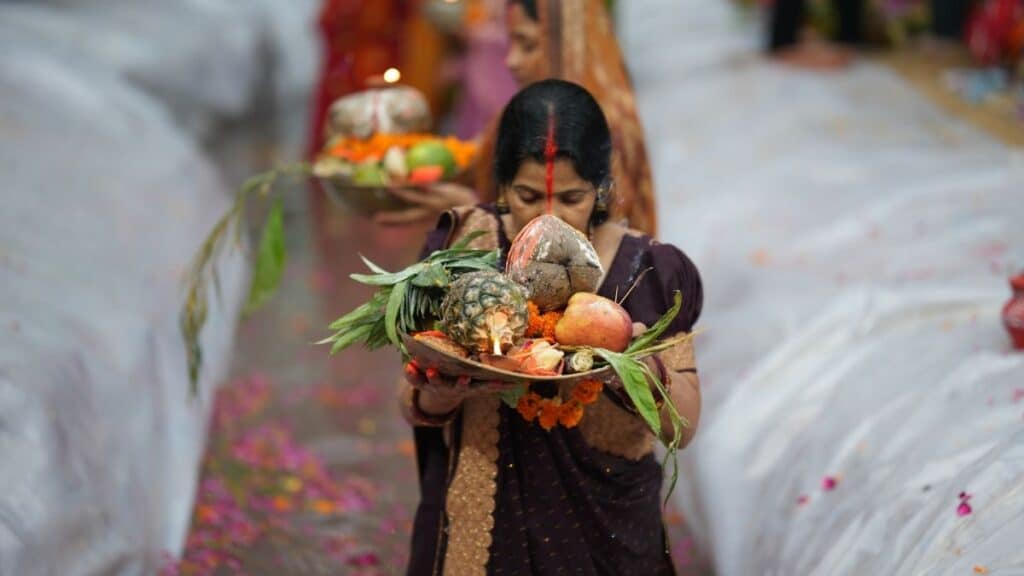
Chhath Puja embodies profound spiritual symbolism and cultural values that transcend religious ritual.
Gratitude to Nature: The festival acknowledges the sun as the fundamental life force, expressing thankfulness for light, warmth, and energy that sustain all existence. Chhath worships nature holistically—sun, water, air, and earth.
Spiritual Purification: The rigorous fasting and discipline represent inner cleansing, burning away ego and negativity. The 36-hour waterless fast tests and strengthens devotion, building spiritual resilience.
Scientific Dimension: On Shashthi Tithi, unique astronomical alignment occurs when Earth, Moon, and Sun form specific configurations. Ultraviolet rays concentrate more heavily at sunrise and sunset. The ritual practice of standing in water during these times is believed to optimize beneficial solar energy absorption while minimizing harmful UV effects.
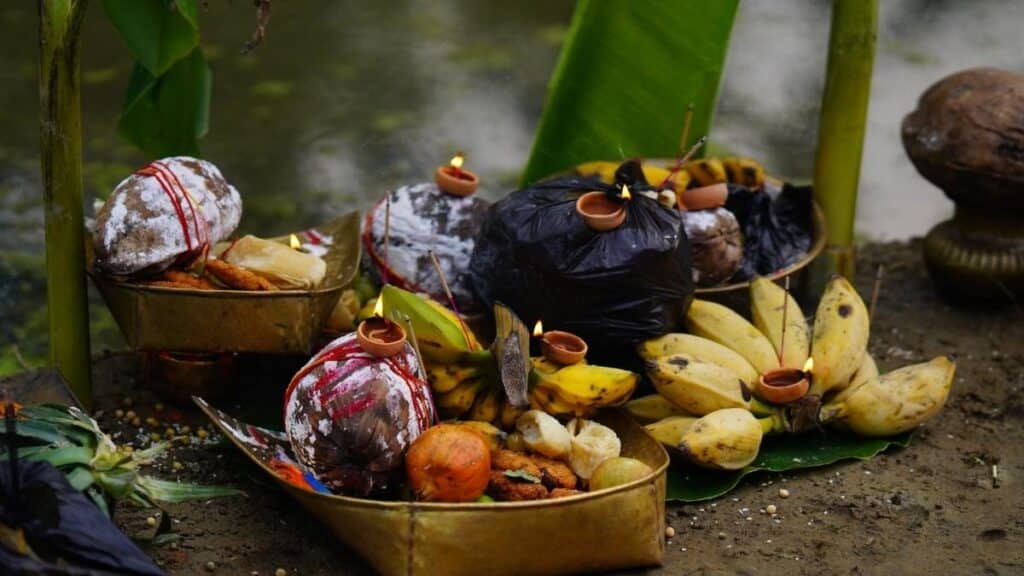
Environmental Consciousness: Chhath stands as Hinduism’s most eco-friendly festival, using zero plastic, no synthetic materials, and only biodegradable offerings. Everything—bamboo baskets, clay pots, natural produce—returns to nature harmlessly.
Social Equality: Unlike caste-based rituals requiring priests, Chhath is democratic and accessible. Poor farmers and wealthy merchants observe identical practices, creating social cohesion and community bonds.
Goddess Chhathi Maiya: As the sixth form of Parvati and Surya’s sister, Chhathi Maiya protects children and grants progeny blessings. Devotees seek her grace for offspring welfare and family prosperity.
Culturally, Chhath represents the identity and resilience of Maithili, Magahi, and Bhojpuri peoples, maintaining unbroken continuity with ancient traditions while adapting to modern contexts.
Chhath Puja Prayers and Religious Observances
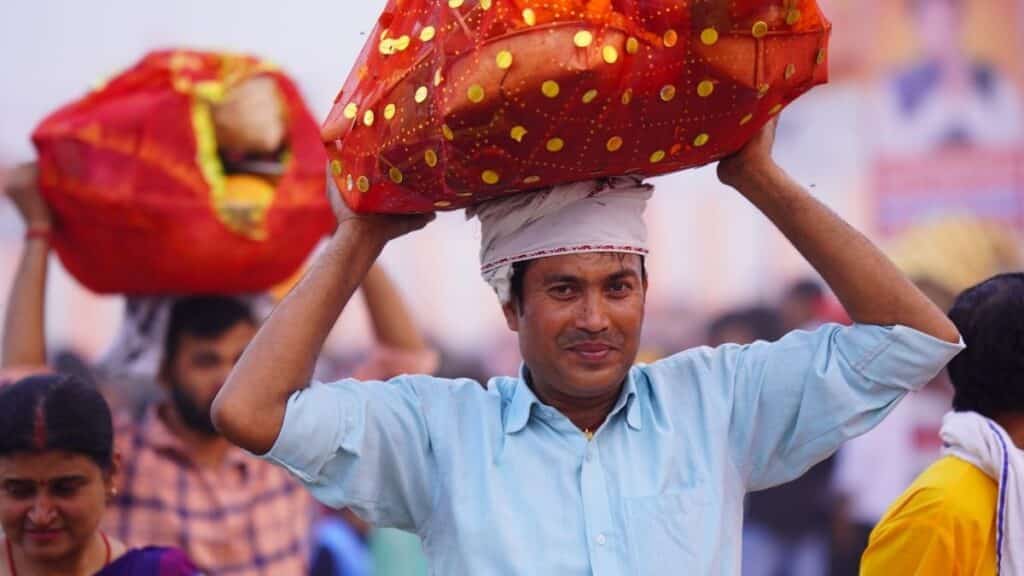
The Four-Day Ritual Journey
Day 1 – Nahay Khay (Bathing and Eating):
Devotees purify their homes and take holy baths in the Ganga, tributaries, or ponds. They consume only one simple vegetarian meal—Arwa rice with ghee, pumpkin curry, and mung dal—prepared in bronze or clay pots using mango wood fire. No onion, garlic, or fried foods are permitted.
Day 2 – Kharna (Breaking Fast):
A complete sunrise-to-sunset waterless fast (nirjala vrat) is observed. In the evening, devotees prepare kheer using rice, jaggery, and sugarcane juice (no salt or sugar). After offering to the Sun God, they consume it alone (ekant) in complete silence while family members leave the house. The 36-hour waterless fast begins after this meal. At midnight, devotees prepare thekua, the special Chhath prasad.
Day 3 – Sandhya Arghya (Evening Offering):
Devotees observe a complete waterless fast throughout the day. In the evening, they carry bamboo baskets (daura) filled with offerings to riverbanks or ponds, singing Chhath folk songs. Standing knee-deep in water, they offer arghya to the setting sun—a practice unique to Chhath. After five circumambulations, they either stay overnight at the ghat or return home.
Day 4 – Usha Arghya (Morning Offering):
Before sunrise, devotees return to the water and offer arghya to the rising sun, facing east. After worshipping the ghat and distributing prasad, they return home to worship the village peepal tree (Brahma Baba). The fast concludes (parana) with raw milk sherbet and small prasad—the first food after 36 hours.
Home vs Temple Observance
Chhath is primarily a home and riverbank festival. The domestic space becomes sacred through purity maintenance. Devotees sleep on floors (no beds), wear unstitched cotton clothes (saris for women, dhoti for men), and maintain strict discipline.
Natural water bodies serve as temples—rivers, ponds, and lakes become sacred spaces. Urban areas create temporary ghats with infrastructure support.
While not mandatory, devotees recite Surya mantras, Gayatri mantra, and melodious Chhath folk songs throughout the observance.
Chhath Puja Mantra
In Hindi
अर्घ्य मंत्र
ॐ ऐहि सूर्यदेव सहस्त्रांशो तेजो राशि जगत्पते।
अनुकम्पय मां भक्त्या गृहणार्घ्य दिवाकरः।।
सरल मंत्र
- ॐ सूर्याय नमः
- ॐ आदित्याय नमः
- ॐ नमो भास्कराय नमः
गायत्री मंत्र
ॐ भूर्भुवः स्वः तत्सवितुर्वरेण्यं
भर्गो देवस्य धीमहि धियो यो नः प्रचोदयात्।।
Hinglish
Arghya Mantra
Om Aihi Suryadev Sahastransho Tejo Rashi Jagatpate
Anukampaya Maam Bhaktya Grihanarghya Divakarah
Simple Mantra
- Om Suryaya Namah
- Om Adityaya Namah
- Om Namo Bhaskaraya Namah
Other Mantra
- Om Ghrini Suryaya Namah
- Om Hreem Suryaya Namah
Gayatri Mantra
Om Bhur Bhuvah Swah Tat Savitur Varenyam
Bhargo Devasya Dheemahi Dhiyo Yo Nah Prachodayat
Chhath Puja Katha
In Hindi
बहुत पहले की बात है, एक राजा थे जिनका नाम प्रियव्रत था और उनकी पत्नी का नाम मालिनी था। दोनों संतानहीन थे और संतान प्राप्ति की इच्छा रखते थे।
उन्होंने महर्षि कश्यप के मार्गदर्शन में एक यज्ञ करवाया। यज्ञ के दौरान महर्षि ने उन्हें एक विशेष खीर दी, जिसे ग्रहण करने के बाद रानी गर्भवती हो गईं। लेकिन जब संतान का जन्म हुआ, तो वह मृत थी।
यह देखकर राजा अत्यंत दुखी हो गए और जीवन समाप्त करने का विचार करने लगे। तभी अचानक उनके सामने एक देवी प्रकट हुईं। उन्होंने स्वयं को छठी मइया बताया और कहा कि यदि वे श्रद्धा से उनकी पूजा करेंगे, तो उन्हें संतान सुख अवश्य प्राप्त होगा।
राजा और रानी ने विधिपूर्वक छठी मइया की पूजा की, जिसके फलस्वरूप उन्हें स्वस्थ संतान प्राप्त हुई। तभी से छठ पूजा का महत्व और भी बढ़ गया।
In Hinglish
Bahut pehle ki baat hai, ek raja the jinka naam Priyavrat tha aur unki patni ka naam Malini tha. Dono santanheen the aur santan ki ichha rakhte the.
Maharishi Kashyap ke kehne par unhone ek yagya karwaya. Yagya ke dauran unhe ek vishesh kheer di gayi. Us kheer ko grahan karne ke baad rani garbhvati hui, lekin janm ke samay bachcha mrit paida hua.
Raja bahut dukhi ho gaye aur jeevan samapt karne ka sochne lage. Tabhi ek devi prakat hui jo swayam ko Chhathi Maiya batati hain. Unhone kaha ki agar ve unki bhakti aur shraddha se pooja karenge, to unhe santan prapt hogi.
Raja ne poori shraddha se pooja ki aur unhe phir se santan sukh prapt hua. Tab se Chhath Puja ka mahatva aur badh gaya.
Chhathi Maiya Aarti
In Hindi
जय छठी मैया, मैया जय छठी मैया।
व्रत करे जो नर-नारी, दुःख-दरिद्र नसाय।।
केरवा जे फरेला घवद से, ओही पर सुगा मेड़राय।
मारबो रे सुगवा धनुष से, सुगा गिरे मुरझाय।।
उत्तर दिसा जे केरवा फरेला, ओही पर सुगा मेड़राय।
ओही जे सुगनी जे रोएले वियोग से, आदित होई ना सहाय।।
गंगा जे जमुना सरस्वती, ओही पर सभे नहाय।
ओही जे कनियाँ सभे गोड़ लगेली, मैया वर माँगैं सहाय।।
धूप दीप फल फूल से, पूजा सभे होय।
जो जन माँगे माता से, सुख संपत्ति पावै सोय।।
जय छठी मैया, मैया जय छठी मैया।।
In Hinglish
Jai Chhathi Maiya, Maiya Jai Chhathi Maiya
Vrat kare jo nar-naari, dukh-daridra nasaya
Kerwa je phare la ghavad se, ohi par suga medraye
Maarbo re sugwa dhanush se, suga gire murjhaye
Uttar disa je kerwa phare la, ohi par suga medraye
Ohi je sugni je roele viyog se, Aadit hoi na sahay
Ganga je Jamuna Saraswati, ohi par sabhe nahay
Ohi je kaniya sabhe god lageli, Maiya var maange sahay
Dhoop deep phal phool se, pooja sabhe hoy
Jo jan maange Maiya se, sukh sampatti paave soy
Jai Chhathi Maiya, Maiya Jai Chhathi Maiya
How Chhath Puja Is Celebrated Across India
State-Wise Traditions
Bihar:
The festival’s epicenter. Entire cities participate—Patna’s Ganga ghats, Munger’s Sita Charan temple, Begusarai’s waterfront witness millions of devotees. Government declares holidays, and Chhath songs dominate radio and television for weeks.
Jharkhand:
Similar intensity as Bihar, particularly in Ranchi, Jamshedpur, and Dhanbad. Industrial townships see workers returning to villages or creating community ghats.
Eastern Uttar Pradesh:
Varanasi’s Ganga ghats transform completely. Gorakhpur, Deoria, Ballia, and Azamgarh observe with deep devotion. The Purvanchal region considers Chhath culturally essential.
West Bengal:
Concentrated in areas with Bihari populations. Kolkata’s Rabindra Sarovar and Hooghly riverbanks host organized celebrations with increasing Bengali Hindu participation.
Delhi NCR:
Major hubs at Yamuna ghats (ITO, Kalindi Kunj) and artificial ponds across East and West Delhi. Municipal corporations create temporary infrastructure for the massive migrant population.
Maharashtra:
Mumbai’s Juhu Beach, Powai Lake, and Pune’s Mula-Mutha river see growing celebrations as North Indian communities establish traditions.
Nepal:
The Terai region celebrates Chhath as enthusiastically as Bihar, with government recognition as a major festival. Cross-border cultural continuity remains strong.
Despite regional variations, core rituals—waterless fasting, standing in water for arghya, singing folk songs, offering thekua—remain consistent everywhere.
Participation Across Religions in India

Chhath Puja demonstrates India’s interfaith harmony and cultural pluralism. In Bihar, Muslim participation is significant—both as devotees and facilitators. Muslim families help clean ghats, distribute prasad, respect fasting practices, and participate in community preparations.
Christian and Sikh neighbors in urban centers join cleaning drives, respect public space usage during celebrations, and appreciate the festival’s cultural significance. Some families observe Chhath as cultural practice beyond religious boundaries.
Chhath’s folk origins and nature worship emphasis make it accessible across faiths. The festival’s stress on environmental purity, community service, and gratitude resonates universally. Muslims offering premises for prasad preparation, Christians joining ghat beautification, and diverse communities collaborating reflect India’s syncretic traditions.
The shared cultural experience strengthens neighborhood bonds, creating collaborative festive atmospheres that transcend religious divisions.
How Chhath Puja Is Celebrated Outside India

Indian diaspora communities worldwide maintain Chhath traditions with creative adaptations:
United States:
Major celebrations in New York (Queens), New Jersey, California (Bay Area), Texas, and Chicago. Community centers, lakes, temple tanks, and even swimming pools serve as symbolic water bodies. Bihar associations coordinate weekend-aligned observances.
Canada:
Toronto, Brampton, Mississauga, Vancouver, and Calgary host celebrations. November’s cold weather necessitates indoor alternatives with water arrangements while maintaining ritual integrity.
United Kingdom:
London (Southall, Wembley), Leicester, and Birmingham communities use Thames riverbanks and community halls. Cultural programs feature traditional Chhath songs and food fairs.
UAE:
Dubai, Abu Dhabi, and Sharjah’s Indian expatriate communities celebrate at designated beaches (with permissions) or apartment pools symbolically, strictly following the lunar calendar despite work schedules.
Australia & New Zealand:
Sydney, Melbourne, Brisbane, and Auckland communities use local beaches and lakefronts. November coincides with early summer, creating different seasonal contexts but maintaining devotional fervor.
Germany & Singapore:
Growing observances in Berlin, Frankfurt, Munich, and Singapore, with indoor temple celebrations and authorized public spaces.
Adaptations
Diaspora communities often compress four days into weekends, use alternative water bodies (pools, bathtubs, containers), prepare thekua with locally available substitutes, and connect virtually with India-based families during arghya times.
Chhath Puja Gifting Traditions
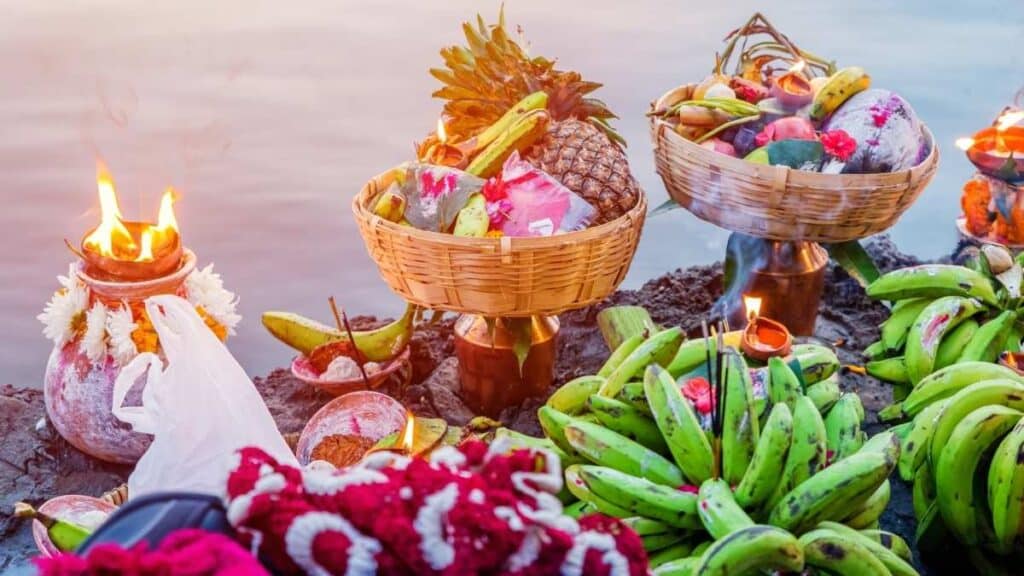
Traditional Gifts
Chhath emphasizes prasad sharing over commercial gifting, but certain practices exist:
For Devotees:
New unstitched cotton saris for women, dhoti for men, puja essentials (clay diyas, bamboo baskets, brass vessels)
Within Family:
Raw materials for prasad preparation—rice, jaggery, sugarcane, turmeric, coconut
Community Contributions:
Supporting ghat cleaning and decoration, donating for collective prasad, helping economically weaker devotees
Modern Practices
Contemporary gifting includes eco-friendly puja kits, organic jaggery hampers, traditional clothing store gift cards, and donations in devotees’ names. NRIs send money to India-based families or ship specific items (thekua molds, special rice) to diaspora friends.
All gifts reflect Chhath’s core values—purity, simplicity, environmental consciousness—avoiding ostentation and preferring natural, useful items.
Traditional Chhath Puja Foods and Culinary Traditions

Signature Dishes
Thekua:
The iconic prasad made from wheat flour, jaggery, ghee, fennel seeds, and coconut. Dough pressed on wooden frames, deep-fried golden, and stored for weeks without spoilage.
Kheer:
Special rice kheer for Kharna, prepared with jaggery or sugarcane juice (no white sugar), offered to the Sun God before consumption.
Kasar:
Rice flour roti coated with thick jaggery syrup.
Rice Laddus (Kachwaniya):
Sweet rice balls offered during both arghya ceremonies.
Natural Offerings:
Fresh sugarcane, raw turmeric, coconut, large lemons, ripe bananas, water chestnuts, sweet potatoes, taro root, and Kushi Kerav seeds (offered only to the rising sun).
Purity Standards
No onion, garlic, or strong spices; no salt in many preparations; bronze or clay cookware preferred; mango wood for cooking fire; food prepared only by fasting devotees or designated pure family members.
Diaspora uses available cookware while maintaining ingredient authenticity, accepting gas stoves when wood is unavailable.
Chhath Puja: Music, Art, and Cultural Expression
Chhath Folk Songs (Geet)
The soul of Chhath resides in melodious devotional folk songs sung throughout four days.
Iconic Songs:
- “Kelwa Je Pherela Ghavad Se” — Most famous Chhath song
- “Ugu Na Suruj Dev Bhailo” — Hymn to the rising sun
- “Pokharva Ke Chaupar” — Celebrating ghat preparations
Themes: Devotion to Sun God and Chhathi Maiya, family welfare prayers, ritual descriptions, nature’s beauty, emotional fulfillment.
Artists: Traditional village women passing songs orally; modern singers like Sharda Sinha (legendary), Malini Awasthi, Kalpana, Khesari Lal Yadav, Pawan Singh.
Musical Style: Simple melodies, call-and-response patterns, accompanied by manjira (cymbals) and dhol (drums).
Cultural Expression
Visual arts include paintings of arghya scenes, ghat murals depicting legends, and Madhubani folk art incorporating Chhath themes. Stunning sunrise/sunset arghya photographs become iconic representations.
Bhojpuri, Maithili, and Magahi literature is rich with Chhath references, poems, and stories. Cinema (Gangs of Wasseypur) and television feature Chhath prominently, while #ChhathPuja trends globally on social media.
Chhath Puja’s Modern Relevance and Cultural Continuity
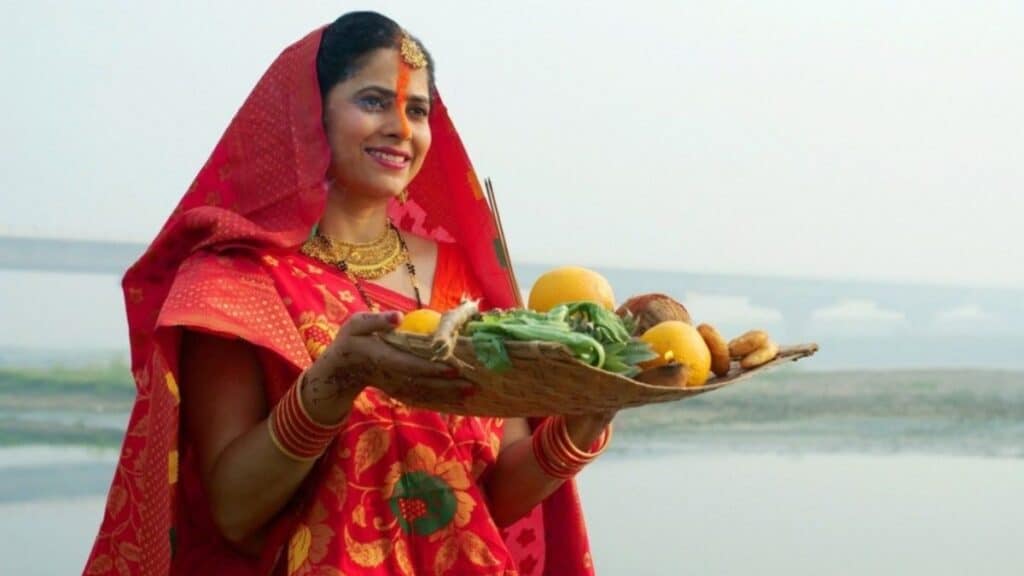
In today’s fast-changing world, Chhath Puja endures as testament to cultural continuity, environmental wisdom, and community strength. While elaborate temple ceremonies and commercialized festivals dominate, Chhath remains defiantly simple—demanding only pure intention, natural elements, and collective participation.
Its scientific foundation—optimizing beneficial solar energy exposure—merges seamlessly with spiritual devotion, demonstrating ancient India’s holistic worldview. The festival’s folk origins ensure accessibility; no priest, no scripture, no wealth required—just faith, discipline, and gratitude.
For diaspora communities, Chhath becomes a cultural anchor connecting second-generation Indians to ancestral roots through embodied practice. Standing in cold American lakes or British rivers, singing Bhojpuri songs, preparing thekua—these acts transcend geography, creating portable homeland.
As environmental consciousness grows globally, Chhath offers a blueprint for sustainable celebration through its rejection of waste, emphasis on natural materials, and reverence for water bodies.
The festival’s interfaith participation showcases India’s syncretic potential, where Muslims and Hindus collaboratively create sacred spaces. Chhath survives because it addresses eternal human needs: gratitude for nature’s bounty, community belonging, discipline’s spiritual rewards, and hope for family welfare.
Jai Chhathi Maiya! Jai Surya Dev!