
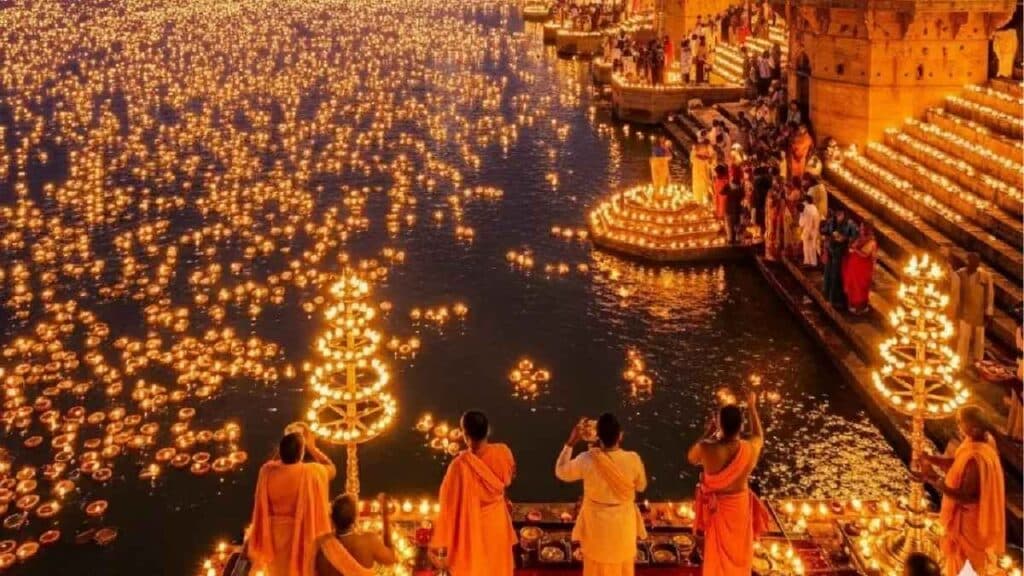
Kartik Purnima is one of the most sacred full moon nights in the Hindu calendar, celebrated on the fifteenth day of the bright fortnight of the lunar month of Kartika. Popularly known as Dev Diwali — the Festival of Lights of the Gods — it falls approximately fifteen days after Diwali and marks the culmination of an entire month of spiritual observance, fasting, pilgrimage, and lamp-lighting.
The festival commemorates Lord Shiva’s victory over the demon Tripurasura, the manifestation of Vishnu’s Matsya avatar, and the birthday of Kartikeya. It is also observed by Sikhs as Guru Nanak Jayanti and by Jains as a major pilgrimage day. On this night, thousands of earthen lamps are lit on riverbanks and temple ghats, miniature boats are floated on water, and devotees across India and the world gather in prayer and celebration.
Kartik Purnima is observed by Hindus, Sikhs, and Jains across India, Nepal, and countries worldwide including the USA, UK, Canada, UAE, Australia, and Singapore.
When Is Kartik Purnima in 2026?
Kartik Purnima 2026 falls on Tuesday, November 24, 2026.
- Moonrise on Purnima – 04:56 PM
- Purnima Tithi Begins – 11:42 PM on Nov 23, 2026
- Purnima Tithi Ends – 08:23 PM on Nov 24, 2026
Table of Contents
Kartik Purnima In USA, Canada, Australia, New Zealand, UK, UAE, Singapore 2026 Dates
Kartik Purnima on Tuesday, November 24, 2026
- Moonrise on Purnima – 04:15 PM
- Purnima Tithi Begins – 01:12 PM on Nov 23, 2026
- Purnima Tithi Ends – 09:53 AM on Nov 24, 2026
Kartik Purnima on Tuesday, November 24, 2026
- Moonrise on Purnima – 04:25 PM
- Purnima Tithi Begins – 01:12 PM on Nov 23, 2026
- Purnima Tithi Ends – 09:53 AM on Nov 24, 2026
Kartik Purnima on Tuesday, November 24, 2026
- Moonrise on Purnima – 07:46 PM
- Purnima Tithi Begins – 05:12 AM on Nov 24, 2026
- Purnima Tithi Ends – 01:53 AM on Nov 25, 2026
Kartik Purnima on Tuesday, November 24, 2026
- Moonrise on Purnima – 03:16 PM
- Purnima Tithi Begins – 06:12 PM on Nov 23, 2026
- Purnima Tithi Ends – 02:53 PM on Nov 24, 2026
Kartik Purnima on Tuesday, November 24, 2026
- Moonrise on Purnima – 05:06 PM
- Purnima Tithi Begins – 10:12 PM on Nov 23, 2026
- Purnima Tithi Ends – 06:53 PM on Nov 24, 2026
Kartik Purnima on Tuesday, November 24, 2026
- Moonrise on Purnima – 06:34 PM
- Purnima Tithi Begins – 02:12 AM on Nov 24, 2026
- Purnima Tithi Ends – 10:53 PM on Nov 24, 2026
Why Does the Date Change Every Year?
Kartik Purnima follows the Hindu lunisolar calendar and falls on the full moon of the month of Kartika. Because the lunar cycle of approximately 29.5 days does not align with the Gregorian solar calendar, the date shifts by 10 to 11 days each year, with occasional leap month corrections to keep it within seasonal alignment. It typically falls between late October and late November.
Kartik Purnima Overview
Kartik Purnima is celebrated on the full moon day of Kartika, the eighth and holiest lunar month in the Hindu calendar. The month of Kartika holds special significance in both Vaishnava and Shaivite traditions, and its final day — Purnima — is considered its spiritual peak.
The day draws together multiple strands of Hindu mythology and marks the conclusion of several month-long vows including Kartika Snana (pre-dawn river bathing), Bhishma Panchaka fasting, and the Tulasi Vivah ceremony. It also marks the end of Chaturmasya — the four-month cosmic sleep of Vishnu — making it a time of cosmic renewal and divine return.
Whether through the spectacle of Dev Diwali at Varanasi’s ghats, the maritime commemoration of Boita Bandana in Odisha, or the Jain pilgrimage at Palitana, Kartik Purnima holds living traditions that span India’s full cultural breadth.
Other Names and Regional Identities
Kartik Purnima is known by many names across India’s linguistic and regional communities.
| Name | Language / Region |
|---|---|
| Kartik Purnima / Kartika Purnima | Hindi, Sanskrit, pan-India |
| Kartika Pournami | Telugu, Tamil, Kannada |
| Tripuri Purnima / Tripurari Purnima | North India, Shaivite tradition |
| Dev Diwali / Deva-Deepawali | Hindi belt, Varanasi |
| Karthika Deepam | Tamil Nadu, Kerala, Sri Lanka |
| Boita Bandana | Odisha |
| Guru Purab / Prakash Parva | Sikh communities |
| Kartik Poornima | Rajasthan, Gujarat |
| Damodara Purnima | Vaishnava communities |
In diaspora communities and internationally, the festival is most commonly referred to as Kartik Purnima or Dev Diwali, with global visibility growing through Varanasi’s televised ghat celebrations.
Origins, History, and Legends
Kartik Purnima is rooted in multiple mythological traditions, each drawn from ancient Puranic scripture.
The most widely known legend is Shiva’s destruction of Tripurasura. The three demon sons of Tarakasura had built three indestructible flying cities — called Tripura — and conquered the heavenly and earthly realms. The gods appealed to Shiva, who destroyed all three cities with a single arrow, using Mount Meru as a bow and the serpent Vasuki as its string. Overjoyed, the gods declared the day a festival of illumination. This is why Shiva bears the name Tripurantaka, Destroyer of Tripura, and the day is called Dev Diwali — the Diwali of the Gods.
Kartik Purnima also commemorates Matsya, Vishnu’s first avatar — the divine fish who saved the Vedas from a great deluge. It is additionally the manifestation day of Vrinda, the personification of the sacred Tulasi plant, as described in the Brahma Vaivarta Purana.
In South India, the day is celebrated as the birthday of Kartikeya, the son of Shiva and the god of war, after whom the month of Kartika is named.
Among Sikhs, this day is observed as Guru Nanak Jayanti — the birth anniversary of Guru Nanak Dev Ji, the founder of Sikhism, though some scholars note historical debate around this association.
Scholars also suggest that Kartik Purnima may have pre-Puranic roots in an ancient Vedic sacrifice called Shakamedhah, performed to secure victory over enemies, which was later recast within Puranic mythology.
Cultural and Spiritual Significance
Kartik Purnima holds a place of extraordinary sanctity in Hindu tradition. The month of Kartika is widely regarded as the holiest lunar month, and Purnima — its final day — is its spiritual peak.
The day carries immense astrological significance. When Kartik Purnima coincides with the Krittika nakshatra, it is called Maha Kartika and considered exceptionally meritorious. Any act of charity, worship, or pilgrimage on this day is traditionally believed to yield the spiritual benefit of performing ten yajnas (sacred fire rituals).
Symbolically, the lighting of thousands of lamps on this night represents the victory of light over darkness, the return of the divine, and the illumination of the inner self. The festival also marks the end of Chaturmasya — the period of Vishnu’s cosmic sleep — signifying renewal, divine awakening, and the resumption of auspicious activities.
Prayers and Religious Observances
Kartika Snana (Pre-Dawn Bathing) The month-long ritual of bathing in a holy river or lake before sunrise culminates on Kartik Purnima. The most auspicious sites are the Ganges at Varanasi and Pushkar Lake in Rajasthan. This ritual is believed to cleanse the devotee of sins and lead to liberation.
Lamp Offerings 360 or 720 oil wicks are lit at temples and on riverbanks — the 720 wicks symbolizing the 360 days and 360 nights of the Hindu calendar year. Deepmalas (towers of lamps) are illuminated at temple complexes. Lamps are floated in miniature clay boats on rivers and placed under Tulasi, sacred fig, and amla trees.
Tulasi Vivah Kartik Purnima is the final auspicious day to perform Tulasi Vivah — the ceremonial marriage of the Tulasi plant to Shaligram, a sacred representation of Vishnu. This ceremony can be held from Prabodhini Ekadashi through Purnima.
Bhishma Panchaka Fasting The five-day fast observed in Vaishnava tradition from Ekadashi to Purnima — also called Vishnu Panchaka — concludes on Kartik Purnima and is among the most important fasts in Vaishnavism.
Worship of Shiva and Vishnu Processions carrying images of Shiva commemorate his victory over Tripurasura. Special pujas for Vishnu are held alongside Shiva at temples, especially following Vaikuntha Chaturdashi the day prior. Evening prayers are offered at moonrise.
Charitable Acts Donating cows, feeding Brahmins, offering gold and oil lamps to priests, and fasting are prescribed acts of charity. All forms of violence — including cutting of hair, trees, and crops — are prohibited on this day.
Celebrations Across India
Regional expressions of Kartik Purnima reflect India’s extraordinary diversity.
Varanasi, Uttar Pradesh hosts the most spectacular Dev Diwali in the country. All 84 ghats of the Ganges are illuminated with hundreds of thousands of diyas, and grand Ganga Aarti is performed while devotees float lamps on the river. This sight draws visitors from across India and the world.
Pushkar, Rajasthan holds the Pushkar Fair — Asia’s largest camel fair — drawing approximately 200,000 people and 25,000 camels. The fair concludes on Kartik Purnima, when a bath in Pushkar Lake is believed to grant moksha. The fair is held in honor of Brahma, whose only major temple in India stands here.
Odisha celebrates Boita Bandana, a beloved tradition of maritime memory. Families head to the nearest water body at dawn and set afloat miniature boats of banana stem, coconut sticks, and betel leaves lit with lamps, commemorating the ancient seafarers of Kalinga who traded with Bali, Java, and Sumatra. The entire Kartika month in Odisha is observed with strict vegetarianism, culminating in the five-day Panchuka festival.
Tamil Nadu celebrates Karthika Deepam, especially when Purnima coincides with the Krittika nakshatra. In Tiruvannamalai, a ten-day festival culminates in a massive bonfire lit atop Arunachala Hill. Rows of lamps light balconies and courtyards across the state.
Andhra Pradesh and Telangana observe the entire Kartika Maasamu as sacred. On Purnima, 365-wick lamps prepared at home are lit in Shiva temples. Kartika Puranam is read and fasting is maintained until sunset through the month.
Pandharpur, Maharashtra concludes its Prabodhini Ekadashi fair on Kartik Purnima, drawing thousands of Warkari pilgrims.
Participation Across Religions in India
Kartik Purnima is observed across multiple faiths, reflecting India’s pluralistic spiritual culture.
Hindus form the largest group of observers, with traditions spanning Shaivite, Vaishnava, Shakta, and regional folk practices. The day’s mythological connections to Shiva, Vishnu, Brahma, and Kartikeya simultaneously make it a rare pan-Hindu occasion.
Jains mark Kartik Purnima as a major pilgrimage day at Palitana, associating it with Adinath, the first tirthankara, who is believed to have delivered his first sermon on the Shatrunjay hills. Thousands of Jain pilgrims undertake a 216 km walking pilgrimage to the Adinath temple on this day.
Sikhs observe it as Guru Nanak Jayanti with prayers, Nagar Kirtan processions, and community langar at Gurudwaras worldwide.
The Swaminarayan Sampradaya also celebrates this day with special prayers and community gatherings.
Global and Diaspora Celebrations
Indian diaspora communities around the world observe Kartik Purnima with devotion adapted to their local context. As November 24, 2026 falls on a Tuesday, many communities hold celebrations on the preceding weekend — Saturday, November 21 or Sunday, November 22 — for broader participation.
In the USA and Canada, Hindu temples in New York, Chicago, Houston, Toronto, and Vancouver organize Dev Diwali events with lamp-lighting, Ganga Aarti recreations, and cultural programs. Sikh communities hold large Nagar Kirtan processions for Guru Nanak Jayanti.
In the United Kingdom, temples in Leicester, London, Birmingham, and Southall hold Kartik Purnima pujas and lamp-lighting events. Sikh Guru Nanak Jayanti processions are among Europe’s largest.
In the UAE, Indian communities in Dubai and Abu Dhabi observe the festival through temple gatherings and community aarti events.
In Australia and New Zealand, Hindu and Sikh associations in Sydney, Melbourne, Brisbane, and Auckland organize temple prayers and cultural celebrations, with some communities hosting floating lamp events near waterways.
In Germany and Singapore, Indian cultural associations organize Kartik Purnima prayers combined with cultural programming.
Gifting Traditions
Traditional Kartik Purnima gifting centers on devotion and spiritual merit. The most meaningful gifts are:
Oil lamps (diyas) — offered to priests, temples, and neighbors, symbolizing the light of knowledge and divine grace. Giving a lamp on Kartik Purnima is among the most meritorious acts prescribed in Hindu texts.
Gold — even a token offering of gold is said to fulfill all desires and bestow liberation.
Prasad and sweets — sharing food offerings prepared for Annakuta or homemade festive sweets with neighbors and family is a common and cherished practice.
In diaspora communities and urban India, gifting has evolved to include decorative brass or clay diya sets, Tulasi plant saplings, religious books, and festival hampers with sweets and dry fruits. Eco-friendly handcrafted lamp sets are increasingly popular, combining spiritual tradition with environmental awareness.
Kartik Purnima Foods and Culinary Traditions
Kartik Purnima falls during a month of fasting and satvik (pure) eating, and the foods of this festival reflect both restraint and celebration.
Many devout Hindus — particularly in Odisha and Andhra Pradesh — observe strict vegetarianism through the entire Kartika month. Foods prepared for Purnima exclude onion, garlic, and non-vegetarian ingredients.
Kheer (rice pudding) is a classic Purnima dish, traditionally prepared with the full moon’s milk and shared as prasad. Panchamrit — a sacred mixture of milk, curd, honey, ghee, and sugar — is prepared for ritual abhishek of deities. Malpua, sweet fried pancakes, are a festive offering across northern and eastern India. Annakuta — a grand offering of dozens of dishes to the deity — is presented at temples and distributed as prasad.
In Odisha, traditional rice-based sweets and pitha are prepared during the Panchuka period, and the first non-vegetarian meal after the Kartika month — called Chhada Khai — is itself a cherished cultural moment for Odia families.
Music, Art, and Cultural Expression
Kartik Purnima has a rich cultural dimension that extends beyond temple rituals.
In Vaishnava tradition, the night is associated with Krishna’s Raas Lila — the divine circle dance with Radha and the gopis. Performances of Raas Lila are organized at Jagannath Temple in Puri and at Radha-Krishna temples in Vrindavan and Mathura.
In Odisha, the Boita Bandana ceremony is accompanied by folk songs about the ancient Kalinga seafarers — songs unique to Odia cultural memory that have been preserved across generations.
Bhajans and kirtans dedicated to Shiva, Vishnu, Kartikeya, and Guru Nanak fill temples and community spaces on this night. The illumination of ghats and the arrangement of thousands of floating lamps in geometric patterns on rivers represents a living art tradition that is instantly recognizable and globally celebrated.
In Sikh communities, Nagar Kirtan — devotional processions through city streets with the singing of Gurbani — is the primary cultural and musical expression of Guru Nanak Jayanti.
Modern Observance and Evolving Practices
Kartik Purnima has adapted gracefully to contemporary life while preserving its spiritual core.
The tradition of floating lamps on rivers has prompted growing awareness around environmental responsibility. Many communities now actively promote biodegradable alternatives — clay diyas, banana stem boats, and natural materials — echoing Odisha’s traditional Boita Bandana craft. Several city administrations organize eco-friendly Dev Diwali events at ghats and waterways.
Live streaming of the Ganga Aarti from Varanasi on Dev Diwali night has made this festival globally accessible, with millions in the diaspora watching in real time from New York, London, Toronto, and Melbourne.
In countries where November 24 falls mid-week in 2026, community organizations shift celebrations to the preceding weekend, combining religious observance with cultural programs and shared meals.
How to wish someone on Kartik Purnima: “Kartik Purnima ki shubhkamnayein” | “Happy Dev Diwali” | “Shubh Kartik Purnima” | “Subha Kartika Purnima” (Odia) | “Karthika Deepam Vazhthukkal” (Tamil)
Cultural Reflection
Kartik Purnima endures because it speaks to something timeless — the victory of light over darkness, the return of the divine, and the human impulse to gather, to illuminate, and to give thanks. Whether it is a devotee completing a month of pre-dawn bathing in the Ganges, an Odia family floating a tiny banana-stem boat at dawn, a Jain pilgrim climbing the Shatrunjay hills in darkness, or a Sikh community marching in Nagar Kirtan through Toronto’s streets — Kartik Purnima holds many communities together under one full moon. Its light, quite literally, belongs to everyone.