
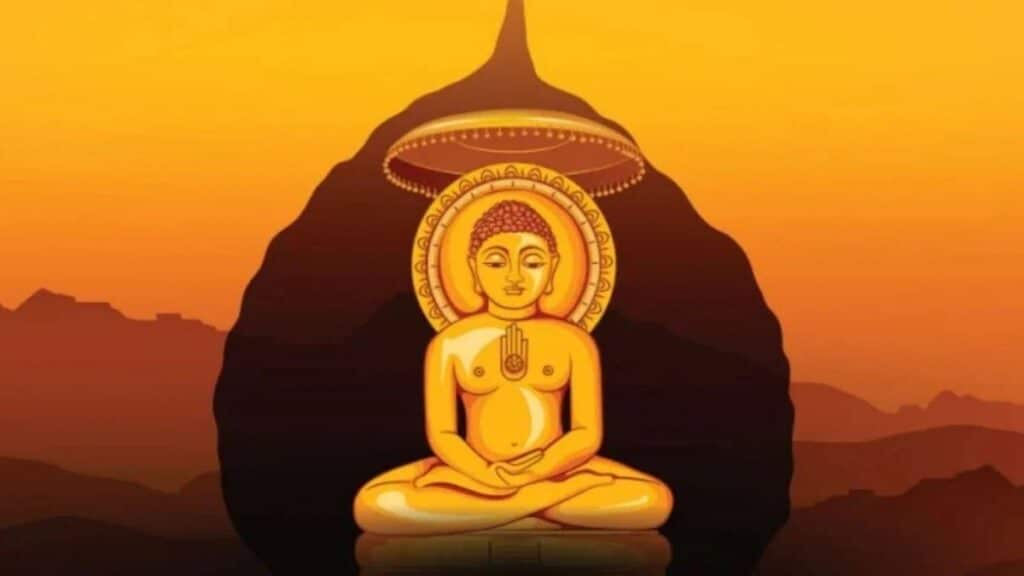
Mahavir Jayanti is one of the most sacred festivals in Jainism, celebrating the birth of Lord Mahavira — the 24th and last Tirthankara (supreme preacher) of the present cosmic era. Observed with deep reverence by Jains across India and the world, this day marks the life of the spiritual teacher who established the core tenets of Jain philosophy: non-violence, truthfulness, and compassion toward all living beings.
The festival commemorates the birth of Vardhamana Mahavira, born in 599 BCE in Kundagrama, Bihar, who renounced royal life to pursue spiritual truth and ultimately attained omniscience (Kevala Jnana). His teachings on Ahimsa (non-violence), Satya (truth), and Aparigraha (non-possessiveness) continue to guide millions of Jains worldwide.
Mahavir Jayanti is a national public holiday in India and is observed with temple rituals, chariot processions (Rath Yatras), charitable acts, prayers, and fasting. Beyond Jainism, its universal message of peace and non-violence resonates with people of all backgrounds.
When Is Mahavir Jayanti Celebrated in 2026?
Mahavir Jayanti is observed on the 13th day of the bright fortnight (Shukla Paksha Trayodashi) of the Hindu month of Chaitra, falling in March or April each year.
Mahavir Jayanti 2026 Date in India
Mahavir Jayanti will be celebrated on Tuesday, March 31, 2026 in India. This marks the 2,624th birth anniversary of Lord Mahavira.
Panchang Timings (IST, New Delhi): Trayodashi Tithi Begins: 07:09 AM on March 30, 2026 Trayodashi Tithi Ends: 06:55 AM on March 31, 2026
Note: In Panchang tradition, the day begins at sunrise. Since Trayodashi is prevailing at sunrise on March 31, the festival is observed that day.
Table of Contents
Mahavir Jayanti In USA, Canada, Australia, New Zealand, UK, UAE, Singapore 2026 Dates
Mahavir Jayanti on Monday, March 30, 2026
- Trayodashi Tithi Begins – 09:39 PM on Mar 29, 2026
- Trayodashi Tithi Ends – 09:25 PM on Mar 30, 2026
Mahavir Jayanti on Monday, March 30, 2026
- Trayodashi Tithi Begins – 09:39 PM on Mar 29, 2026
- Trayodashi Tithi Ends – 09:25 PM on Mar 30, 2026
Mahavir Jayanti on Tuesday, March 31, 2026
- Trayodashi Tithi Begins – 12:39 PM on Mar 30, 2026
- Trayodashi Tithi Ends – 12:25 PM on Mar 31, 2026
Mahavir Jayanti on Monday, March 30, 2026
- Trayodashi Tithi Begins – 02:39 AM on Mar 30, 2026
- Trayodashi Tithi Ends – 02:25 AM on Mar 31, 2026
Mahavir Jayanti on Monday, March 30, 2026
- Trayodashi Tithi Begins – 05:39 AM on Mar 30, 2026
- Trayodashi Tithi Ends – 05:25 AM on Mar 31, 2026
Mahavir Jayanti on Tuesday, March 31, 2026
- Trayodashi Tithi Begins – 09:39 AM on Mar 30, 2026
- Trayodashi Tithi Ends – 09:25 AM on Mar 31, 2026
Why Does Mahavir Jayanti Change Dates Every Year?
Mahavir Jayanti follows the Hindu lunisolar calendar, not the Gregorian calendar. It falls on Chaitra Shukla Trayodashi, which shifts by approximately 10–11 days annually relative to the solar calendar.
In 2025, it fell on April 10; in 2026, it moves earlier to March 31. This is why Jain and Hindu festivals do not have fixed Gregorian dates.
Mahavir Jayanti Other Names and Regional Identities
- Hindi: महावीर जयंती (Mahavir Jayanti)
- Gujarati: મહાવીર જન્મ કલ્યાણક (Mahavir Janma Kalyanak)
- Tamil: மகாவீர் ஜயந்தி (Mahavir Jayanti)
- Kannada: ಮಹಾವೀರ ಜಯಂತಿ (Mahavira Jayanti)
- Telugu: మహావీర్ జయంతి (Mahavir Jayanti)
- Marathi: महावीर जयंती (Mahavir Jayanti)
- Bengali: মহাবীর জয়ন্তী (Mahaveer Jayanti)
Formal Jain name: Mahavira Janma Kalyanaka — one of the five Pancha Kalyanakas (supremely auspicious events) in a Tirthankara’s life.
In diaspora communities across the USA, UK, Canada, and Australia, it is commonly referred to as Mahavir Jayanti, Mahavir Janma Kalyanaka, or Lord Mahavira’s Birthday.
Origins, History, and Legends of Mahavir Jayanti
Mahavira was born in 599 BCE to King Siddhartha and Queen Trishala of Kundagrama, in the democratic Vajji republic (present-day Bihar). He was named Vardhamana, meaning “One who grows,” reflecting the prosperity witnessed in the kingdom at his birth.
Before his birth, Queen Trishala experienced a series of auspicious dreams. The Shvetambara sect holds she saw 14 dreams; the Digambara sect holds she saw 16 — both signifying the arrival of a great spiritual soul. At the moment of Mahavira’s birth, Indra, king of the celestial beings, performed the sacred abhisheka (ritual anointing) on Mount Sumeru — the second of the five Pancha Kalyanakas in a Tirthankara’s life.
At age 30, Mahavira renounced his royal life and undertook twelve years of rigorous austerity and meditation, attaining Kevala Jnana (omniscience) at age 42. He preached for 30 years, systematizing the Jain philosophical tradition found in the Agamas (Jain scriptures). He attained Nirvana at Pavapuri, Bihar, in 527 BCE at the age of 72.
His core teachings — the Five Principles of Ahimsa, Satya, Asteya, Brahmacharya, and Aparigraha — and the philosophical doctrine of Anekantavada (many-sidedness of truth) remain the foundational pillars of Jainism today.
Mahavir Jayanti: Cultural and Spiritual Significance
Mahavir Jayanti is far more than a birthday commemoration — it is a global reaffirmation of the Jain way of life and a renewed commitment to Mahavira’s teachings.
Spiritually, the festival invites reflection on the Five Principles: Ahimsa (non-violence), Satya (truth), Asteya (non-stealing), Brahmacharya (celibacy/fidelity), and Aparigraha (non-possessiveness). It is a time to internalize non-violence not just in action but in thought and speech toward all living beings.
Culturally, Mahavir Jayanti promotes compassion, equality, and service. The Jain community’s tradition of charitable giving — feeding the poor, freeing animals, donating to education — reflects the living practice of Ahimsa.
The festival is also philosophically significant: Mahavira’s Anekantavada teaches tolerance and humility toward differing perspectives, a message deeply relevant in today’s polarized world.
Mahavir Jayanti Prayers and Religious Observances
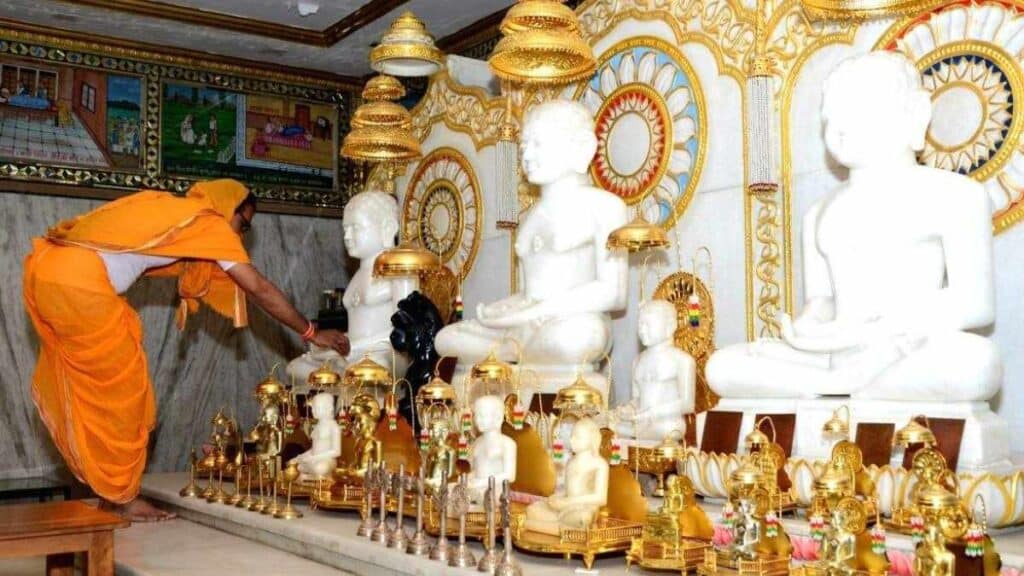
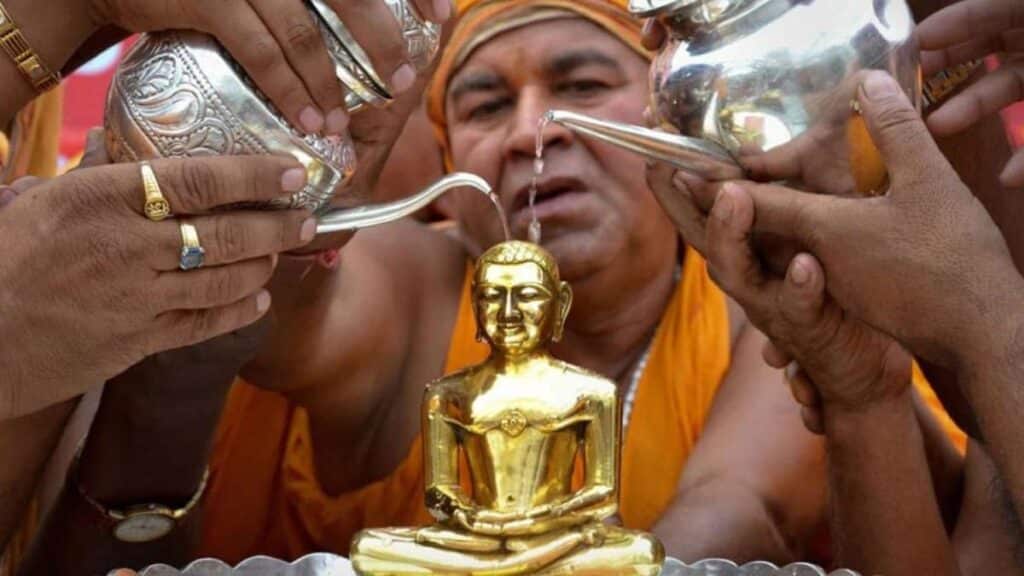
Jains rise early, bathe, and visit temples dressed in white — the color of purity. The main ritual is the Abhisheka, a ceremonial bathing of Mahavira’s idol with sacred water, milk, saffron, sandalwood paste, and flowers, while mantras are chanted. This mirrors the divine abhisheka performed by Indra at Mahavira’s birth.
The Navkar Mantra — the most sacred prayer in Jainism — is recited throughout the day. It pays homage to the five supreme beings representing spiritual perfection:
Namo Arihantanam | Namo Siddhanam | Namo Ayariyanam | Namo Uvajjhayanam | Namo Loe Savva Sahunam
Jain monks and nuns deliver pravachans (discourses) in temples and community halls, expounding Mahavira’s teachings on the soul, karma, and the path to liberation. Stavans (devotional hymns) fill temples throughout the day. Many devotees observe partial or complete fasting as a form of spiritual discipline and purification.
How Mahavir Jayanti Is Celebrated Across India
While the spirit of Mahavir Jayanti is universal, its expressions vary across regions.
In Gujarat and Rajasthan — the heartland of India’s Jain community — grand Rath Yatras carry beautifully decorated idols of Mahavira through city streets, with devotees walking alongside, chanting stavans and waving flags. Jain temples are illuminated with lights and flowers throughout the day.
In Mumbai and Maharashtra, community kitchens (bhojanshala) serve free meals to the poor, and Ahimsa rallies are organized across neighborhoods.
In Delhi and NCR, temples in Chandni Chowk, Sadar Bazaar, and South Delhi host processions, lectures, and charitable drives. As a national gazetted holiday, offices and many schools remain closed.
In Bihar — Mahavira’s birthplace — Kundagrama near Vaishali and Pavapuri attract thousands of pilgrims. The Jal Mandir at Pavapuri, where Mahavira attained Nirvana, becomes a hub of devotion and reflection.
Participation Across Religions in India
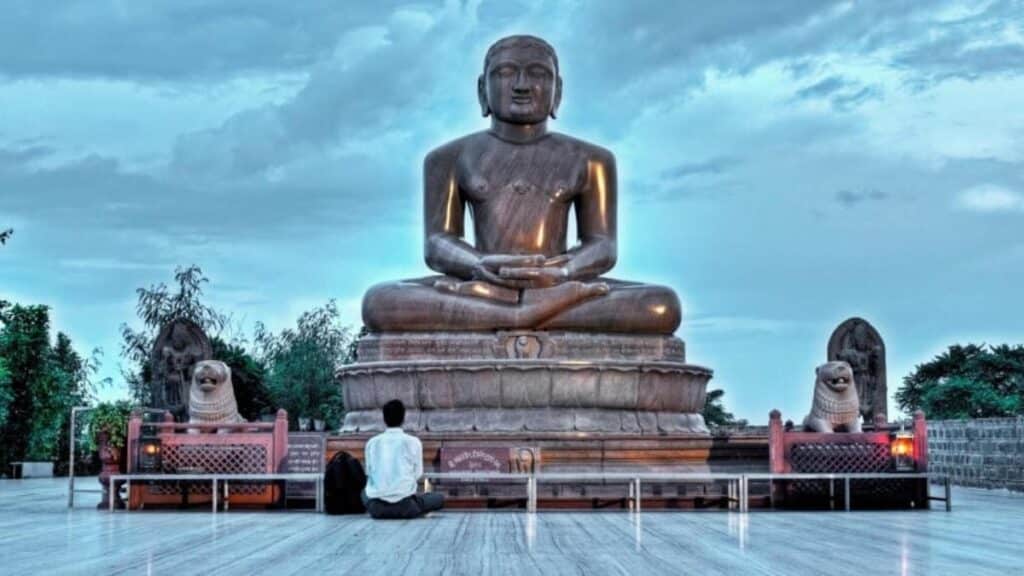
Mahavir Jayanti’s message of Ahimsa and compassion extends well beyond Jainism. Hindus — who share deep philosophical affinities with Jains around vegetarianism, karma, and temple devotion — frequently visit Jain temples or join local processions on this day.
Gandhi’s concept of non-violence, central to India’s independence movement, drew extensively from Jain philosophy, making Mahavir Jayanti resonate widely across Indian civil society. Charitable activities — feeding the poor, rescuing animals, donating to education — are undertaken with open invitations regardless of faith, reinforcing the spirit of shared humanity.
How Mahavir Jayanti Is Celebrated Outside India
Indian diaspora communities across the USA, UK, Canada, UAE, Australia, and beyond observe Mahavir Jayanti through:
- Community temple rituals and Abhisheka ceremonies
- Pravachans (discourses) by Jain scholars and monks
- Cultural programs, stavan singing, and art exhibitions
- Ahimsa workshops, youth programs, and charitable drives
- Public celebrations with Rath Yatra processions in larger cities
In the USA, organizations like JAINA (Federation of Jain Associations in North America) coordinate events in cities including New Jersey, Chicago, Houston, and Los Angeles. Since March 31, 2026 falls on a Tuesday, diaspora communities in Western countries may organize extended celebrations over the weekend of April 4–5.
In the UK, communities in Leicester, London, and Coventry host events through Jain Samaj and Jain Network UK. Similar community-organized observances take place in Canada (Toronto, Vancouver), UAE (Dubai), Australia (Melbourne, Sydney), and Singapore.
Mahavir Jayanti Gifting Traditions
Mahavir Jayanti is rooted in giving rather than gift exchange. Donating to Jain institutions, funding education for the underprivileged, contributing to animal welfare organizations, and giving to food banks are all considered deeply auspicious acts of generosity.
Gifting copies of Jain scriptures, books on Mahavira’s life, or philosophical texts on Ahimsa is a valued tradition, particularly for younger family members. At temples, prasad (offerings of dry fruits, mishri, or fruits) is distributed among family, friends, and neighbors.
In modern diaspora communities, sustainable products, organic foods, meditation items, or charitable donations in someone’s name have become thoughtful expressions of the festival’s spirit.
Mahavir Jayanti Foods and Culinary Traditions

Jain dietary ethics are among the most distinctive in the world. Mahavir Jayanti is observed with strict adherence to Jain vegetarianism, which excludes not only meat, fish, and eggs but also root vegetables such as onions, garlic, and potatoes that harm microorganisms when harvested.
Common Mahavir Jayanti foods include:
- Sabudana Khichdi and Sabudana Vada — sago-based dishes popular as fast-friendly foods
- Makhane ki Kheer — a festive sweet pudding made from fox nuts, milk, and sugar
- Farali Pattice — a Gujarati Jain snack of raw banana or sweet potato with coconut stuffing
- Dry Fruit Barfi — sweet confections of cashews, almonds, and pistachios offered as prasad
- Puranpoli — a sweet flatbread with jaggery-lentil filling, prepared in Maharashtrian Jain homes
All foods are prepared without root vegetables — a direct expression of Ahimsa in daily life.
Mahavir Jayanti: Music, Art, and Cultural Expression
Stavans — devotional hymns composed in Gujarati, Hindi, Rajasthani, Kannada, and other languages — fill temples and community spaces on Mahavir Jayanti. These range from simple melodic prayers to elaborate compositions performed by trained vocalists, serving as both devotion and cultural identity.
Jain classical art — intricate manuscript paintings, bronze Tirthankara sculptures, and ornate temple carvings — depicts the life of Mahavira. Museums and temples display these on Mahavir Jayanti, connecting communities to a rich artistic heritage spanning centuries.
Homes and temples are decorated with rangoli featuring Jain symbols: the Swastika (auspiciousness), the Jain hand (Ahimsa), and the Ashtamangala (eight auspicious symbols). Theatrical enactments of Mahavira’s life are staged in many communities, particularly for children.
Mahavir Jayanti’s Modern Relevance and Cultural Continuity

More than 2,600 years after his birth, Mahavira’s teachings remain strikingly relevant. In a world grappling with violence, inequality, and environmental crisis, his call for Ahimsa — not just as a religious principle but as a philosophy of engaging with all of life — carries an urgency that transcends faith.
For Jain communities worldwide, Mahavir Jayanti is a thread of cultural continuity — a way of staying connected to roots, language, and community across generations and geographies. It is an annual invitation to pause, reflect, and recommit to the values of non-violence, compassion, and truth.
Mahavir Jayanti’s enduring relevance lies in its ability to adapt while staying true to its essence — celebrating a life devoted to the liberation of all souls.
Jai Jinendra.