
Muharram is the first and one of the most sacred months of the Islamic lunar calendar. Its name means “forbidden” or “sacred” in Arabic — referring to its status as one of the four months in which warfare is strictly prohibited, a tradition that predates Islam itself. The month marks the beginning of the Islamic New Year and culminates on its tenth day, Ashura, which holds deep spiritual significance for Muslims worldwide.
Rooted in both Quranic decree and centuries of tradition, Muharram encompasses themes of justice, sacrifice, renewal, and devotion. For Shia Muslims, the month is defined by mourning the martyrdom of Imam Hussain ibn Ali at the Battle of Karbala in 680 CE. For Sunni Muslims, Ashura is a day of gratitude commemorating the miraculous salvation of Prophet Musa (Moses) and the Children of Israel. Together, these traditions make Muharram a month of profound remembrance observed by 1.8 billion Muslims across the world.
When Is Muharram in 2026?
Muharram follows the Islamic lunar calendar, so its dates shift approximately 10–11 days earlier each Gregorian year.
Muharram 2026 Dates in India:
- 1st Muharram (Islamic New Year): Tuesday, June 16, 2026
- 9th Muharram (Tasu’a): Thursday, June 25, 2026
- 10th Muharram (Ashura): Friday, June 26, 2026
All dates are subject to official moon sighting confirmation.
Table of Contents
Muharram In USA, Canada, Australia, New Zealand, UK, UAE, Singapore 2026 Dates
Muharram on Friday, June 26, 2026
Muharram on Friday, June 26, 2026
Muharram on Friday, June 26, 2026
Muharram on Friday, June 26, 2026
Muharram on Friday, June 26, 2026
Muharram on Friday, June 26, 2026
Why Do Muharram Dates Change Every Year?
Muharram is observed according to the Islamic lunar (Hijri) calendar, not the Gregorian solar calendar. The lunar year is approximately 10–11 days shorter than the solar year, which means Muharram shifts earlier each year, cycling through all seasons over roughly 33 years. The precise start of the month depends on the physical sighting of the crescent moon (hilal), which may differ by one day between countries based on geography and local religious rulings.
Muharram Overview – What Is It and Who Observes It?
Muharram is the first month of the 12-month Islamic calendar and one of four sacred months mentioned in the Quran (Surah At-Tawbah, 9:36). It is called “Shahr Allah” — the Month of Allah — an honor given to no other month in Islamic tradition. The Prophet Muhammad ﷺ said: “The most virtuous fasting after the month of Ramadan is that of Allah’s month of Al-Muharram.” (Hadith | Tirmidhi)
The month is observed globally by both Sunni and Shia Muslim communities, with the 10th day — Ashura — being its spiritual peak. Muharram also commemorates the Hijrah, the historic migration of the Prophet ﷺ from Makkah to Madinah in 622 CE, which marks the beginning of the Islamic calendar itself.
Other Names and Regional Identities
While “Muharram” is the universally recognized name, the month and its key observance are known by various names across Indian languages and regional communities.
| Language | Name | Script |
|---|---|---|
| Arabic | Al-Muharram | ٱلْمُحَرَّم |
| Urdu / Hindi | Muharram | محرم / मुहर्रम |
| Persian | Moharram | محرم |
| Bengali | Mohorom | মহরম |
| Tamil | Muharram | முஹர்ரம் |
| Telugu | Maharram | మహర్రం |
| Kannada | Moharam | ಮೊಹರಂ |
| Gujarati | Moharram | મોહર્રમ |
| Marathi | Moharram | मोहर्रम |
| Malayalam | Muharram | മുഹർറം |
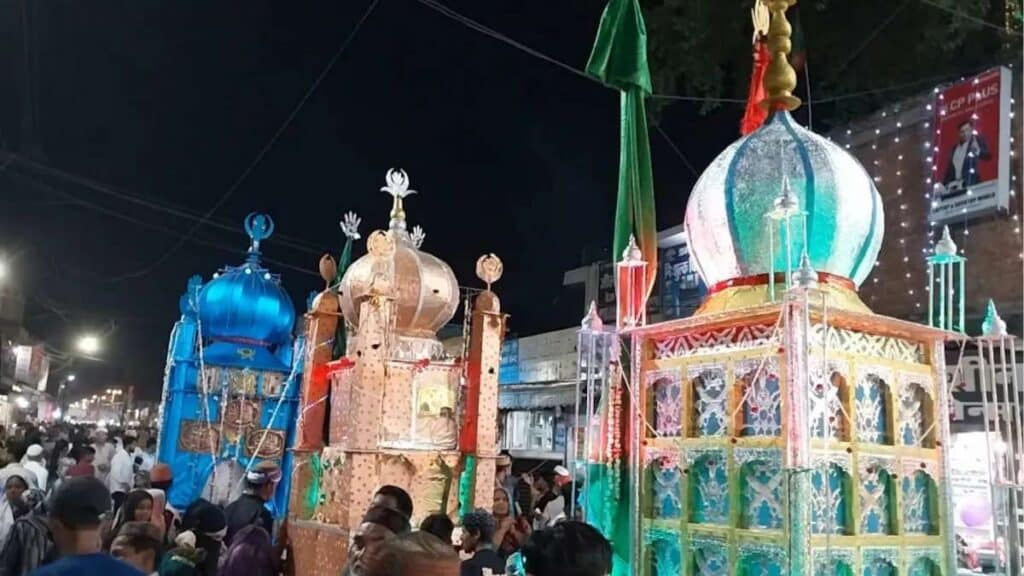
The 10th day is universally known as Ashura (يَوْم عَاشُورَاء). The 9th day is called Tasu’a. In South Asian communities, Muharram processions are often called Tazia processions, named after the ornate replicas of Hussain’s tomb carried through the streets. In Trinidad and Tobago, the tradition is known as Hosay.
Origins, History, and Legends
Pre-Islamic Roots Muharram’s sanctity predates Islam. In ancient Arab tradition, it was one of four sacred months during which all tribal warfare was forbidden, enabling safe passage for trade and pilgrimage. Over time, the word “Muharram” — meaning forbidden — came to be the month’s name itself, distinguishing “sacred Safar” from regular Safar.
The Hijrah — Anchor of the Islamic Calendar The Islamic Hijri calendar begins with the Hijrah — Prophet Muhammad ﷺ’s migration from Makkah to Madinah in 622 CE. This event, marking the birth of the first Muslim community, is commemorated on the 1st of Muharram as the Islamic New Year. The calendar was formally established during the caliphate of Umar ibn al-Khattab around 638 CE.
The Battle of Karbala (680 CE) The most defining event of Muharram is the Battle of Karbala, fought on the 10th of Muharram, 61 AH (October 10, 680 CE) in present-day Iraq. Imam Hussain ibn Ali, grandson of Prophet Muhammad ﷺ, refused on moral grounds to pledge allegiance to the tyrannical Umayyad Caliph Yazid ibn Mu’awiya. With a small group of family members and companions — fewer than 100 people — Hussain was intercepted by a Umayyad army of thousands. Access to the Euphrates river was cut off on the 7th of Muharram, leaving the camp without water. After failed negotiations, the Battle of Karbala was fought on Ashura. By day’s end, Hussain and most of his male companions were martyred. The women and children were taken prisoner and marched to Damascus. This event is the spiritual heart of Shia Islam and a universal symbol of standing against oppression.
The Story of Prophet Musa (AS) In Sunni tradition, Ashura commemorates the day Prophet Musa (Moses) and the Israelites were saved from Pharaoh by the parting of the Red Sea. When the Prophet ﷺ arrived in Madinah and learned that Jews fasted on this day in gratitude, he too fasted and encouraged believers to observe the same.
Cultural and Spiritual Significance
Muharram holds a rare dual character — it is simultaneously a month of spiritual elevation and solemn mourning. As one of the four sacred months, good deeds carry greater reward and wrongdoings carry greater weight during Muharram.
For Shia Muslims, the month is inseparable from the tragedy of Karbala. Hussain’s stand is understood not merely as history, but as a timeless moral statement — a refusal to submit to injustice even at the cost of one’s life. Mourning Hussain is considered an act of spiritual solidarity and protest against all forms of oppression. As the traditional saying goes: “Every day is Ashura, every land is Karbala.”
For Sunni Muslims, Muharram is a time of voluntary worship, fasting, gratitude, and Quranic recitation — an opportunity to begin the Islamic year in devotion and reflection.
Across both traditions and in broader South Asian culture, Muharram stands as a festival of conscience — one that asks each generation to reexamine its relationship with truth, justice, and sacrifice.
Prayers and Religious Observances
Fasting on Ashura Fasting on the 10th of Muharram is among the most recommended voluntary (nafl) acts in Islam. The Prophet ﷺ stated it expiates the sins of the previous year. Scholars recommend pairing it with a fast on the 9th or 11th to distinguish Muslim practice.
Shia Observances — The Ten Days of ‘Azadari For Shia Muslims, the first ten days of Muharram are a period of mourning, communal gathering, and remembrance, including:
- Majalis: Evening gatherings in mosques and imambaras where scholars recount Karbala through sermons and elegies, moving audiences to collective grief and reflection.
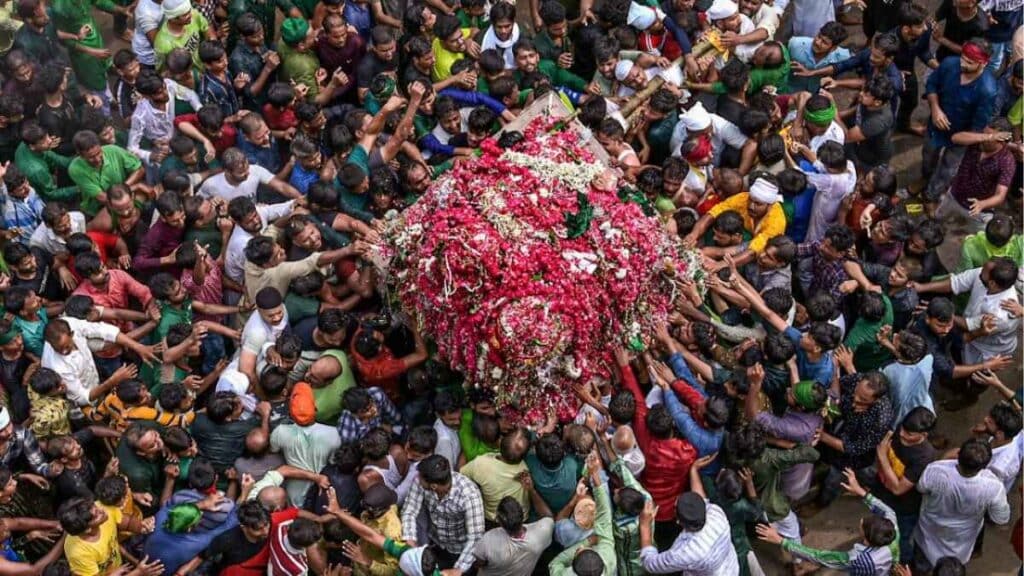
- Processions (Juloos): Community marches on Ashura with participants in black attire chanting “Ya Hussain,” carrying symbolic banners and Tazias.
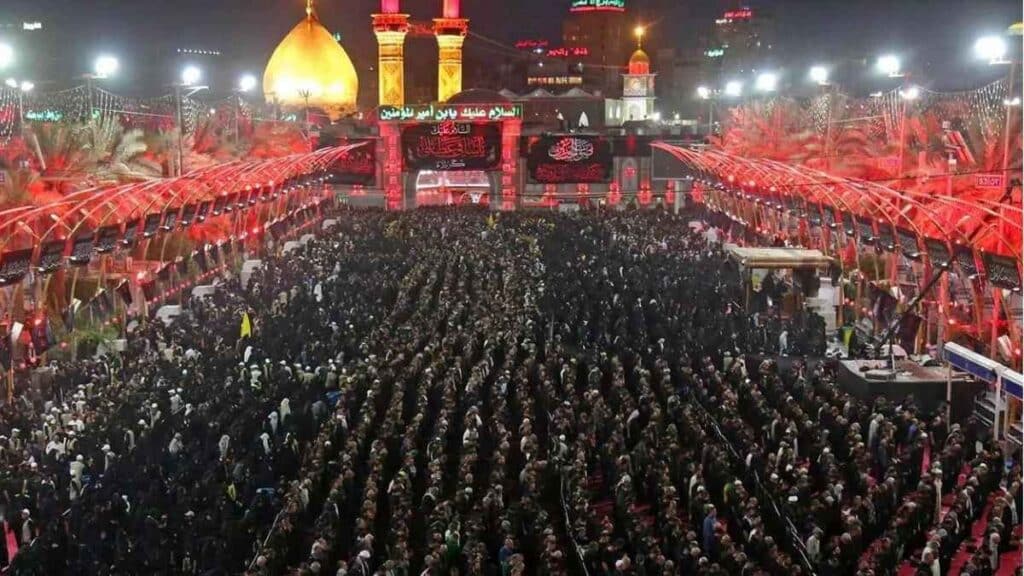
- Ziyarat: Pilgrimage to the shrine of Imam Hussain in Karbala — one of the largest human gatherings on Earth.
Sunni Observances Sunni Muslims observe Muharram through voluntary fasting, increased Quran recitation, nafl prayers, charity (sadaqah), and mosque gatherings. The month is treated as a spiritual reboot — a time to align one’s life with intention and devotion.
How Muharram Is Celebrated Across India
India is home to one of the largest Muslim populations in the world, and Muharram observances here carry a distinct regional flavor shaped by centuries of syncretic tradition.
Lucknow, Uttar Pradesh is the heart of Muharram in India. The city’s elaborate Tazia processions, Majalis at the historic Bara and Chota Imambaras, and recitation of Marsiya (Urdu elegiac poetry) are among the most iconic expressions of the festival in the subcontinent.
Hyderabad, Telangana witnesses large processions with the carrying of Alam (ceremonial banners symbolizing Hussain’s standard), followed by the immersion of Tazias in water.
Mumbai sees significant Ashura processions in Dongri, Agripada, and Mohammed Ali Road, with both Shia and Sunni communities participating and food distributed freely to all.
Delhi hosts processions converging at Karbala grounds across the city, with the Nizamuddin area serving as a major center of observance.
Tamil Nadu and South India have unique Muharram traditions involving folk performances, fire-walking, and Karakam dances — with non-Muslim communities historically participating in the festivities as part of shared local culture.
Kashmir observes Muharram with deep solemnity, with large processions in Srinagar and widespread communal Dastarkhan (food distribution).
Participation Across Religions in India
One of the most remarkable aspects of Muharram in India is its interfaith character. In many parts of Tamil Nadu, Andhra Pradesh, Karnataka, and rural UP and Bihar, Hindu communities have historically built and carried Tazias, joined Ashura processions, and contributed to communal food distributions alongside Muslim neighbors.
This tradition — rooted in the Ganga-Jamuni tehzeeb (the composite Gangetic culture of mutual coexistence) and Sufi influences — reflects how Hussain’s story transcended religious boundaries in India. Scholars, community leaders, and ordinary citizens from Hindu, Sikh, and Jain backgrounds have participated in Majalis gatherings, honoring the sacrifice of Karbala as a universal symbol of moral courage. Muharram in India stands as one of the subcontinent’s most powerful living examples of shared cultural heritage.
How Muharram Is Celebrated Outside India

Iraq — Karbala Pilgrimage The most significant Muharram gathering on Earth takes place at the Imam Hussain Shrine in Karbala, where tens of millions of pilgrims converge on Ashura. The Arbaeen pilgrimage, 40 days after Ashura, draws even larger numbers — widely recognized as the world’s largest annual peaceful human gathering.
Iran observes the first ten days of Muharram as a national period of mourning, with ta’ziyeh passion plays, black-draped streets, and continuous religious broadcasts. Ashura is a national holiday.
UK, USA & Canada — Diaspora communities in cities like London, Toronto, New York, Houston, and Dearborn organize Majalis gatherings, Ashura processions, and educational programs at Islamic centers and universities.
Trinidad & Tobago observes a unique Muharram tradition called Hosay — a colorful folk festival descended from traditions brought by Indian Muslim indentured laborers in the 19th century, now observed across communities of all backgrounds.
Australia & New Zealand — Growing South Asian and Middle Eastern Muslim communities in Sydney, Melbourne, Auckland, and Wellington hold Ashura Majalis and community events, often shifted to the weekend for maximum participation.
Muharram Foods and Culinary Traditions
Food is central to Muharram observances, both as nourishment for those fasting and as charity freely shared with communities.
Haleem — A slow-cooked stew of wheat, lentils, and meat, Haleem is the quintessential Muharram dish across India and Pakistan, prepared in large vessels and distributed as nazar.
Biryani (Nazar) — Fragrant rice and meat cooked as a votive offering and distributed freely at mosques and imambaras on Ashura.
Sherbet / Rose Water Drink — Distributed along procession routes as a symbolic offering, recalling the water cruelly denied to Hussain’s camp at the Euphrates.
Khichda — A hearty porridge of wheat, barley, lentils, and meat, commonly prepared as communal nazar across South Asian communities.
Dates and Dry Fruits — Breaking the Ashura fast with dates follows the Prophetic tradition. Dry fruits and sweets are widely shared as sadaqah.
The act of distributing food freely — known as nazar or langar — carries deep symbolic resonance on Ashura. To feed the hungry and offer water to the thirsty is to honor the memory of Hussain in the most direct way.
Music, Art, and Cultural Expression
Marsiya — The Urdu Elegy Marsiya is a classical Urdu poetic form written in commemoration of the martyrs of Karbala. Lucknow is its literary home, with the compositions of Mir Anees and Mirza Dabeer standing among the greatest works in Urdu literature. Recited melodiously during Majalis, Marsiya moves listeners to tears and deep reflection.
Noha — Lamentation Poetry Noha are rhythmic lament poems sung during processions in call-and-response format, creating waves of collective mourning. Modern Noha recordings in Urdu, Arabic, Farsi, and regional Indian languages are widely shared digitally.
Ta’ziyeh — The Passion Play Originating in Iran and spreading across the Islamic world, ta’ziyeh dramatizes the events of Karbala through music, costumes, and performance. UNESCO recognized Iranian ta’ziyeh as Intangible Cultural Heritage in 2010.
The Tazia as Folk Art The Tazia — a bamboo, mica, cloth, and paper replica of Hussain’s mausoleum — is a remarkable South Asian art form. Master craftsmen in Lucknow and Hyderabad spend weeks producing towering, intricate Tazias with distinct local artistic styles developed over centuries.
Modern Observance and Evolving Practices
Muharram in the 21st century is shaped by both tradition and modernity, particularly for diaspora communities navigating religious identity in multicultural societies.
Digital Majalis have become a permanent feature since the pandemic, with scholars from Karbala, Lucknow, and London streaming sermons live to millions globally. YouTube channels and apps dedicated to Noha and Karbala lectures draw massive audiences year-round.
Muharram and Social Justice — Among younger Muslims globally, the message of Karbala is being actively reclaimed as a call to activism. Hussain’s stand against tyranny is invoked in campaigns against oppression, poverty, and injustice — with “Every day is Ashura” gaining renewed cultural resonance.
Green Muharram — Environmental concerns have prompted communities to shift toward reusable, eco-friendly Tazias and reduce single-use materials in processions, reflecting the festival’s ability to adapt while preserving its essence.
How to Wish Someone on Muharram:
- On the Islamic New Year (1st Muharram): “Muharram Mubarak” or “Naya Saal Mubarak”
- On Ashura, offer condolences to Shia Muslims respectfully: “May Allah accept your observance”
- For those fasting on Ashura: “Taqabbal Allahu minkum” (May Allah accept from you)
Cultural Reflection
Muharram endures not because of ritual alone, but because it speaks to something deeply human — the memory of injustice, the dignity of sacrifice, and the hope that standing for truth carries eternal meaning. The story of Karbala has moved hearts across fourteen centuries and across religious boundaries.
In India, Muharram’s syncretic traditions — processions shared by Hindus and Muslims, communal distribution of food, and the recitation of Marsiya — represent some of the subcontinent’s most enduring expressions of shared humanity. For diaspora communities worldwide, Muharram is a bridge between heritage and the present — keeping alive the values of justice, compassion, and moral courage for each new generation.
As Muharram 1448 AH arrives on June 16, 2026, communities across the world will gather — in mourning, in prayer, in fasting, and in solidarity — with the timeless conviction that conscience is worth every sacrifice.