


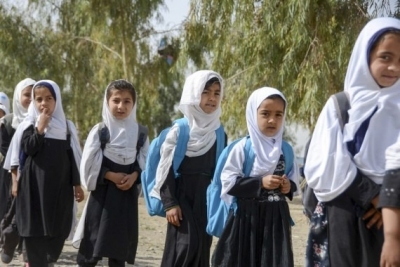
The new academic year in Afghanistan schools has commenced without girls above sixth grade returning to classrooms for the fifth consecutive year. Despite calls for reopening schools for older girls, the classes started with senior officials attending a formal ceremony. Concerns have been raised by Afghan students, families, and rights groups regarding the continued exclusion of girls from studying above sixth grade.
The Taliban’s Education Ministry reported that the new academic year began with formal ceremonies and classes resuming in colder provinces. UNICEF’s Regional Director for South Asia, Sanjay Wijesekera, emphasized the importance of reopening schools for girls, stating that education is crucial for hope, dignity, and the future. Afghanistan’s former President Hamid Karzai also advocated for allowing girls to study beyond the sixth grade, warning that denying education to girls and restricting women’s work could have severe consequences for Afghanistan’s stability, progress, and self-reliance.
Former President Karzai’s call was supported by the United Nations Special Rapporteur on the situation of human rights in Afghanistan, Richard Bennett, who labeled the bans on women’s and girls’ education as unacceptable. Bennett urged the Taliban to end the restrictions promptly. The Taliban’s prohibition on girls studying beyond the sixth grade extends to universities, institutes, and various other learning spaces, limiting their academic and professional opportunities.
Aid agencies have repeatedly highlighted that the exclusion of girls from education and work not only violates their rights but also hinders Afghanistan’s long-term recovery and development. The United Nations Assistance Mission in Afghanistan (UNAMA) cautioned on March 9 that the restrictions imposed on women in Afghanistan are impeding the country’s progress and exacerbating humanitarian challenges. UNAMA Acting Head Georgette Gagnon criticized the Taliban for prioritizing ideological policies over the welfare of the Afghan people. Gagnon emphasized that the restrictions on women working in humanitarian organizations are affecting aid operations and hindering agencies’ ability to assist vulnerable individuals.
Gagnon stressed that the humanitarian crisis in Afghanistan has worsened in 2026 due to reduced international funding, increased needs, and the return of a large number of migrants, compounded by the restrictive policies of the Taliban.
