


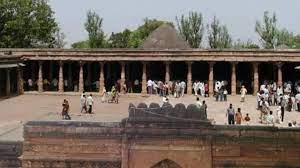
The conflict surrounding the Bhojshala-Kamal Maula complex in Dhar, Madhya Pradesh, has escalated as Basant Panchami coincides with Friday on January 23, 2026. The Hindu Front for Justice has filed an urgent application with the Supreme Court, seeking exclusive access for Hindus to conduct Goddess Saraswati Puja on that day.
The site, recognized as a protected monument by the Archaeological Survey of India (ASI), is claimed by Hindus as an ancient temple dedicated to Goddess Vagdevi (Saraswati) and by Muslims as the Kamal Maula Mosque. The plea requests a prohibition on Muslim prayers that day, enhanced security measures by the ASI and state government, and a prompt hearing of the ongoing case in the Supreme Court.
There is a critical ambiguity in the ASI’s directive from April 7, 2003, which allows Hindus to worship on Tuesdays and Basant Panchami, and permits Muslims to offer Friday prayers from 1 p.m. to 3 p.m. The order does not address situations where Basant Panchami falls on a Friday, as it does this year.
Hindu groups argue that Basant Panchami is of great significance in Sanatan Dharma as the birth anniversary of Goddess Saraswati, traditionally observed with uninterrupted worship at the site. They claim that overlapping observances have historically led to conflicts and even communal violence on such rare coinciding days. The plea alleges that allowing Friday prayers without determining the monument’s religious identity violates the spirit of the Ancient Monuments and Archaeological Sites and Remains (AMASR) Act.
The broader dispute stems from historical contentions; Hindus assert that the structure was originally a center of Vedic learning and Saraswati temple before being destroyed and converted during medieval invasions, while Muslims argue for the continuity of worship at the mosque named after Maulana Kamaluddin Chishti. The Madhya Pradesh High Court, in its order from July 22, 2024, declined to proceed with WP No. 10497/2022 related to the Bhojshala dispute in Dhar, citing the Supreme Court’s interim order from April 1, 2024.
The case will only be listed again after the Supreme Court’s final decision or further instructions. With the primary case challenging the site’s religious nature and ASI survey findings already before the Supreme Court, the recent plea highlights escalating tensions due to the calendar overlap. Local authorities in Dhar have bolstered security measures, deploying numerous personnel to prevent any potential incidents on January 23.
