


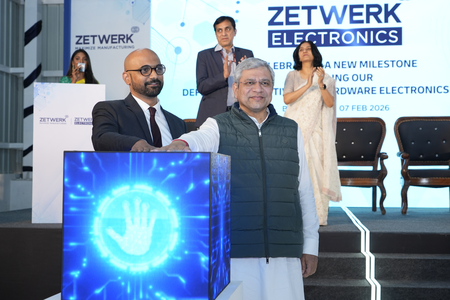
The manufacturing of electronic components is on the rise, with 46 approvals granted, and Karnataka is poised to receive investments exceeding Rs 10,000 crore, as per Union Minister Ashwini Vaishnaw. In the Budget for 2026-27, Finance Minister Nirmala Sitharaman raised the budget for the electronic component manufacturing scheme from Rs 22,000 crore to Rs 40,000 crore, aiming to accelerate the electronics manufacturing sector significantly.
“Our Prime Minister has set a production target of $500 billion by the 2030-2031 financial year. Therefore, we all need to move very quickly in that direction,” stated Vaishnaw during the inauguration of Zetwerk Electronics’ new manufacturing facility in Bengaluru, catering to defense, automotive, and IT hardware electronics.
Today, India is witnessing the design of complete ‘2-nanometer’ chips, a significant achievement for the country, with equipment manufacturers also establishing a presence in India, according to the Union IT Minister. Applied Materials and Lam Research have already set up operations in India, with the goal now being to bring ASML into the country.
Commercial production is set to commence this year, with the first commercially produced chip from a semiconductor plant expected soon. The upcoming ‘Semicon 2.0’ initiative will focus on design, equipment manufacturing, chemicals, gases, validation, and yield improvement, essential for a sustainable semiconductor journey.
“We aim to train 85,000 silicon engineers over 10 years, with 67,000 already trained in four years. This will lead to a significant portion of chip design happening in India, marking a major shift in the industry,” Vaishnaw highlighted. With the introduction of the ‘fab,’ India has charted a path from 28-nano meter to 7-nano meter, a crucial aspect of Silicon 2.0.
“We believe in a cooperative system where the country prospers when all states progress,” Vaishnaw emphasized. Vishal Chaudhary, Co-founder and Managing Director (Aerospace and Defence) at Zetwerk, emphasized the need for deep integration in electronics manufacturing across design, engineering, suppliers, and scaled production, ensuring faster validation, robust quality control, and reliable execution throughout the product lifecycle.
