


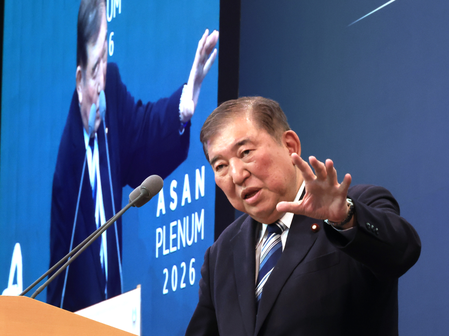
Former Japanese Prime Minister Shigeru Ishiba emphasized the need for South Korea and Japan to collaborate, particularly at the UN level, to address the supply disruptions caused by the conflict in Iran affecting the global economy. Speaking at a forum in Seoul, Ishiba highlighted the impact of Iran’s blockade of the vital Strait of Hormuz, a key route for global energy supplies, on multiple nations and global stability.
During a keynote speech at the Asan Plenum event, Ishiba stressed the urgency of ending the conflict in Iran promptly and treating it as a security issue based on UN resolutions. He urged like-minded countries, including Japan and South Korea, to unite in addressing the situation and take a leading role in discussions at the UN.
In furthering cooperation, Ishiba proposed that South Korea and Japan explore the possibility of signing an acquisition and cross-servicing agreement (ACSA) to strengthen their bilateral relations. He underscored the significance of close coordination between the two countries for regional and global peace, citing the ACSA as a crucial step in this direction.
Ishiba also highlighted the importance of trilateral cooperation among South Korea, the US, and Japan to enhance deterrence against North Korea’s nuclear and missile capabilities. He emphasized the need for strengthened coordination among these countries to maximize deterrence effectiveness, particularly in response to evolving threats from Pyongyang.
Advocating for a collective defense framework in Asia akin to NATO, Ishiba proposed a security cooperation structure involving South Korea and the Philippines, in addition to Japan. He suggested considering scenarios that could lead to a NATO-style security framework in the region to bolster security cooperation and stability.
