


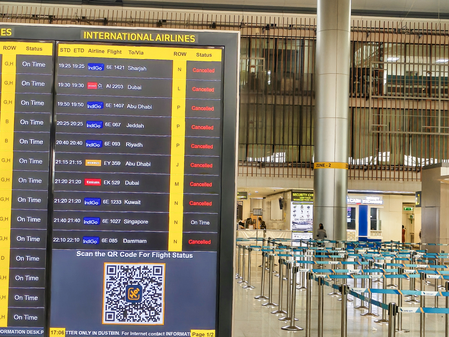
Global and Indian airlines have been forced to cancel and divert numerous flights for the third consecutive day due to the escalating tensions between the US, Israel, and Iran, leading to widespread airspace closures across West Asia and the Gulf. Airlines in the Asia Pacific (APAC) region experienced financial losses during early trading sessions, with companies like Interglobe Aviation Ltd, which operates IndiGo, seeing a 4.24% dip. Singapore Airlines, Japan’s ANA and JAL, and Australia’s Qantas also faced significant drops in their stock values.
Major transit hubs such as Dubai, Doha, and Abu Dhabi have been closed for extended periods, compelling airlines to either suspend, reroute, or cancel flights to various destinations in the region, including Tel Aviv, Dubai, Beirut, Tehran, Riyadh, and others. Indian carriers, notably IndiGo, witnessed a high number of flight cancellations, with reports indicating 410 flights were canceled on February 28, around 350 on March 1, and an expected impact on at least 300 flights on March 2.
In response to the situation, the Directorate General of Civil Aviation (DGCA) in India has been working closely with airlines and related agencies. They have set up a Passenger Assistance Control Room to aid stranded travelers. Air India, for instance, has extended the suspension of flights to and from the UAE, Saudi Arabia, Israel, and Qatar until 11.59 pm on March 2, utilizing alternative routes due to the closure of Iranian and Iraqi airspace, which has increased flight durations to Europe by about 30-40 minutes, leading to higher operating costs.
Several airlines, including Air France, KLM, British Airways, Cathay Pacific, and others, have announced flight suspensions or reroutings in light of the ongoing tensions. The situation was further exacerbated by Israeli strikes on Tehran, prompting retaliatory missile attacks on Israeli territory and US bases in the Gulf, intensifying the prevailing uncertainty.
