


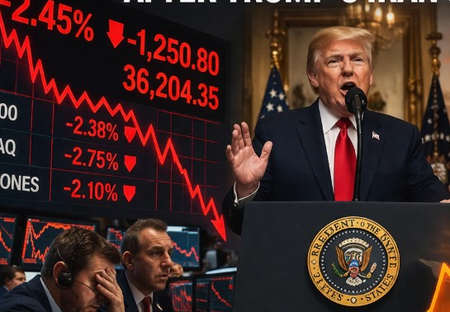
Global markets experienced a decline, and oil prices surged following US President Donald Trump’s indication of an extended Iran conflict. Trump’s remarks raised concerns about potential supply disruptions and prolonged economic repercussions. US stock futures, including S&P 500, Nasdaq, and Dow, dropped significantly after Trump’s speech, with futures pointing to a negative trend.
Asian markets also showed weakness in early trading sessions, with South Korea’s Kospi and Japan’s Nikkei witnessing declines. This decline reflected investor apprehension regarding energy supply prospects amidst the escalating tensions. Oil prices saw a sharp increase in response to Trump’s warning of intense US actions against Iran in the coming weeks if no agreement is reached.
During and after Trump’s speech, the global benchmark for oil prices surged over 3%, pushing Brent crude above $105 per barrel in Asian trading. Investors were anticipating signs of de-escalation or a clearer exit strategy, but Trump’s speech heightened uncertainties by hinting at potential further military actions. The focus remains on the Strait of Hormuz, a critical route for global oil shipments that has been affected by the ongoing conflict.
Analysts highlighted that prolonged disruptions in the Strait of Hormuz could lead to a tightening of global oil supply, thereby keeping prices elevated. Reports indicated a 10% gap between global oil supply and demand due to the conflict, raising concerns about potential rationing and supply chain disruptions in emerging economies. Rising energy costs have also sparked inflation worries, with US gasoline prices surpassing $4 per gallon, impacting both households and businesses.
Trump acknowledged the increase in fuel prices but assured that they were temporary and would stabilize post-conflict resolution. Economists, however, expressed concerns about a prolonged impact, with some revising growth forecasts downwards and warning of a possible economic slowdown if the conflict persists.
