


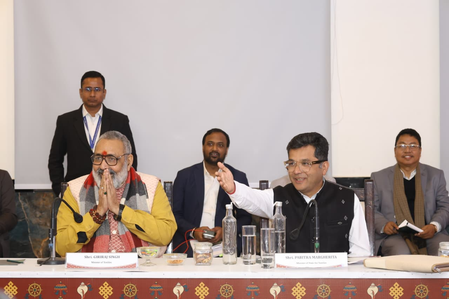
The government has introduced the District-Led Textiles Transformation (DLTT) initiative to drive inclusive and sustainable growth in India’s textile sector. Through a sector-specific, district-level strategy, the Ministry of Textiles aims to turn 100 districts into Global Export Champions and uplift 100 Aspirational Districts. This initiative was unveiled at the National Textile Ministers Conference in Guwahati, Assam.
By employing a data-driven scoring system based on Export Performance, MSME Ecosystem, and Workforce Presence, the ministry categorized districts into Champion Districts and Aspirational Districts. The plan involves a customized implementation framework tailored to each district’s category, focusing on Champion and Aspirational Districts. Additionally, the initiative highlights the Purvodaya convergence in the east and northeast zones for tribal belt development and connectivity enhancement.
The government aims to position unique cultural handicrafts for premium global markets through Geographical Indication (GI) tagging in the east and northeast regions. By combining government resources and partnerships with industry and academia, the program seeks to strengthen textile clusters and expand successful models across districts. A high-level conclave organized by the ministry facilitated discussions on boosting the textile sector in northeastern states through policy coordination, investment promotion, skill development, and market access improvement.
Textiles Minister Giriraj Singh emphasized the crucial role of the northeastern region in the nation’s textile industry and reiterated the government’s commitment to its development. During the discussions, the region’s strengths, including its handloom heritage, GI-tagged products, diverse silk varieties, bamboo crafts, and active participation of women artisans and weavers, were highlighted.
