


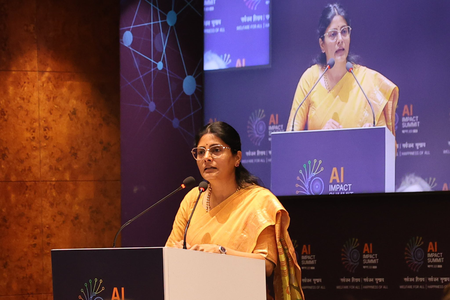
When discussing AI in healthcare in India, Minister of State for Health and Family Welfare, Anupriya Patel, highlighted that it goes beyond just advanced algorithms to actually impacting lives and addressing health disparities across the nation. Speaking at the ‘India AI Impact Summit 2026’ in New Delhi, she emphasized how AI plays a crucial role in improving public health outcomes and strengthening healthcare systems in India.
Patel stressed that AI, in line with Prime Minister Narendra Modi’s vision for India, stands for All-Inclusive Intelligence rather than just Artificial Intelligence. With the goal of achieving a developed India by 2047, health stands out as a key pillar of progress. Given India’s diverse population, urban-rural divide, and the challenges posed by various diseases, the integration of technology, especially AI, becomes essential in overcoming these hurdles.
The minister noted that AI has been seamlessly integrated into various aspects of healthcare, ranging from disease prevention and surveillance to diagnosis and treatment. She highlighted the Media Disease Surveillance System, an AI tool that monitors disease trends in multiple languages, issues real-time alerts, and bolsters outbreak readiness, showcasing the effectiveness of AI in enhancing disease control efforts in India.
Furthermore, Patel mentioned initiatives by the Indian Council of Medical Research (ICMR) utilizing AI for genomic surveillance to predict potential zoonotic outbreaks before they occur, marking a significant advancement in preventive public health measures. She also pointed out the successful deployment of AI-driven handheld X-ray machines and Computer-Aided Detection tools for tuberculosis (CA-TB), which have led to improved diagnostics and increased case detection rates for TB patients.
The government’s efforts to establish a robust AI ecosystem in healthcare were underscored, including the establishment of three Centers of Excellence for AI at prominent medical institutions. Experts at the summit emphasized that while Artificial Intelligence holds great potential in revolutionizing public health, its responsible, ethical, and widespread deployment is crucial for its success.
