


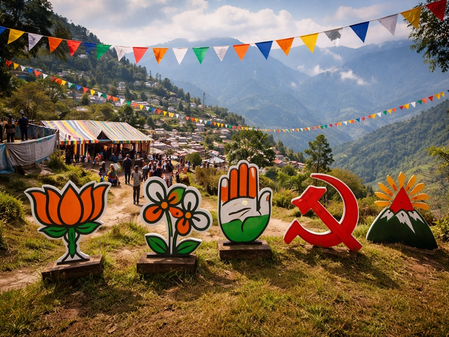
At a time when most Assembly constituencies in West Bengal are gearing up for four-cornered contests in the upcoming elections, the hill constituencies of Darjeeling, Kalimpong, and Kurseong are poised for a unique five-cornered battle. While the usual contenders in other constituencies include the Trinamool Congress, BJP, CPI-M-led Left Front, and AISF alliance, the hill regions will see the BJP supported by Gorkha Janmukti Morcha (GJM), Bharatiya Gorkha Prajatantrik Morcha (BGPM) led by Anit Thapa, Indian Gorkha Janshakti Front (IGJF) founded by Ajoy Edwards, Left Front-AISF alliance, and the Congress competing against each other.
The entry of IGJF as an independent candidate has added complexity to the electoral landscape, particularly affecting the BJP-GJM and Trinamool Congress-BGPM dynamics in Darjeeling, Kalimpong, and Kurseong, where Gorkha voters hold significant sway. Despite differing claims, all parties believe that IGJF’s participation will enhance their chances of victory in these constituencies. While the BJP and GJM anticipate a split in the anti-BJP and anti-GJM Gorkha vote share, BGPM and Trinamool Congress foresee a dent in the core vote bank of BJP-GJM, potentially favoring their candidates.
Ajoy Edwards of IGJF, however, disagrees with these assessments, emphasizing the Gorkhas’ frustration over unmet promises and advocating for a separate Gorkhaland state. Edwards asserts that voters may opt for an alternative force that can effectively address hill issues in the Assembly. On the other hand, GJM’s Roshan Giri expresses support for BJP candidates, citing the BJP’s historical backing for smaller states like Gorkhaland as crucial for a permanent political solution. Meanwhile, BGPM’s Anit Thapa underscores the party’s focus on hill development, emphasizing the need for Trinamool Congress’ support.
