


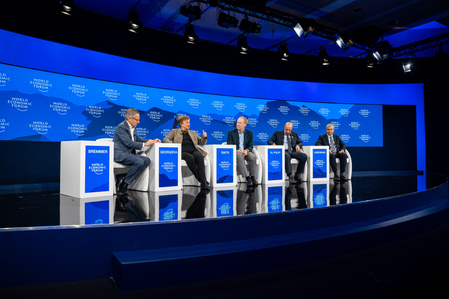
A tsunami of change is hitting the job market as artificial intelligence (AI) both enhances and replaces jobs, according to Kristalina Georgieva, Managing Director of the International Monetary Fund (IMF). Speaking at the World Economic Forum (WEF) in Davos, Georgieva highlighted the uneven distribution of AI opportunities across the world. She emphasized the need to invest in skills and prepare communities for the AI-driven transformation.
Georgieva noted that AI is reshaping economies by boosting productivity in certain roles while causing others to disappear. The IMF estimates that, on average, 40% of jobs globally are affected by AI, with implications for pay. In advanced economies, this figure rises to 60%, while in low-income countries, it ranges from 20 to 26%. The potential impact on global growth varies from 0.1% to 0.8%, with a 0.8% productivity boost potentially surpassing pre-pandemic growth levels.
At the WEF session, Ashwini Vaishnaw, Minister of Electronics and Information Technology, emphasized the importance of understanding the economic dynamics of the 5th Industrial Revolution. He highlighted the significance of Return on Investment (ROI) in deploying cost-effective solutions for optimal returns in the AI era. Khalid Al-Falih, Minister of Investment of Saudi Arabia, stressed the need for global accessibility of AI infrastructure to harness its power effectively.
