


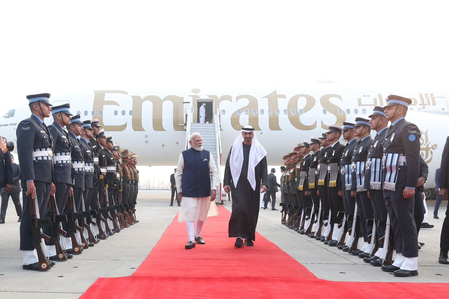
India and the United Arab Emirates (UAE) are enhancing their bilateral relationship by establishing a clear defence and security framework, moving beyond transactional engagements to cooperation that includes hard-security considerations. This shift follows the signing of the Strategic Defence Partnership Agreement in January 2026, forming part of a broader set of agreements covering defence, space, energy, technology, and investment. Dr. Anu Sharma from Amity Institute of Defence and Strategic Studies highlighted this development in an opinion piece for India Narrative.
The Strategic Defence Partnership framework aims to expand collaboration in various areas such as defence industrial cooperation, advanced technologies, training, special operations, cyberspace, and counter-terrorism. It signifies a transition from sporadic military interactions to a more structured partnership focusing on aligning doctrines, enhancing interoperability, and building capacities in emerging sectors like cybersecurity. This shift is influenced by evolving geopolitical tensions in West Asia, indicating changing regional alignments and increasing strategic complexities.
The report emphasizes the UAE’s need to diversify partnerships to boost military capabilities, intelligence-sharing, and access to advanced technologies over the past decade. For India, instability in West Asia impacts energy price stability, the welfare of its diaspora, and maritime security, issues that cannot be solely addressed through diplomacy. Counter-terrorism cooperation and financial enforcement are integral aspects of the partnership, with both countries condemning terrorism, including cross-border activities, and committing to strengthening cooperation under the Financial Action Task Force (FATF) framework.
The partnership is viewed as a comprehensive security arrangement covering kinetic and non-kinetic domains, including intelligence coordination, financial monitoring, and regulatory measures. Additionally, the agreement integrates security cooperation with connectivity and corridor-based geopolitical strategies, positioning India and the UAE as key partners in the India–Middle East–Europe Economic Corridor (IMEC) initiative. The partnership’s broader regional implications are underscored by their strong ties with Israel, reflecting a strategic alignment that addresses geoeconomic challenges.
India’s shift towards a more direct role in regional security, particularly in maritime security and non-traditional threats, is evident in the defence partnership with the UAE. Focus areas include trade corridors, connectivity for small enterprises, cybersecurity, interoperability, and addressing cross-domain threats like drone warfare and cyberattacks. Strengthening defence ties with India offers the UAE diversification in security and industrial cooperation, leveraging India’s expanding defence-industrial base for co-developing military capabilities and establishing resilient supply chain partnerships.
The partnership between India and the UAE emphasizes sovereignty, strategic autonomy, counter-terror financing, interoperability, and collaboration in advanced technologies, shaping a security-relevant partnership in a multipolar and crisis-prone regional environment. While not a traditional alliance, the strategic alignment reflects a pragmatic operational content that positions India as a more engaged partner in West Asia, focusing on security cooperation alongside established defence collaboration. This strategic defence partnership signifies a consolidation phase, formalizing a security relationship that has evolved beyond economic engagement.
