


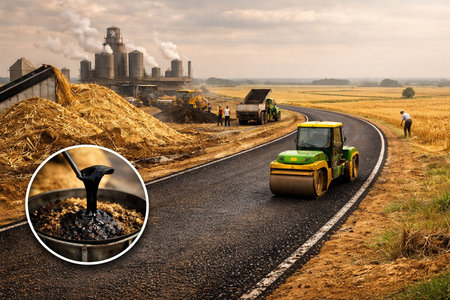
India has made significant progress in promoting greener infrastructure by introducing a new technology that converts crop waste into bio-bitumen, a crucial material in road construction. Developed by scientists from the Council of Scientific and Industrial Research (CSIR), this innovation aims to reduce the country’s reliance on imported petroleum-based bitumen and address the issue of stubble burning.
Union Minister Dr. Jitendra Singh emphasized the significance of this advancement, highlighting that crop residues like rice straw can now be transformed into a valuable binding material through a process known as pyrolysis. By heating biomass without oxygen, this method generates a sustainable and environmentally friendly substitute for conventional bitumen, showing promising results in initial trials for potential widespread application in road building.
The timing of this breakthrough is crucial as stubble burning remains a major cause of air pollution in various parts of India. By offering farmers a practical solution for agricultural waste, this new approach could substantially decrease the necessity to burn leftover crop materials, leading to cleaner air quality and improved environmental conditions.
CSIR Director General N Kalaiselvi mentioned that industries are expressing interest in adopting this technology, with plans in place to transfer it to companies for broader implementation. Apart from its application in road construction, the technology holds promise for other uses such as pest control solutions and advanced carbon-based materials, diversifying its potential benefits.
Experts view the development of bio-bitumen as a mutually beneficial solution for India, supporting sustainable infrastructure growth, aiding farmers, reducing pollution levels, and enhancing the country’s economic resilience amidst global supply challenges.
