


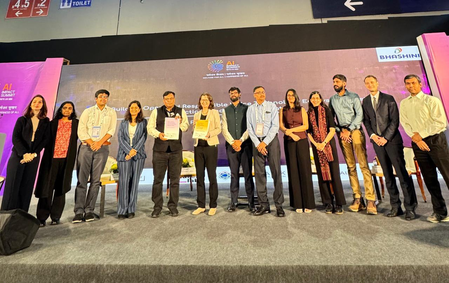
India is progressing towards a voice-first digital environment, emphasizing the need for strong policy foundations and practical implementation frameworks, as stated by Amitabh Nag, CEO of Digital India BHASHINI Division. Voice technologies are gaining importance for digital inclusion in India, leading to the launch of a Policy Report and Developers’ Toolkit on voice technologies at the ‘India AI Summit Expo 2026’. The Policy Report and Toolkit aim to establish open, inclusive, and responsible speech technologies in India, providing guidance for ecosystem alignment and actionable practices across the AI lifecycle.
The report suggests specific policy recommendations to enhance the voice-technology ecosystem, such as treating foundational speech datasets as digital public goods, enhancing model openness and representativeness, investing in sustainable public infrastructure, and incorporating safeguards against misuse while fostering innovation. The toolkit, a collaborative effort by ARTPARK at IISc, Digital Futures Lab, Trilegal, Bhashini, and FAIR Forward – AI for All initiative supported by GIZ, addresses the challenges faced by developers working with Indian-language voice datasets and developing voice applications.
Voice technologies play a crucial role in India’s diverse linguistic landscape by serving as a vital component of digital public infrastructure, enabling easier access to digital platforms through speech-based applications. However, the utilization of speech technologies raises complex issues related to data governance, inclusion, openness, quality, and responsible usage. The Developers’ Toolkit complements the policy analysis by shedding light on the key challenges encountered by developers in this domain, including uneven data representation, weak quality assurance mechanisms, limited evaluation practices, and fragmented governance structures.
Dr. Ariane Hildebrandt, Director-General of the department for global health, equality of opportunity, digital technologies, and food security at the German Federal Ministry for Economic Cooperation and Development, emphasized the significance of voice AI in local languages and dialects as a means to enhance access to public services, healthcare, education, and economic participation.
