


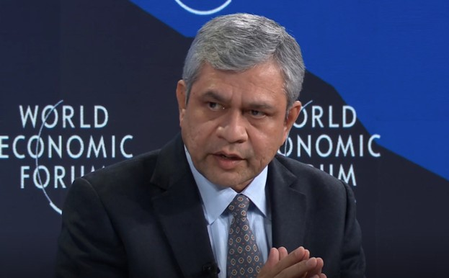
India is considered a top AI nation, with a comprehensive AI architecture comprising application, model, chip, infrastructure, and energy layers, according to Union Minister for Electronics and IT, Ashwini Vaishnaw. Speaking at the World Economic Forum (WEF) annual meeting in Davos, Vaishnaw highlighted India’s focus on large-scale AI adoption, economic feasibility, and techno-legal governance. He emphasized that India is actively involved in all five layers of AI architecture.
During a panel discussion at Davos moderated by Ian Bremmer, Vaishnaw pointed out that India is poised to become a major global service provider at the application layer of AI. He stressed that the real return on investment in AI lies in deploying it at an enterprise level for productivity gains, rather than just creating large models. Vaishnaw mentioned that a significant percentage of AI use cases can be handled with models ranging from 20 to 50 billion parameters, many of which India already possesses and is implementing across various sectors.
Vaishnaw also cautioned against linking geopolitical influence with the ownership of massive AI models, noting that such models can be deactivated and could lead to economic challenges for their developers. He highlighted the importance of cost-effective AI deployment for maximizing returns, emphasizing the need to deploy affordable solutions to achieve high returns. The minister underscored the shift towards CPUs, smaller models, and custom silicon in AI deployment, reducing reliance on any single country and questioning the idea of AI dominance based solely on scale.
In addressing the shortage of GPUs, Vaishnaw mentioned India’s initiative of setting up a public-private partnership model that includes around 38,000 GPUs as a national compute facility. This subsidized facility, supported by the government, offers cost-effective access to GPUs for students, researchers, startups, and innovators at a fraction of the global cost.
