


India’s children are picking up pens—and publishing contracts—at unprecedented rates. But behind this literary boom lies a complex story of genuine talent, parental ambition, and an increasingly competitive academic landscape where a published book has become the new black belt.
When Seven-Year-Olds Become Authors
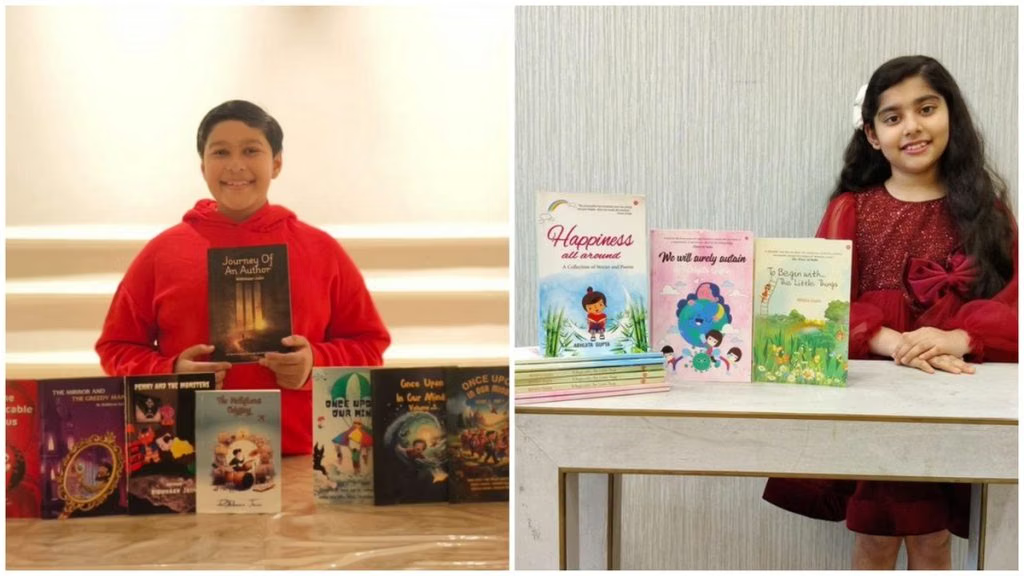
Abhijita Gupta was just seven when she sent her manuscript to ten publishers. Nine rejected her outright. The tenth, Invincible Publishers, took a chance after meeting the young writer in person.
Her debut book, Happiness All Around, featured short stories and poems inspired by her surroundings during the COVID-19 lockdown. Now twelve, Abhijita is adamant about her writing process.
“I like keeping it authentic. I don’t want to add outside creations to my work,” she said, emphasizing that she avoids ChatGPT and relies solely on pen and paper.
In 2022, Abhijita was the only writer among awardees at the Global Child Prodigy Awards—a recognition that highlights both her talent and the growing ecosystem around child authorship in India.
Read More: How to Teach Indian Culture to Children Abroad: Practical Tips for Parents
The Publishing Ecosystem Takes Shape
Twelve-year-old Ridhhaan Jaiin is already planning his sixth novel, this time exploring what would happen if Ravana from Indian mythology faked his death and planned to return in Kali Yuga.
Ridhhaan’s journey began at age four with storytelling, but the pandemic pushed him to write down nearly 90 stories. His first book, Once Upon in My Mind, was published when he was eight.
Facing rejection and what his father Vishal Jaiin calls a lack of empathy from traditional publishers, the family turned to self-publishing. They didn’t stop there. In 2022, they launched RidhzWorld Publishing to help other children publish their work.
Their annual story-writing competition, ‘Once Upon In Our Mind’, has received over 4,000 submissions from 24 countries and published 28 young authors at no cost. Ridhhaan also hosts a YouTube podcast, B’coz I Can, featuring conversations with young authors and artists.
“I believe that there are many children who have even more talent than me. But it’s just that they didn’t get the platform,” Ridhhaan explained.
Check Out: Parenting as an Indian Family in Canada: A Complete Guide
The Business Behind Young Authors
The infrastructure supporting child authors has expanded rapidly. This year’s Chennai Book Festival featured a dedicated stall for child authors for the first time. Parents can enter their children into awards like the Global Child Prodigy Awards for approximately Rs 1,200.
Platforms like BriBooks, which raised $1.5 million in pre-seed funding in 2022, offer AI-assisted writing tools and on-demand publishing specifically for children. The platform even hosted a National Young Authors’ Fair and awards students with ‘Silver Star Medallions’.
Schools have joined the circuit, posting photographs of young authors on social media and stocking self-published titles in their libraries—sometimes featuring entire classes of published students.
Quality Versus Credentials
Kavya Wahi, Assistant Manager – Children’s Marketing at Penguin Random House, has noticed a shift.
“Over the last three years, it seems that aspirational and enthusiastic parents motivate their children to publish their creative writings, sometimes even before their children have had the chance to polish their craft or discover their original voice,” Wahi observed.
Eighteen-year-old writer Prisha Agrawal is blunt about what she sees as the “ChatGPT-fication” of writing. After publishing her own poetry collections through self-publishing platforms, she estimates that 99 percent of young authors she’s encountered published primarily for the “wow factor” rather than artistic motivation.
“With ChatGPT, with 21 prompts that you can copy and paste, you can have a published book in your name,” Agrawal said, expressing skepticism about AI-powered platforms making publishing too easy.
She recounted knowing a friend whose mother published a book in his sister’s name, even though the sister hadn’t written it.
The College Admissions Factor
Akhil Daswani, co-founder of college admissions consulting firm OnCourse Global, sees book publishing as part of a broader trend in India’s competitive academic environment.
“There is a lot of FOMO in play,” Daswani explained. “They [parents] see a neighbour’s child publishing a book, and wonder whether they should also do that for their kid.”
The pattern mirrors what’s happening in academic research, where students scramble to publish papers—sometimes in dubious journals—to strengthen college applications. Publishing a book has become another checkbox on the CV, alongside karate black belts and mobile app development.
However, Daswani notes that not all publications carry equal weight. “It’s about how good the content is, do you have any credibility behind it and has anyone written about you,” he said.
A Path Forward
For some families, the goal extends beyond resume-building. Vishal Jaiin views extracurricular pursuits as opportunities to develop skills that traditional education doesn’t provide.
“After all, Sachin Tendulkar didn’t play international cricket on day one when he held the bat,” he pointed out, emphasizing that early exposure to writing could establish career pathways similar to those in sports.
The challenge remains creating genuine literary development structures for children interested in writing—something India lacks compared to well-established coaching systems for cricket or other sports.
As the child author phenomenon continues growing, the question isn’t whether children should write and publish. It’s whether the current ecosystem supports authentic creative development or simply manufactures credentials for an increasingly competitive future.
