


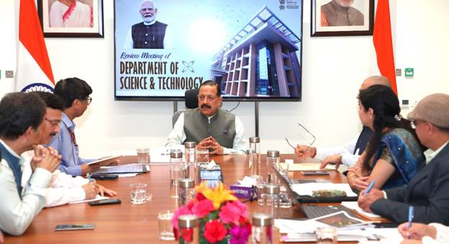
India’s National Quantum Mission has made a significant stride by establishing a 1,000-kilometre secure quantum communication network within three years of its launch, as stated by Union Minister of State Dr. Jitendra Singh. Launched in October 2024, the mission initially aimed to construct a 2,000-km quantum communication network in eight years. The accomplishment of half the targeted distance in less than three years signifies a notable advancement in India’s quantum capabilities.
During discussions, Dr. Jitendra Singh emphasized the importance of transparency, improved evaluation mechanisms, and broader awareness regarding government funding initiatives. He also advocated for enhanced communication efforts to showcase India’s scientific accomplishments globally. The network, developed using indigenous technology by QNu Labs, a startup supported under the mission, specializes in quantum-safe cybersecurity solutions.
Officials highlighted that this deployment is one of the lengthiest quantum key distribution (QKD) implementations globally. DST Secretary Dr. Abhay Karandikar hailed the development as a breakthrough in secure communication, indicating progress ahead of schedule. Quantum communication, employing sophisticated encryption methods, is vital for ensuring highly secure data transmission.
This technology is expected to play a pivotal role in fortifying secure communications in sectors like defense, banking, and critical infrastructure. Officials noted its adaptability in challenging environments, such as underwater and underground networks, broadening its applicability for both civilian and strategic purposes. Concurrently, the government is expanding its support for startups in the quantum domain.
Under the mission, nine new startups have been included, bringing the total number of supported ventures to 17. These startups are engaged in various cutting-edge technologies, encompassing quantum computing, sensing, biosensors for disease detection, and precision electronic systems. The review also revealed a growing industry interest in government-backed research and innovation funding.
The Technology Development Board has received over 100 proposals in two months, while the Biotechnology Industry Research Assistance Council has received nearly 200 applications in fields like cancer research, gene therapy, and bio-manufacturing. To bolster startups, the government is utilizing innovative funding mechanisms like optionally convertible debt, enabling companies to raise funds without immediate equity dilution and attract private investments.
