


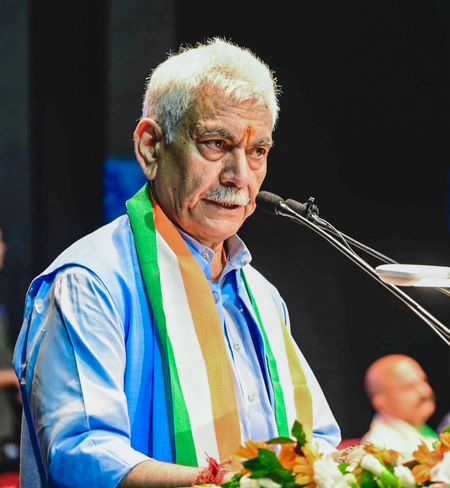
Jammu and Kashmir’s Lt Governor, Manoj Sinha, has directed the establishment of a high-level committee to create detailed standard operating procedures (SOPs) for regulating the transportation of bovine animals within the union territory. The committee, as per an order from the General Administration department, will assess current laws and frameworks to develop comprehensive SOPs governing the transport of bovine animals by vehicles and on foot. It will also define documentation and verification protocols, including permits and health certificates, to be verified during inspections by enforcement agencies.
This panel is also responsible for proposing measures to ensure animal welfare during transportation, enhancing coordination among departments, and formulating standard procedures to prevent illegal transport while facilitating the smooth movement of legitimate consignments. Additionally, the committee will recommend leveraging technology-driven solutions to enhance transparency and efficiency in monitoring bovine transport across the union territory.
The need for establishing this committee arose due to a rise in attacks by cow protection groups on individuals transporting bovine animals for breeding and dairy purposes in Jammu and Kashmir. These attacks often occur because individuals involved in legitimate activities are mistaken for those engaged in cow slaughter. Once the SOPs are formulated, the lawful transportation of bovine animals can be conducted without risks. Moreover, with the implementation of these SOPs, individuals carrying proper permissions for transporting livestock will receive police protection.
Currently, there is confusion as permissions granted by authorities in one district are not recognized by authorities in another district. Notably, nomadic goatherds known as ‘Bakarwals’ migrate between Jammu and Kashmir annually to graze their cattle, sheep, and goats. The SOPs related to bovine animal transport will be beneficial for numerous nomadic families whose livelihoods revolve around tending to their livestock.
