


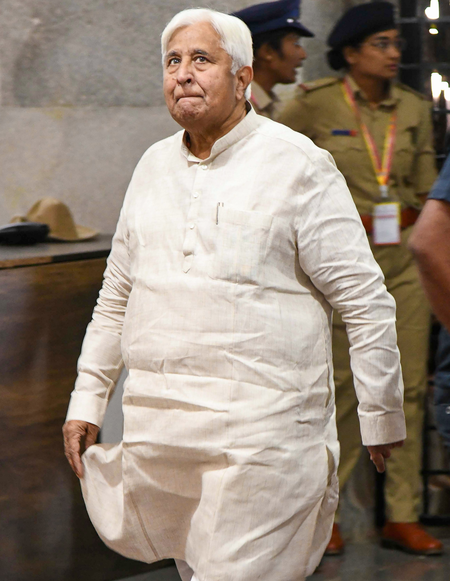
The Karnataka cabinet, led by state Tourism, Law, and Parliamentary Affairs Minister H.K. Patil, discussed the Union government’s decision to withdraw the Mahatma Gandhi National Rural Employment Guarantee Scheme (MGNREGA). The cabinet has resolved to challenge the newly introduced VB–G RAM G scheme and take legal action against it. Patil emphasized that the new scheme undermines decentralization efforts initiated after the 73rd Constitutional Amendment, alleging that it deprives rural people of their employment rights.
Patil criticized the VB–G RAM G scheme, labeling it a “draconian law” that compels laborers to work on national highway projects managed by contractors, unlike MGNREGA, which empowered panchayats for asset creation. He accused the Union government of neglecting laborers’ welfare and infringing upon their employment rights. The minister highlighted that the new scheme strips panchayats of their decision-making authority on local projects, transferring this power to the central government.
Expressing strong opposition to what he termed a “draconian legislation,” Patil stated that the Karnataka government would combat it through political, legal, and public avenues. He raised concerns about the lack of clarity on funding for the promised 125 days of work under the new scheme, pointing out that states would bear a significant portion of the costs without prior consultation. Patil underscored that the scheme’s implementation followed the 15th Finance Commission’s recommendations.
Additionally, the cabinet approved the premature release of 33 life convicts based on good conduct, with two requiring consent from the Union Ministry of Home Affairs. Land allocation for the construction of a Congress Bhavan and the issuance of “A-Khata” to properties within urban local bodies were also sanctioned. The cabinet’s decisions encompassed the implementation of the “Akka Pada” scheme in collaboration with the Home Department across various districts and police commissionerates in Karnataka.
