


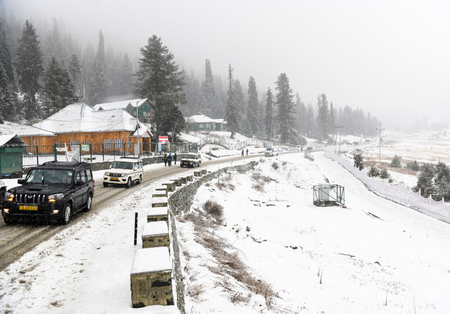
Light snowfall graced the higher regions of Kashmir Valley in the past 12 hours while the plains experienced rain on Thursday. Tourists at Gulmarg, Sonamarg, and Pahalgam enjoyed the snowfall on New Year’s Eve, singing and dancing to welcome the new year. In Srinagar’s Lal Chowk, numerous tourists gathered despite the cold weather to celebrate the arrival of the new year.
Hotels, lodges, and guest houses in the Valley are fully booked, raising hopes for a prosperous and peaceful 2026 for the locals involved in the tourism sector. The Valley witnessed a decline in tourist arrivals after a severe terror attack in Pahalgam in April 2025, but the resurgence of winter tourism has brought optimism. Residents of Srinagar and other towns missed the traditional snowfall on New Year’s Eve, affecting plans for snow-related activities.
Srinagar recorded a minimum temperature of 2.2 degrees Celsius, while Gulmarg and Pahalgam registered -5.5 and 0.4 degrees respectively. Jammu city saw a minimum temperature of 10.7 degrees Celsius, with Katra, Batote, Banihal, and Bhaderwah experiencing slightly lower temperatures. The ‘Chillai Kalan’, a 40-day period of severe winter cold, began on December 21, 2025, and will conclude on January 30, 2026.
The absence of heavy snowfall during this period could lead to significant challenges in irrigation for agriculture, horticulture, and water supply in Jammu and Kashmir. The heavy snowfall during Chillai Kalan is crucial for replenishing water reservoirs in the mountains, which support the region’s water resources during the summer. Due to insufficient rain and snowfall this winter, water sources like rivers, streams, and lakes are at their lowest levels, with December 2025 recording a 28% rainfall deficit.
