


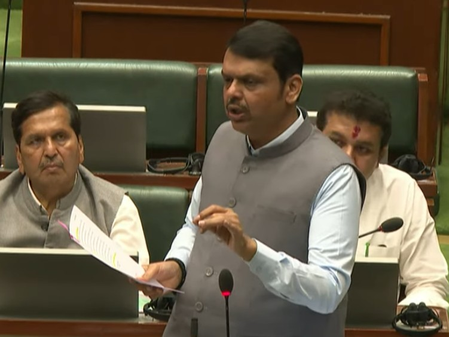
Maharashtra Chief Minister Devendra Fadnavis revealed the state budget for 2026-27, totaling Rs 7,69,467 crore in the state Assembly. The budget includes a crop loan waiver of up to Rs 2 lakh for farmers and various initiatives to enhance agriculture, infrastructure, and social welfare. It anticipates a revenue deficit of Rs 40,552 crore and a fiscal deficit of Rs 1,50,491 crore, with revenue receipts of Rs 6,16,099 crore against revenue expenditure of Rs 6,56,651 crore for the financial year.
Fadnavis highlighted that the government has successfully kept the revenue deficit below 1% of Gross State Domestic Product (GSDP) and the fiscal deficit below 3% of GSDP. The revised estimates for 2025-26 indicate revenue receipts at Rs 6,01,789 crore, surpassing the budget estimates. The budget speech outlined a vision for “Viksit Maharashtra 2047,” emphasizing agriculture, healthcare, sustainable development, and good governance, aiming for a 1 trillion dollar economy by 2030 and a 5 trillion dollar economy by 2047.
A key feature of the budget is the Punyashlok Ahilyabai Holkar Farmers’ Loan Waiver Scheme, forgiving crop loans up to Rs 2 lakh per farmer as of September 3, 2025. The government also allocated Rs 20,000 crore to provide free electricity to farmers using water pumps up to 7.5 HP. Moreover, a pilot project employing artificial intelligence will be initiated in 75 villages to offer farmers real-time data on weather, crop trends, and soil health to boost productivity.
In terms of infrastructure, Maharashtra plans to become a “seamless multimodal hub,” developing a substantial metro rail network and expressways by 2047. The budget proposes dedicated funding and expedited execution for the Mumbai – Pune high-speed rail corridor. Projects like the Sewri-Worli connector and underground tunnels in Mumbai and Pune are scheduled to alleviate traffic congestion.
To support startups, a Startup and Innovation Centre will be established in Wadala, spanning 130 acres. A new commissionerate will be formed to aid micro, small, and medium enterprises (MSMEs). Major “growth hubs” will be developed in the Mumbai Metropolitan Region, Pune, and Nagpur with a combined investment of Rs 5,000 crore over the next five years.
Regarding social welfare, the Ladki Bahin Yojana will continue with necessary funding, following a verification process for fiscal discipline and genuine beneficiaries. The government has allocated Rs 33,410 crore for the Pradhan Mantri Awas Yojana-Gramin, now including mandatory rooftop solar installations. Additionally, a new film city will be established in Ramtek, Vidarbha, to decentralize the state’s entertainment industry.
