


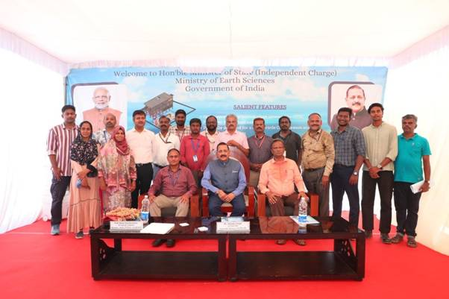
The Ministry of Earth Sciences highlighted that ocean technology projects in Lakshadweep will enhance water security and create opportunities for clean energy in island regions. Union Minister of State for Earth Sciences and Science and Technology, Dr. Jitendra Singh, recently assessed the progress of crucial projects by the National Institute of Ocean Technology during a meeting in Kavaratti. The review focused on the functioning of existing Low Temperature Thermal Desalination (LTTD) plants and the upcoming Ocean Thermal Energy Conversion (OTEC)-powered desalination facility in Lakshadweep.
During the meeting with scientists and officials from the National Institute of Ocean Technology (NIOT) in Kavaratti, the minister evaluated the operational status of LTTD plants on eight islands of Lakshadweep. These plants, established by the government through NIOT, offer a reliable source of drinking water in a region historically facing challenges like limited groundwater resources and salinity intrusion. The technology operates by converting seawater into potable water using the temperature variance between warm surface water and cold deep-sea water.
The ministry emphasized that the availability of desalinated water has enhanced access to safe drinking water and reduced dependence on rainwater harvesting systems across Lakshadweep. Additionally, progress on the nation’s first OTEC-powered desalination plant in Kavaratti was reviewed by the minister. This innovative facility aims to produce electricity and potable water simultaneously by harnessing the ocean’s natural thermal gradient. The project involves civil construction nearing completion and the fabrication of major process equipment for installation.
NIOT officials mentioned that the OTEC-powered desalination plant project includes deploying a high-density polyethylene pipeline to draw cold seawater from depths exceeding 1,000 meters. Welding of pipeline sections is currently ongoing along the southern side of the Kavaratti lagoon, with significant progress already made. Once operational, the plant is projected to generate around 100 cubic meters of potable water daily, reducing reliance on diesel-based electricity and supporting the island’s water and energy requirements in the long run.
