


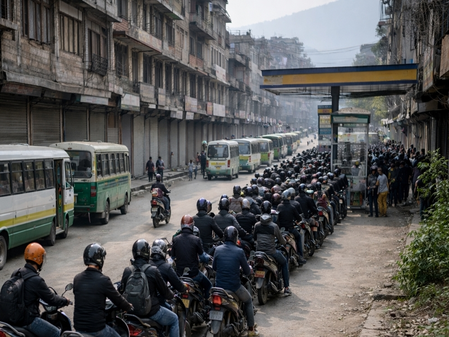
Citing disruptions in global oil supply from West Asia, the Nepali government has decided to introduce a two-day weekend for government offices and educational institutions. Public holidays will now fall on Saturdays and Sundays under this new arrangement. Minister Sasmit Pokharel, responsible for Education, Science, Technology, Youth, and Sports, announced the Cabinet’s decision following concerns over the impact of oil supply disruptions on the global economy, especially in Asian nations.
Government offices, except educational institutions, will now operate from 9 a.m. to 5 p.m. on working days, a change from the previous timing of 10 a.m. to 5 p.m. Additionally, the Nepal Cabinet plans to establish the necessary legal framework to support the conversion of petrol- and diesel-powered vehicles to electric vehicles. Despite a growing shift towards electric cars for new purchases, internal combustion engine (ICE) vehicles remain prevalent in the market due to past buying trends.
The ongoing conflict involving the U.S., Israel, and Iran has led to the closure of the Strait of Hormuz, a critical passage for about 20% of the world’s fuel supply. With many Asian countries heavily reliant on West Asian oil for various purposes such as energy production, transportation, and cooking, the disruptions have had significant repercussions. Nepal, which relies entirely on India for refined fuel and gas, is also feeling the impact of the supply chain disruptions stemming from the region.
As a result of the oil supply disruptions, Nepal has experienced a surge in domestic market prices, affecting not only fuel but also the prices of essential goods and non-food items. This situation has created challenges for households and businesses, highlighting the broader economic implications of the global oil supply chain disruptions.
