


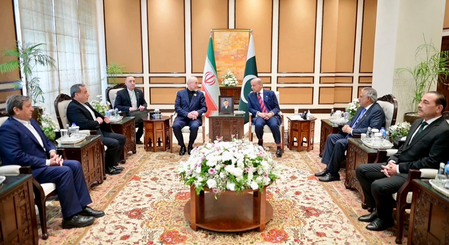
Pakistan’s involvement in mediating between the United States and Iran has been likened to that of a courier rather than a mediator, lacking substantial leverage or proposed solutions. Acting as a diplomatic channel, Pakistan facilitated communication between major powers like China without direct engagement, a report revealed.
The United States and Iran agreed to a two-week ceasefire on April 8, with Pakistan being credited as the ‘mediator’ behind this development. However, beyond the surface, Pakistan’s role seemed more like that of a messenger shuttling messages between the US and China, rather than actively shaping outcomes.
Following Pakistani Foreign Minister Ishaq Dar’s visit to Beijing, elements of a joint peace proposal by China and Pakistan emerged in the ceasefire framework accepted by both Washington and Tehran. The proposal focused on key concerns for China, such as the Strait of Hormuz, while leaving more contentious issues ambiguous.
For US President Donald Trump, openly acknowledging Chinese assistance would have posed political challenges, potentially signaling reliance on Beijing’s influence over Tehran. Meanwhile, China, historically cautious about high-profile diplomatic engagements, took a discreet role to avoid reputational risks.
Pakistan played a crucial role in bridging the gap between the US and China, providing a partner for the US to acknowledge publicly and a channel for China’s influence over Iran to operate discreetly. This strategic coordination likely involved discussions on securing China as a guarantor for any agreement, with Beijing potentially serving as the ultimate guarantor for any US-Iran agreement.
The report emphasized that Pakistan’s role should be viewed more as that of a diplomatic courier rather than a mediator, with the ceasefire’s structure and key arrangements being influenced significantly by Beijing alongside Islamabad.
