


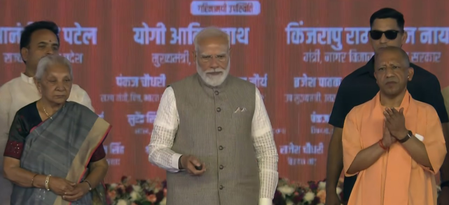
Prime Minister Narendra Modi inaugurated the Noida International Airport in Jewar, Uttar Pradesh, a significant step in India’s aviation infrastructure expansion. The airport, developed under the Public-Private Partnership model with an investment of about Rs 11,200 crore, is set to begin operations with Phase I ready. Envisioned as a major international gateway for the National Capital Region (NCR), the airport aims to enhance both regional and global connectivity.
The Noida International Airport will serve as the second international airport for the Delhi-NCR region, complementing the Indira Gandhi International Airport. Together, these airports are expected to form an integrated aviation network, reducing congestion, increasing passenger capacity, and positioning Delhi-NCR as a global aviation hub. The facility, one of the largest greenfield airport projects in India, will initially cater to around 12 million passengers annually, with plans to scale up to 70 million passengers per year upon full development.
Featuring a 3,900-meter-long runway capable of accommodating wide-body aircraft, the airport boasts advanced navigation infrastructure like the Instrument Landing System and modern airfield lighting for efficient, all-weather operations. It includes a comprehensive cargo ecosystem, including a Multi-Modal Cargo Hub with an Integrated Cargo Terminal and logistics zones, designed to handle over 2.5 lakh metric tonnes annually initially, with expansion potential up to around 18 lakh metric tonnes.
The airport also houses a dedicated 40-acre Maintenance, Repair, and Overhaul (MRO) facility, emphasizing sustainability and future-readiness through net-zero emissions operations. Its architectural design blends Indian heritage elements inspired by traditional ghats and havelis with modern infrastructure. The inauguration event saw extensive security measures, with the region divided into multiple security zones and heavy police and paramilitary presence to ensure a smooth program without incidents.
