


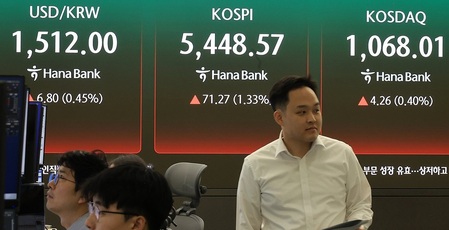
South Korean stocks faced a decline on Monday due to escalating concerns over the prolonged conflict in the Middle East. This unease followed the stalled U.S.-Iran peace talks and President Donald Trump’s warning of a potential blockade of the Strait of Hormuz. The Korea Composite Stock Price Index (KOSPI) fell by 1.16 percent to 5,790.72.
President Trump’s announcement of a blockade on Iranian ports came after unsuccessful discussions between Washington and Tehran in Islamabad. The U.S. military confirmed the blockade would be enforced at 10 a.m. Monday (U.S. time). Analysts, like Seo Sang-young from Mirae Asset Securities, highlighted that the breakdown in talks and the looming blockade could heighten uncertainties, amplifying worries about global supply chains.
In the South Korean market, key players like Samsung Electronics and Hanmi Semiconductor experienced declines. Samsung Electronics dropped by 2.31 percent, while Hanmi Semiconductor, a significant chip equipment manufacturer, saw a 2.8 percent dip. Additionally, shipbuilders such as HD Hyundai Heavy Industries and Hanwha Ocean also registered losses, with declines of 2.11 percent and 2.19 percent, respectively.
Amidst the market downturn, some companies managed to buck the trend. CJ Cheiljedang, a prominent food giant, recorded a 0.84 percent increase. Meanwhile, Samyang Foods, renowned for its Buldak ramyeon series, surged by 4.85 percent. The South Korean won also weakened against the U.S. dollar, opening at 1,495.4 per dollar, down by 12.9 won from the previous session’s close. The currency’s volatility has been influenced by developments in the Middle East conflict, particularly the spike in oil prices, which have raised concerns about inflation and a potential economic slowdown.
The dollar index, a measure of the U.S. dollar’s value against major currencies, rose by 0.4 percent to 99.04, reflecting the broader impact of geopolitical tensions on global markets.
