


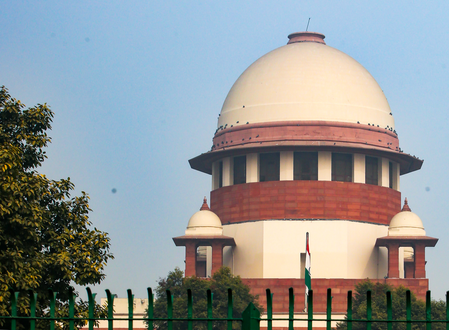
The Supreme Court has ruled that a High Court does not have the authority to waive the statutory penalty for deficient stamp duty. This power exclusively belongs to the competent authority under the relevant Stamp Act. In a significant judgment, a bench of Justices Sanjay Kumar and K. Vinod Chandran overturned a Karnataka High Court order that had exempted the penalty while requiring payment of deficient stamp duty on lease documents.
The apex court was addressing an appeal related to a long-pending partition suit from 2008, where the admissibility of two lease documents was disputed due to insufficient stamping. The bench led by Justice Sanjay Kumar clarified that once a document is found to be inadequately stamped, its impounding is mandatory under the Karnataka Stamp Act, 1957. The statutory framework does not allow courts to lessen penalty provisions as done by the High Court.
According to the Supreme Court, the High Court cannot direct payment of stamp duty and waive the penalty mandated by the statute. The determination of deficit duty and imposition of penalty fall within the jurisdiction of the Deputy Commissioner under the Karnataka Stamp Act. The court emphasized that imposing a penalty is compulsory when an insufficiently stamped document is sought to be admitted in evidence.
The Supreme Court highlighted that there is no discretion for the court to impose a penalty less than ten times the deficit duty when admitting an instrument as evidence. However, it mentioned that the Deputy Commissioner may have the discretion to reduce or refund excess penalty in accordance with the law. The liability to pay stamp duty and penalty in lease transactions lies with the lessee, granting them the choice to pay duty and penalty before the court or seek adjudication by the Deputy Commissioner.
The court clarified that documents can only be admitted in evidence after complying with the Stamp Act, rejecting the plea for a speedy trial of the suit independent of stamp duty proceedings. The Supreme Court set aside the Karnataka High Court’s direction that waived the penalty, concluding the appeal without expressing any opinion on the civil dispute’s merits. The appeal was drafted and filed by Ayush Negi and argued by senior advocate Nachiketa Joshi, supported by advocate Aarushi Gupta for the petitioner.
