


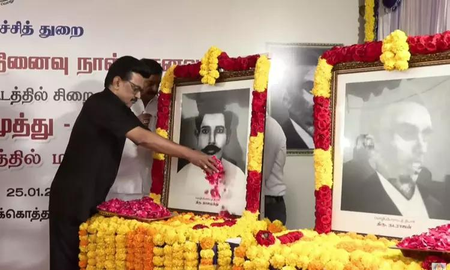
Tamil Nadu Chief Minister M.K. Stalin honored Language Martyrs’ Day by paying tribute to those who sacrificed their lives during the anti-Hindi protests. Dressed in black, he visited the Thalamuthu-Natarasan Memorial in Chennai to honor the martyrs of the language movement. Stalin laid floral wreaths at the portraits of Thalamuthu and Natarasan, who lost their lives protesting against the imposition of Hindi.
The Chief Minister, in a solemn moment, chanted, “Salutations to the martyrs of the language struggle,” emphasizing the state’s commitment to linguistic pride and federal principles. He expressed his firm stance against Hindi by stating that it has no place in Tamil Nadu. Stalin highlighted the state’s history of resisting Hindi imposition and protecting the linguistic rights and identities of diverse communities in the region.
Language Martyrs’ Day, observed annually on January 25, commemorates those who resisted mandatory Hindi, especially during the anti-Hindi movements of the 1930s and the protests in 1965. The 1965 agitation, marked by student and public participation, resulted in casualties and influenced national language policies. Following protests, the Union government ensured that English would remain an associate official language alongside Hindi, maintaining India’s multilingual character.
Deputy Chief Minister Udhayanidhi Stalin, along with Ministers P.K. Sekar Babu and M.P. Saminathan, and Chennai Mayor R. Priya, joined the Chief Minister in paying tribute. The event was attended by senior officials, party leaders, and the public, highlighting the enduring significance of the language issue in Tamil Nadu’s public discourse. Later, CM Stalin is set to unveil statues of Thalamuthu and Natarasan at the Thalamuthu-Natarasan Mansion complex in Egmore, expected to draw students, language activists, and various organizations.
By leading the commemoration, CM Stalin reiterated the Dravidian movement’s belief that linguistic rights are crucial for social justice, self-respect, and India’s federal unity, shaping Tamil Nadu’s political and cultural landscape.
