


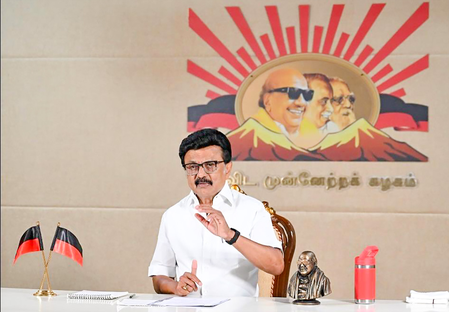
Tamil Nadu Chief Minister, M.K. Stalin, has criticized the Centre’s delimitation exercise, calling it an attempt to consolidate political power rather than a genuine reform. He expressed concerns about the proposal to increase parliamentary constituencies, stating that it contradicts the BJP’s principle of “minimum government, maximum governance.” CM Stalin argued that expanding constituencies could lead to unfair political representation rather than improving governance.
The Chief Minister highlighted that the delimitation process could disproportionately affect southern states like Tamil Nadu, which have successfully implemented population control measures. He warned that this could disadvantage states with lower population growth rates, such as those in the south, while benefiting states with higher population growth, particularly in northern India. CM Stalin also raised apprehensions about the potential increase in political influence of northern states at the expense of southern states in Parliament.
Stalin expressed his reservations about the Centre’s decision to link women’s reservation with the delimitation process, deeming it politically motivated and unnecessary. He emphasized the need for implementing women’s reservation without delay based on existing constituencies. The Chief Minister also highlighted concerns regarding social justice issues, particularly the underrepresentation of Other Backward Classes (OBCs) in policy-making.
CM Stalin reiterated the demand for a caste-based census, stressing that the lack of such measures undermines equitable representation and policy formulation. He criticized the unchanged income ceiling of ₹8 lakh for determining the “creamy layer” among OBCs, calling for a revision to ensure fairness and inclusivity. The Chief Minister framed the proposed delimitation as a significant political move with implications for federal principles and social justice, advocating for a more balanced and inclusive approach.
