


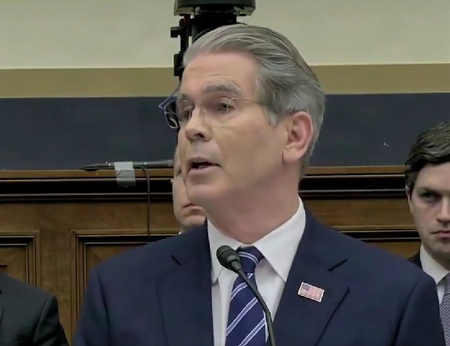
Treasury Secretary Scott Bessent highlighted the importance of economic growth and household security in maintaining financial system stability during a Senate Banking Committee hearing. Bessent mentioned that the Financial Stability Oversight Council (FSOC) is now focusing on identifying specific vulnerabilities rather than broadly categorizing large sectors as risks. He criticized past regulatory approaches as reactive and emphasized the need to promote economic growth for financial stability.
The hearing, which reviewed FSOC’s 2025 annual report, marked a shift towards a more targeted regulatory strategy. Bessent stressed that excessive regulation could hinder stability by impeding growth and opportunities. He emphasized that economic stagnation poses a significant threat to financial stability.
Republican Chairman Tim Scott supported the new approach, emphasizing the importance of aligning affordability with growth. He stated that a system that constrains growth or limits opportunities is not conducive to stability. Ranking Member Elizabeth Warren from the Democratic Party expressed concerns about weakening regulatory safeguards and warned of overlooked risks.
Bessent defended FSOC’s revised focus on strengthening household and business balance sheets. He highlighted that economic growth plays a crucial role in fortifying balance sheets, reducing the risk of defaults and financial stress. Lawmakers engaged in discussions on inflation and bank failures, with Warren cautioning against rolling back oversight to prevent potential crises.
Bessent clarified that FSOC’s objective is not to eliminate risk entirely but to manage it effectively. He cautioned against pursuing a zero-risk financial system, referring to it as “the stability of the graveyard.” FSOC, established post the 2008 financial crisis, monitors systemic risks across markets and institutions, uniting senior regulators from various agencies.
The US regulatory approach and its impact on growth are closely monitored by global markets, including India, where stakeholders track US signals for insights into capital flows and financial conditions.
