


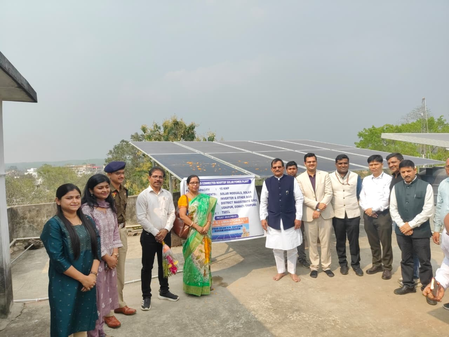
Minister of State for Power and New and Renewable Energy, Shripad Y. Naik, inaugurated a 15-kilowatt grid-connected rooftop solar power plant at the Gomati District Magistrate’s office in Agartala. This marks the beginning of Tripura’s plan to solarize all district administrative headquarters. The state government aims to transition all eight District Magistrate offices to solar-powered electricity generation.
The project aligns with the Ministry of New and Renewable Energy’s “Solar Sankalp” initiative. Tripura State Electricity Corporation Limited (TSECL), the state’s power utility, is responsible for executing the project. Minister Naik emphasized that solar energy is set to play a crucial role in India’s future energy landscape, highlighting the environmental benefits of integrating government offices into the solar energy framework.
Gomati district is the first to have the solar project commissioned, with plans to install rooftop solar plants at the remaining seven district magistrate offices. These installations, totaling 304 kilowatts across all offices, are estimated to cost Rs 2.43 crore. Once operational, these systems are expected to fulfill a significant portion of each office’s energy needs with clean and renewable power.
Tripura Power Minister Ratan Lal Nath praised the initiative as a forward-looking step in the state’s energy policy. He emphasized the cost-saving and environmental benefits of government offices generating their own electricity. Minister Nath also encouraged citizens to participate in the PM Surya Ghar: Muft Bijli Yojana by installing rooftop solar panels for reduced electricity bills and potential earnings through surplus power export.
The grid-connected rooftop solar model enables on-site consumption of generated electricity during the day, reducing reliance on conventional power sources. Any excess power is fed back into the grid, leading to cost savings, efficient energy utilization, and reduced carbon emissions. Energy experts view the solarization of administrative buildings as a practical move towards energy self-reliance, showcasing the adoption of clean energy solutions in public infrastructure.
