


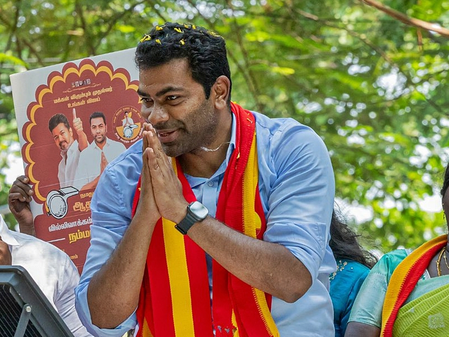
Tamilaga Vettri Kazhagam (TVK) election campaign general secretary Aadhav Arjuna criticized Tamil Nadu Chief Minister M.K. Stalin, accusing him of prioritizing family interests over senior party members and allies before the Assembly elections. Arjuna claimed that Stalin favored his son-in-law V. Sabareesan over his sister, sitting MP Kanimozhi Karunanidhi, and was grooming his son, Udhayanidhi Stalin, for a more significant political role, leading to what he called a rise in family dominance within the party.
Arjuna alleged that experienced leaders like Kanimozhi and general secretary Duraimurugan were being marginalized, with crucial decisions increasingly made by a close inner circle. He also criticized the DMK’s candidate selection process, stating that nominations mainly favored individuals supported by Udhayanidhi Stalin and Sabareesan, causing discontent within the party and uncertainty among coalition partners.
The TVK leader highlighted delays in candidate finalization by key allies such as the Congress, indicating internal issues within the DMK-led alliance affecting coordination. Drawing parallels with Bihar’s political landscape, Arjuna claimed that major parties tend to weaken their allies over time, citing instances like the MDMK contesting under the DMK’s symbol, which he argued eroded their independent political identity.
Arjuna questioned the inclusion of the DMDK in the DMK-led coalition, suggesting it contradicted the ideological principles of its late founder, Vijayakanth. He warned that such alliances could compromise the party’s original vision. Additionally, he alleged pressure tactics on smaller allies and leaders, like VCK chief Thol. Thirumavalavan, in influencing candidate selection and electoral strategies.
Expressing confidence in TVK’s electoral prospects, Arjuna stated that the party had candidates in all 234 constituencies and claimed a substantial shift of about 25% of the AIADMK’s traditional vote base towards TVK. Accusing the DMK of electoral misconduct, he claimed they offered cash incentives to voters, up to Rs 10,000 per vote, while affirming TVK’s commitment to fair practices and advocating for administrative changes, especially in the police force, to ensure transparent elections.
