


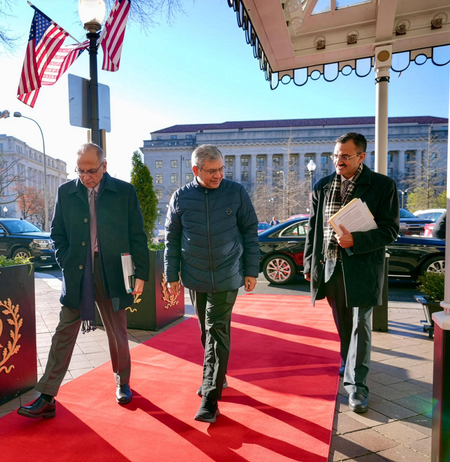
Union Minister for Railways and Electronics and IT, Ashwini Vaishnaw, has traveled to the US to take part in the ‘Critical Minerals Ministerial Meeting’ set for Monday. Vaishnaw emphasized the importance of secure critical mineral supply chains for India’s development goals, known as Viksit Bharat.
The Indian government recently unveiled a scheme to boost the production of sintered Rare Earth Permanent Magnets (REPM) to increase India’s involvement in global advanced-materials value chains and reduce reliance on imports. This initiative, with a budget of Rs 7,280 crore, aims to establish 6,000 metric tonnes per annum of integrated REPM manufacturing capacity, covering the entire chain from rare-earth oxides to finished magnets.
The scheme is structured to enhance competitiveness, attract technology-driven investments, and facilitate long-term scalability while supporting energy-transition objectives and India’s Net Zero 2070 vision. By fostering domestic capabilities and reinforcing downstream connections, this program is expected to create jobs, strengthen industrial capacity, and align with the vision of Atmanirbhar Bharat.
To implement the scheme, 6,000 MTPA of domestic manufacturing capacity will be allocated across five beneficiaries through global competitive bidding, with each eligible for up to 1,200 MTPA. The plan includes Rs 6,450 crore as sales-linked incentives over five years and a Rs 750 crore capital subsidy, to be executed over seven years with a two-year gestation period followed by five years of incentive disbursement.
The Ministry of Mines has engaged in bilateral agreements with mineral-rich nations like Australia, Argentina, Zambia, Peru, Zimbabwe, and Mozambique. Additionally, India actively participates in multilateral forums such as the Minerals Security Partnership (MSP) and the Indo-Pacific Economic Framework (IPEF) to fortify resilient critical minerals supply chains.
