


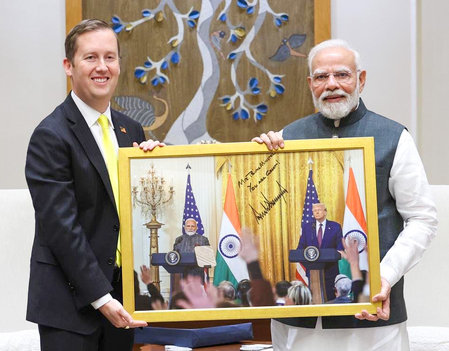
The United States is prioritizing India in its long-term global strategy, with Ambassador Sergio Gor underlining a comprehensive agenda covering defense, trade, and emerging technologies. Gor, the current US Ambassador to India, aims to elevate the bilateral relationship to a defining strategic partnership of the 21st century. Emphasizing a results-driven approach influenced by his experience under President Trump, Gor stresses the importance of tangible outcomes benefiting both nations.
Defence collaboration stands out as a key aspect of the relationship, with initiatives like the Major Defence Partnership and a new 10-year framework expanding cooperation in defense industrial production, science, technology, and operational coordination. Joint military exercises such as Malabar, Tiger Triumph, and Cope India are enhancing interoperability between the armed forces of both countries, ensuring robust defense cooperation. Gor expresses confidence in further strengthening ties to realize his vision of a transformative US-India partnership.
Gor envisions a partnership that delivers concrete benefits to citizens, including increased opportunities for American farmers in Indian markets, joint advancements in energy and medicine research, and seamless military operations for a secure Indo-Pacific region. Rooted in shared democratic values, mutual prosperity, and common security interests, the US-India relationship is poised to shape the global order for generations to come. On the economic front, Gor highlights the potential for expanded bilateral trade, particularly in sectors like energy, aviation, and advanced manufacturing, emphasizing mutual gains.
Additionally, cooperation in securing critical supply chains is growing, with initiatives like the US-India COMPACT framework and the Pax Silica Declaration focusing on building resilience in semiconductors, critical minerals, and pharmaceuticals while reducing reliance on single sources. Artificial intelligence emerges as a significant area of collaboration, with Gor noting the vast potential for US-India cooperation in this field. While acknowledging the benefits, he cautions against centralized global regulation, advocating for a balanced approach to AI governance that avoids excessive restrictions.
