


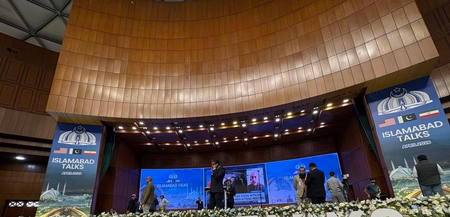
US media outlets covered the ongoing Iran talks in Islamabad, emphasizing extended negotiations and disagreements over crucial issues. The New York Times, The Wall Street Journal, and The Washington Post described the talks as a lengthy diplomatic process between traditional adversaries, with discussions lasting late into the night and early Sunday. Negotiations between US and Iranian officials continued past 5 a.m. local time on Sunday, with both sides aiming to achieve peace following weeks of conflict. The talks, lasting over 15 hours, indicated that there were still unresolved topics, particularly focusing on control of the economically significant Strait of Hormuz.
The talks between the US and Iran, which extended into early Sunday, were described as historic by The New York Times. The prolonged engagement highlighted the commitment of both sides to dialogue despite the absence of a breakthrough. The central point of contention was identified as control over the Strait of Hormuz, a crucial waterway in the dispute between Washington and Tehran. The direct face-to-face engagement at such a high level was deemed remarkable given the historical animosity between the two nations.
The Wall Street Journal’s coverage centered on the security conditions in Islamabad during the talks. The Pakistani capital was described as a “ghost town” due to extensive security measures implemented by authorities. Central Islamabad was under lockdown, with closed roads, shut businesses, and a heavy presence of police and security personnel. The venue of the talks was heavily secured, with stringent checks for journalists before entering the press center to prevent any disruptions to the discussions.
The Washington Post highlighted the significance of the negotiations as the highest level of direct interaction between the US and Iran in decades, led by Vice President JD Vance. The talks, which continued well past midnight, transitioned into technical discussions, indicating some progress but significant differences on key issues. Both sides aimed for a more lasting resolution to the conflict after agreeing to a temporary ceasefire, although substantial gaps remained in their positions. The lack of clarity on the negotiation outcomes was a common theme across media coverage, with the White House refraining from disclosing details despite the talks’ duration.
