
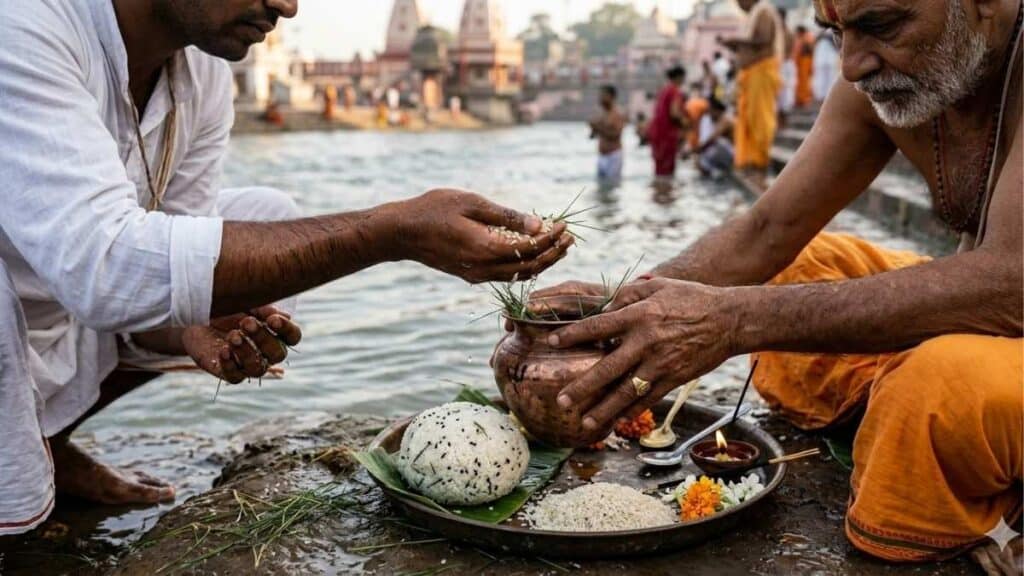
Pitru Paksha is one of Hinduism’s most sacred and solemn observances — a 16-lunar-day period dedicated to honoring deceased ancestors through food offerings, water rituals, and prayer. Known as the “fortnight of the paternal ancestors,” Pitru Paksha reflects one of Hinduism’s core values: the duty to remember and repay those who came before us.
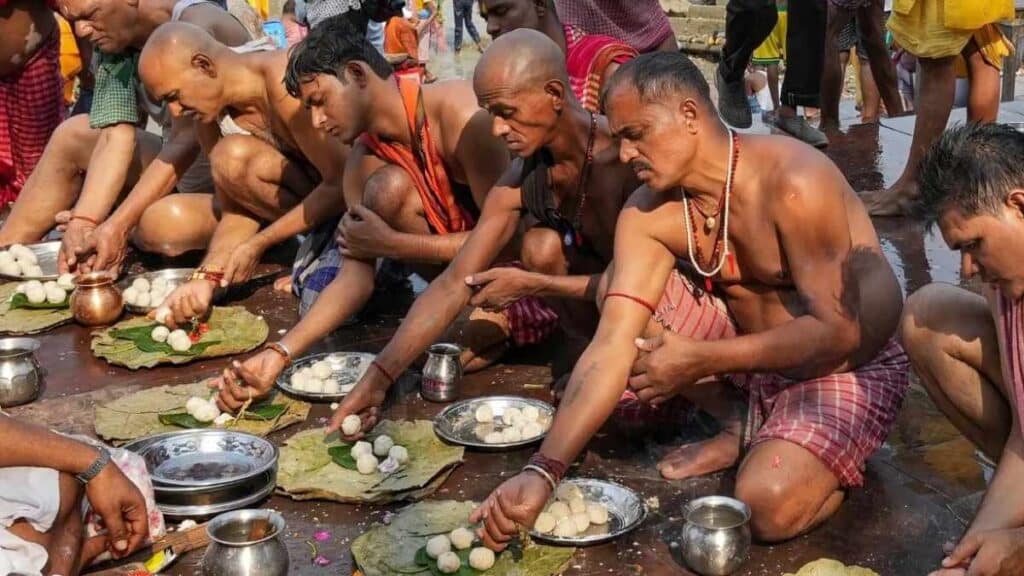
Rooted in ancient Vedic tradition, Pitru Paksha is observed through Shraddha — rituals of offering cooked food, pindas (rice balls), and holy water (tarpan) to the souls of departed forebears. Hindus believe these acts bring peace to ancestral souls residing in Pitriloka, the realm between heaven and earth, and in return bestow blessings of health, prosperity, knowledge, and moksha (liberation) upon the living.
The period is considered deeply sacred but inauspicious for new beginnings — no weddings, housewarming ceremonies, or auspicious events are typically scheduled during these 16 days. The concluding day, Sarva Pitru Amavasya (Mahalaya Amavasya), is the most significant, when offerings can be made for all ancestors regardless of when they passed.
Pitru Paksha is observed by Hindus across India, Nepal, and the global diaspora in countries including the USA, UK, Canada, UAE, Australia, and Singapore.
When Is Pitru Paksha in 2026?
Pitru Paksha 2026 begins on Saturday, September 26, 2026 (Purnima Shraddha) and concludes on Saturday, October 10, 2026 (Sarva Pitru Amavasya / Mahalaya Amavasya). The period spans 16 lunar days in the Krishna Paksha (waning fortnight) of the Hindu month of Ashwina.
Pitru Paksha 2026 Dates in India
- Start: Purnima Shraddha — September 26, 2026 (Saturday)
- End: Sarva Pitru Amavasya (Mahalaya Amavasya) — October 10, 2026 (Saturday)
Shraddha rituals are traditionally performed at midday (Kutup Muhurta), ideally on the riverbank or at home. The specific day within Pitru Paksha on which an individual performs Shraddha corresponds to the lunar tithi on which their ancestor died.
Table of Contents
Pitru Paksha In USA, Canada, Australia, New Zealand, UK, UAE, Singapore 2026 Dates
- Start: Purnima Shraddha — September 25, 2026 (Friday)
- End: Sarva Pitru Amavasya (Mahalaya Amavasya) — October 9, 2026 (Friday)
- Start: Purnima Shraddha — September 25, 2026 (Friday)
- End: Sarva Pitru Amavasya (Mahalaya Amavasya) — October 9, 2026 (Friday)
- Start: Purnima Shraddha — September 26, 2026 (Saturday)
- End: Sarva Pitru Amavasya (Mahalaya Amavasya) — October 10, 2026 (Saturday)
- Start: Purnima Shraddha — September 26, 2026 (Saturday)
- End: Sarva Pitru Amavasya (Mahalaya Amavasya) — October 10, 2026 (Saturday)
- Start: Purnima Shraddha — September 26, 2026 (Saturday)
- End: Sarva Pitru Amavasya (Mahalaya Amavasya) — October 10, 2026 (Saturday)
- Start: Purnima Shraddha — September 26, 2026 (Saturday)
- End: Sarva Pitru Amavasya (Mahalaya Amavasya) — October 10, 2026 (Saturday)
Why Do Pitru Paksha Dates Change Every Year?
Pitru Paksha follows the Hindu lunisolar calendar, not the Gregorian calendar. It always falls in the Krishna Paksha (waning fortnight) of the month of Bhadrapada or Ashwina — depending on whether the Amanta (South Indian) or Purnimanta (North Indian) calendar tradition is followed. Since a lunar year is approximately 11 days shorter than a solar year, the dates shift annually on the Gregorian calendar.
The autumnal equinox — when the Sun transitions from the northern to the southern celestial sphere — also typically falls within this period, an astronomical moment considered sacred in Hindu tradition.
Day-by-Day Shraddha Dates 2026
| Shraddha | Date | Day |
|---|---|---|
| Purnima Shraddha | September 26 | Saturday |
| Pratipada Shraddha | September 27 | Sunday |
| Dwitiya Shraddha | September 28 | Monday |
| Tritiya / Maha Bharani | September 29 | Tuesday |
| Chaturthi Shraddha | September 30 | Wednesday |
| Panchami Shraddha | September 30 | Wednesday |
| Shashthi Shraddha | October 1 | Thursday |
| Saptami Shraddha | October 2 | Friday |
| Ashtami Shraddha | October 3 | Saturday |
| Navami Shraddha (Avidhava Navami) | October 4 | Sunday |
| Dashami Shraddha | October 5 | Monday |
| Ekadashi Shraddha | October 6 | Tuesday |
| Dwadashi / Magha Shraddha | October 7 | Wednesday |
| Trayodashi Shraddha | October 8 | Thursday |
| Chaturdashi Shraddha | October 9 | Friday |
| Sarva Pitru Amavasya (Mahalaya) | October 10 | Saturday |
Other Names and Regional Identities
Pitru Paksha is known by many names across India’s diverse linguistic communities:
- Hindi (North India): Pitru Paksha, Pitarpas, Kanagat
- Bengali: Pitri Pokkho (পিতৃ পক্ষ), Mahalaya (মহালয়া)
- Marathi: Pitrupaksha, Mahalaya Shraddha
- Telugu: Apara Paksha, Peddala Amavasya
- Kannada: Pitru Paksha, Mattu Amavasya
- Tamil: Mahalaya Paksha, Pitru Karma
- Odia: Mahalaya, Bada Osha
- Assamese: Shraaddhaa
- Nepali: Shraddha Karma, Pinda Daan
- Pan-India / Diaspora: Sorah Shraddha (“sixteen shraddhas”), Jitiya, Akhadpak, Mahalaya
In diaspora communities worldwide, the period is most commonly referred to as Pitru Paksha, Shraddha, or Mahalaya.
Origins, History, and Legends
Pitru Paksha has ancient Vedic origins grounded in both cosmology and astronomy. References to Shraddha rituals appear across foundational Hindu scriptures including the Manusmriti, Garuda Purana, Markandeya Purana, and Viramitrodaya. According to Hindu tradition, the south celestial sphere is consecrated to ancestors. The moment the Sun transits from the north to the south celestial sphere — the autumnal equinox — is considered the sacred beginning of the ancestors’ day, around which this entire fortnight is observed.
The most beloved legend of Pitru Paksha comes from the Mahabharata. When the great warrior Karna died and his soul ascended to heaven, he was tormented by extreme hunger — every morsel of food he touched turned to gold. When he sought the reason from Indra, he was told that although he had donated gold throughout his life, he had never offered food to his ancestors during Shraddha. As penance, Karna was permitted to return to Earth for 15 days to perform these rites. That period is what we now observe as Pitru Paksha.
Hindu tradition also holds that souls of three preceding generations reside in Pitriloka, a realm between heaven and earth governed by Yama, the god of death. Shraddha is performed specifically for these three generations, and according to Swami Sivananda, the offerings increase the well-being of souls in heaven, mitigate suffering in other realms, and add to the happiness of souls already reborn.
Cultural and Spiritual Significance
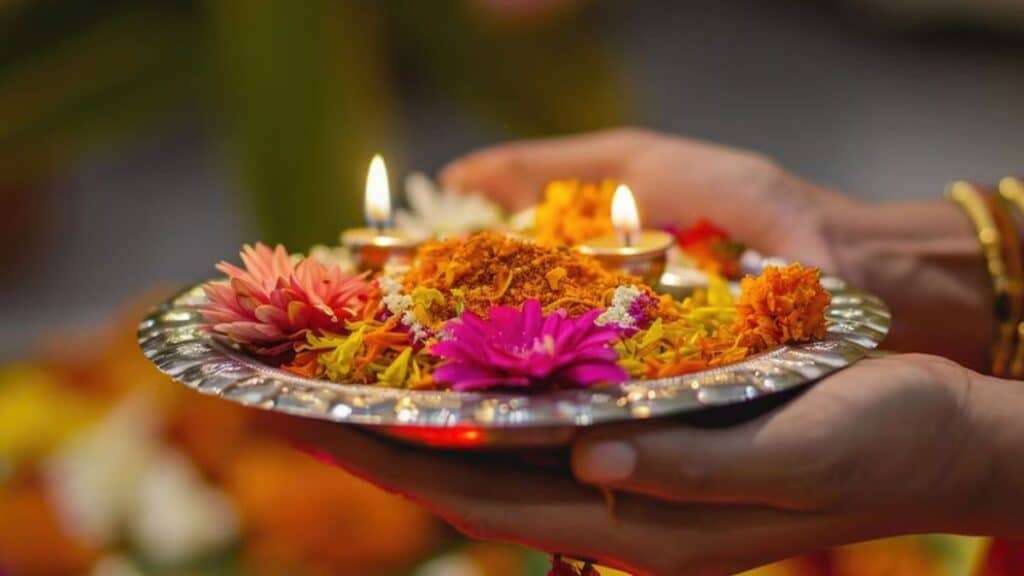
Pitru Paksha embodies a profound philosophy of gratitude and continuity. It teaches that the living and the dead are not separated — the ancestors remain connected to their descendants through an unbroken thread of memory and duty.
Shraddha involves reciting the names of three preceding generations, ensuring that at least six generations — three past, the present, and two future — remain known within a family. Anthropologist Usha Menon of Drexel University notes that Pitru Paksha powerfully connects the deceased, the living, and the yet-unborn through the bonds of blood.
Beyond the family, the ritual reaffirms lineage, social memory, and cultural identity — values especially significant for diaspora communities navigating life far from ancestral roots and rivers.
Prayers and Religious Observances
Tarpan is the primary daily ritual — cupping water mixed with black sesame seeds and barley in the palms and releasing it with Vedic mantras, inviting ancestors to partake. Ideally performed at sacred rivers like the Ganga, Hooghly, or Bagmati, it can also be done at home in a vessel of water.
Pinda Daan is the most important Shraddha rite. The male performer — traditionally the eldest son — wears a dhoti, dons a ring of darbha (kusha) grass in which the ancestor’s soul is invoked, and offers pindas: balls of cooked rice and barley flour mixed with ghee and black sesame seeds, accompanied by the release of water and mantras.
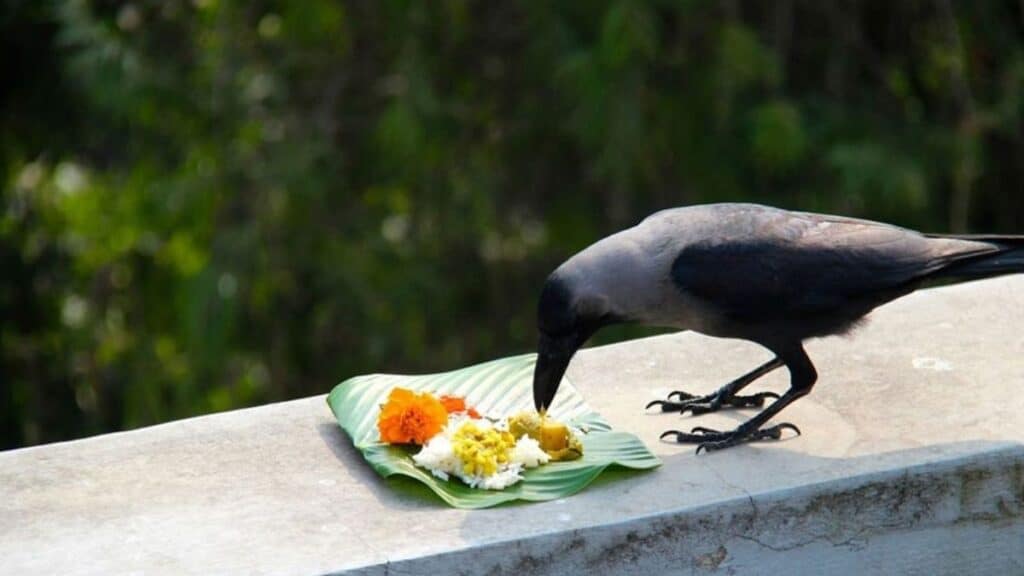
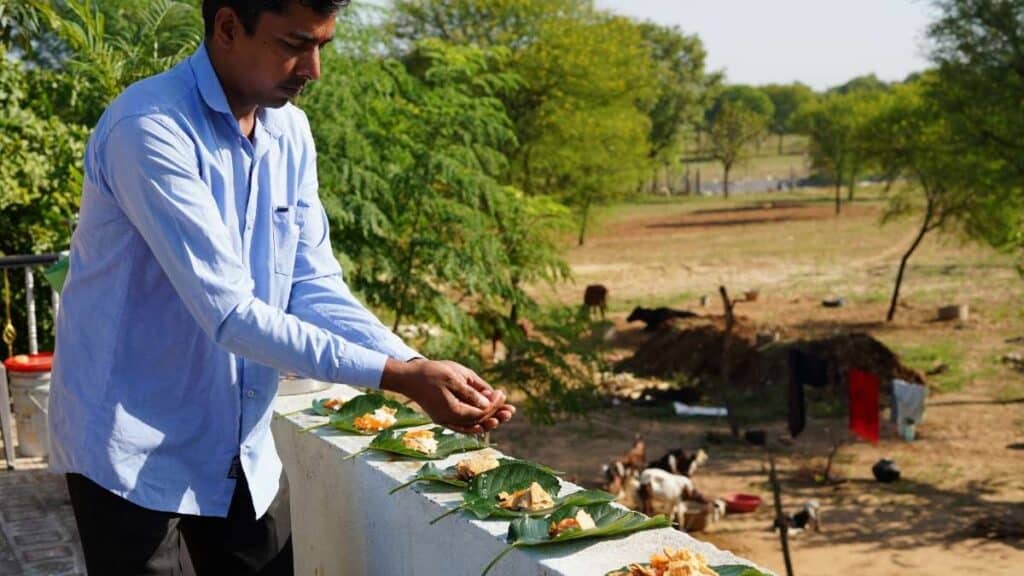
A distinctive belief of Pitru Paksha is that crows are messengers of Yama or manifestations of ancestors. When a crow accepts the food offering, the ritual is considered successful and the ancestors satisfied. Cows and dogs are also fed. Brahmin priests are offered food (Brahmin Bhojan) and donations (dakshina) as an essential conclusion to the rite.
Some families also conduct scriptural recitals of the Bhagavata Purana, Bhagavad Gita, and the Garuda Purana during this period.ayatri mantra, and melodious Chhath folk songs throughout the observance.
How Pitru Paksha Is Celebrated Across India
While the essence of Pitru Paksha is consistent, its expressions vary richly across regions.
In North India — Uttar Pradesh, Bihar, Rajasthan, and Haryana — Pinda Daan at sacred pilgrimage sites holds supreme importance. The Pitru Paksha Mela at Gaya, Bihar, on the banks of the Falgu River, draws an estimated 5 lakh to 75 lakh pilgrims annually, making it one of the world’s largest gatherings tied to ancestral rites. Varanasi and Prayagraj are also major pilgrimage destinations.
In Bengal, Odisha, and Assam, Pitru Paksha culminates in the beloved Mahalaya — the day Goddess Durga is believed to have descended to Earth, formally beginning Durga Puja festivities. Bengalis wake before dawn to listen to Mahisasuramardini, an iconic 90-minute audio composition of hymns and narration from the Devi Mahatmya, first aired on All India Radio in 1931. Mass tarpan is performed at the Hooghly and Ganga rivers.
In Maharashtra, Mahalaya Shraddha is especially significant. Special ritual foods — Puran Poli, Katt-Saag, Bhaji, and God Shevaya — are prepared and offered to Brahmins, cows, crows, and dogs before the family eats.
In South India — Andhra Pradesh, Karnataka, Tamil Nadu, and Kerala — Shraddha is called Pitru Karma. In Karnataka, Mattu Amavasya is observed. In Kerala, the ritual is known as Bali, with rice and bananas offered at the Kavu (Deva Sthanam).
In Nepal, Pinda Daan at the Shri Gokarneshwar Temple in Kathmandu and on the banks of the Bagmati River near Pashupatinath Temple draws large numbers of pilgrims from both Nepal and India.
Participation Across Religions in India
Pitru Paksha is a Hindu observance rooted in Vedic tradition. However, its underlying sentiment — honoring and remembering the deceased — resonates across many communities. In culturally mixed households, non-Hindu family members often observe moments of respect alongside Hindu relatives during Mahalaya, acknowledging the universal human impulse to remember those who came before. Some Jain communities hold comparable ancestor-honoring practices, while Sikh families recite Antim Ardas and offer prayers for departed souls during this period.
How Pitru Paksha Is Celebrated Outside India
For the Indian diaspora, Pitru Paksha carries deep emotional significance — often amplified by the experience of living far from ancestral homelands and sacred rivers.
In the USA and Canada, Hindu temples in cities like New York, New Jersey, Houston, Toronto, and Vancouver offer special Shraddha services and Pitru Paksha puja camps. Many families perform tarpan at home in a vessel of water.
In the UK, temples in Wembley, Leicester, and Birmingham organize Mahalaya puja services.
In the UAE, temples in Dubai and Jebel Ali host organized rituals, and some communities perform tarpan near the sea.
In Australia and New Zealand, Hindu mandirs in Sydney, Melbourne, and Auckland hold Mahalaya Amavasya observances.
Across Germany and Europe, Indian community centers organize gatherings, and online puja services from Indian priests via video call have grown significantly.
In Singapore, South Indian temples in Little India hold dedicated Pitru Paksha services.
Notably, Mahalaya Amavasya in 2026 falls on a Saturday (October 10), offering diaspora families added convenience for temple visits and community participation.
Gifting Traditions
Pitru Paksha is primarily an observance of remembrance and duty rather than festive gift exchange. However, giving is deeply woven into its rituals. Dakshina — offerings of money, grains, and cloth to Brahmin priests — is considered obligatory. Anna Daan (donating food) to temples, shelters, and the community is the heart of Pitru Paksha generosity. Vastra Daan (donating clothes) to priests and the needy is also a traditional practice.
In modern and diaspora contexts, many families make charitable donations in the name of their ancestors — funding hospital beds, sponsoring education, or contributing to old-age homes — as a spiritually meaningful expression of Shraddha. Online puja kits containing sesame seeds, darbha grass, and ritual materials are also shared with family members abroad.
Pitru Paksha Foods and Culinary Traditions
Food is sacred and central to Pitru Paksha — offered first to ancestors, then to priests, animals, and finally to the family. The food prepared for Shraddha must include Kheer (rice cooked in milk, the purest offering), Lapsi (sweet wheat porridge), rice and dal, spring beans (guar), and yellow gourd (pumpkin). Pindas — cooked rice and barley flour balls mixed with ghee and black sesame seeds — are the primary ancestral offering. Food is cooked in silver or copper vessels and served on banana leaves.
In Maharashtra, Puran Poli, Katt-Saag, and God Shevaya are ritual favorites.
In Bengal, simple sattvic meals — rice, lentil soup, and payesh (rice kheer) — are prepared.
Across most observant households, the entire 16-day period calls for strictly vegetarian, sattvic food without onion, garlic, or meat, as a mark of solemnity and respect.okware while maintaining ingredient authenticity, accepting gas stoves when wood is unavailable.
Music, Art, and Cultural Expression
The most iconic cultural expression of Pitru Paksha is Mahisasuramardini in Bengal — a 90-minute composition of Sanskrit hymns, songs, and narration from the Devi Mahatmya, first broadcast on All India Radio in 1931. Traditionally aired at 4 AM on Mahalaya morning, it has been a cultural touchstone for generations of Bengalis worldwide. For millions, waking to its opening notes signals not just ancestral remembrance but the beginning of the most beloved festive season.
In Bengal, Mahalaya also marks the moment artisans ceremonially paint the eyes of the Durga idol — Chokkhu Daan, bringing the Goddess to life for Durga Puja. Devotional bhajans addressed to Yama, Vishnu, and the ancestors are sung across India during this period. Temples organize recitals of the Bhagavata Purana, Bhagavad Gita, and the Garuda Purana.
Modern Observance and Evolving Practices
Pitru Paksha has evolved thoughtfully alongside changing lifestyles. For the global diaspora, online puja services have made it possible to have a priest in Varanasi, Gaya, or Prayagraj perform Shraddha on one’s behalf, streamed live via video call. Apps and digital panchang platforms now guide users on the correct tithi for their family’s Shraddha.
Environmental awareness has prompted adaptations too — tarpan is increasingly performed in designated containers rather than directly in rivers, minimizing waste. Many urban families supplement traditional rites with charitable giving in the name of their ancestors, viewing Anna Daan, sponsoring education, or supporting care homes as living Shraddha.
How to acknowledge Pitru Paksha: Since the period is one of solemn remembrance rather than festivity, conventional “Happy [Festival]” greetings are not appropriate. Meaningful sentiments include:
- “May your Shraddha offerings bring peace to your ancestors.”
- “Wishing you a meaningful Pitru Paksha.”
- “May your forebears be remembered and honored.”
Cultural Reflection
Pitru Paksha endures because it answers a universal human longing: the need to remember those who made us possible. The sight of thousands wading into the Ganga at dawn, the pre-dawn voice of Mahisasuramardini drifting through an open window, a family in London or Toronto cooking kheer on a Saturday morning and watching for a crow on their balcony — all are expressions of the same unbroken thread. At its heart, Pitru Paksha is a practice of gratitude, continuity, and belonging, reminding the living that however far they travel, their ancestors travel with them.