

Pohela Boishakh is the Bengali New Year, one of the most joyful and culturally rich festivals celebrated by Bengalis worldwide. Known as the Festival of New Beginnings, it marks the first day of Boishakh — the opening month of the Bengali calendar — and is observed with processions, music, traditional foods, and community gatherings across West Bengal, Tripura, Assam, Bangladesh, and wherever Bengali diaspora communities have settled.
Unlike many South Asian festivals, Pohela Boishakh is broadly secular and inclusive. It is a celebration of Bengali language, art, music, and shared cultural identity that transcends religious boundaries — observed by Hindus, Muslims, and people of all faiths within the Bengali community.
When Is Pohela Boishakh in 2026?
Pohela Boishakh falls on the first day of the Bengali month of Boishakh, determined by the solar Bengali calendar. The date differs slightly between India and Bangladesh due to different calendar systems in use.
Pohela Boishakh 2026 Dates in India
- April 15, 2026 (Wednesday) — West Bengal, Tripura, Assam (public holiday in West Bengal and Tripura)
Pohela Boishakh 2026 Date in Bangladesh
- April 14, 2026 (Tuesday) — National public holiday; Bangladesh follows its reformed Bengali calendar that permanently fixes the festival on April 14.
Sankranti Moment (IST): 9:39 AM, April 14, 2026 — the sun enters Aries (Mesha Sankranti), the astronomical trigger for the Bengali New Year in India. Since this occurs before noon on April 14, the new year is observed the following day per the traditional calendar rule.
Bengali Year: 1433 begins with Pohela Boishakh 2026.
Table of Contents
Pohela Boishakh In USA, Canada, Australia, New Zealand, UK, UAE, Singapore 2026 Dates
Pohela Boishakh on Tuesday, April 14, 2026
- Sankranti Moment on Pohela Boishakh – 12:09 AM
Pohela Boishakh on Tuesday, April 14, 2026
- Sankranti Moment on Pohela Boishakh – 12:09 AM
Pohela Boishakh on Wednesday, April 15, 2026
- Sankranti Moment on Pohela Boishakh – 02:09 PM, Apr 14
Pohela Boishakh on Wednesday, April 15, 2026
- Sankranti Moment on Pohela Boishakh – 05:09 AM, Apr 14
Pohela Boishakh on Wednesday, April 15, 2026
- Sankranti Moment on Pohela Boishakh – 08:09 AM, Apr 14
Pohela Boishakh on Wednesday, April 15, 2026
- Sankranti Moment on Pohela Boishakh – 12:09 PM, Apr 14
Why Do Pohela Boishakh Dates Change Every Year?
Pohela Boishakh is based on the Bengali solar calendar, not the Gregorian calendar. It falls on the day of Mesha Sankranti — when the sun transitions into the zodiac sign of Aries. Since the solar cycle does not perfectly align with the Gregorian year:
- The date shifts between April 14 and April 15 each year in India
- Bangladesh eliminated this variation through a calendar reform in 1987, permanently fixing the festival on April 14
- India follows the traditional Surya Siddhanta-based calculation, where the timing of the Sankranti moment determines whether the festival falls on April 14 or 15
Pohela Boishakh — Other Names and Regional Identities
Standard Names
- Pohela Boishakh / Pahela Baishakh — Standard Bengali name (পহেলা বৈশাখ)
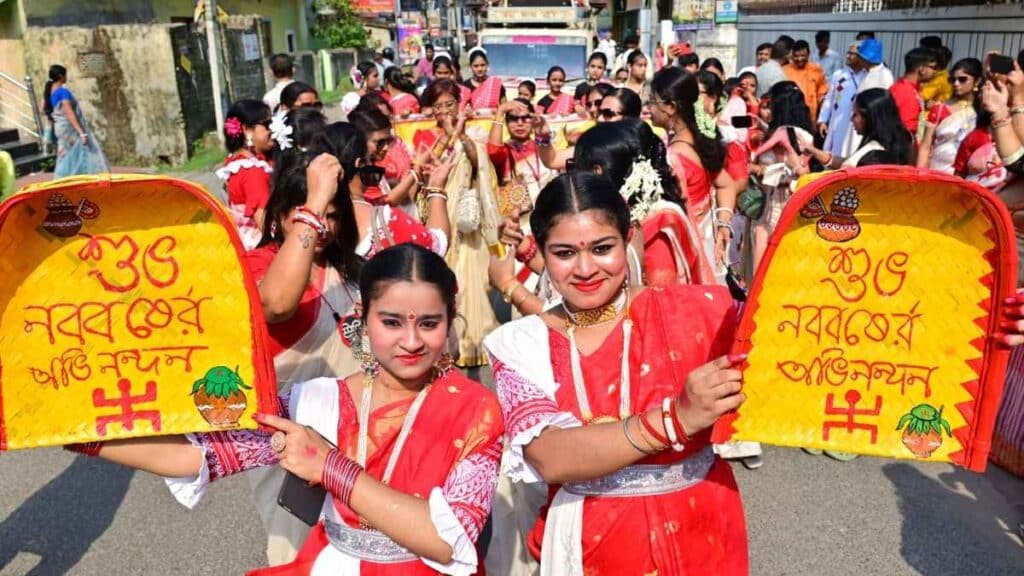
- Noboborsho / Nabo Borsho — Bengali for “New Year” (নববর্ষ)
- Bengali New Year / Bangla New Year — English equivalent used internationally
Regional Names in India
- West Bengal: Poila Boishakh, Nababarsha
- Tripura: Naba Barsha
- Assam (Bengali communities): Naba Barsha; the broader Assamese New Year in the same season is known as Bihu
- Bangladesh: Pahela Baishakh, Shubho Nababarsha
Diaspora and International Naming
- Bengali New Year — Standard English name used globally
- Boishakhi Mela — Name given to the festive fair or public celebration event, used especially in the UK
The Origins, History, and Legends of Pohela Boishakh
The Bengali calendar — and with it, Pohela Boishakh — has roots stretching back over a thousand years, with two main origin theories.
The most widely cited origin connects to Mughal Emperor Akbar in the 16th century. Land taxes in Bengal were collected using the Islamic lunar Hijri calendar, which did not align with the agricultural harvest cycles. Akbar tasked royal astronomer Fathullah Shirazi to create a “Fasholi shan” (harvest calendar) combining the lunar and solar systems. This synchronised tax collection with the post-harvest season and established the beginning of Boishakh as the new year.
Some historians, however, trace the Bengali calendar to the 7th-century Bengal king Shashanka, pointing to inscriptions in Shiva temples that predate the Mughal era. In rural West Bengal, the calendar is credited to Vikramaditya, though the Bengali era’s starting point of 593–594 CE distinguishes it from the standard Vikrami calendar.
The festive celebration itself is traced to the Mahifarash community — Bengali Muslim fishmongers of Old Dhaka — who organised daylong feasts at their Azimpur grounds to mark the harvest season during the Mughal period. These gatherings evolved into the grand Pohela Boishakh traditions seen today.
Cultural and Spiritual Significance
Pohela Boishakh holds a unique place among South Asian festivals as the new year of an entire linguistic civilisation that cuts across national borders.
For Bengalis, the festival is a living affirmation of cultural identity rooted not in religion but in language, music, and shared heritage. The Bengali language and its literary tradition — particularly the works of Rabindranath Tagore — are central to the celebration. Songs like Esho he Boishakh (Come, O Boishakh) performed at dawn are a cultural ritual of renewal that resonates deeply across generations.
The festival also carries deep agrarian symbolism — the settlement of debts, the opening of new account books, and the beginning of a fresh economic and social year. Pohela Boishakh survived colonialism, Partition, and war. During the Pakistani suppression of Bengali culture in the 1950s–60s, the festival became a powerful symbol of Bengali resistance and cultural pride.
Pohela Boishakh Prayers and Religious Observances
As a largely secular festival, Pohela Boishakh does not carry a fixed set of religious rituals — but several meaningful traditions are observed.
In West Bengal, many families begin the day with a visit to the temple, praying for health and prosperity in the new year. The Laxmi Puja — worship of the goddess of wealth — is performed by households and businesses at the new year’s start.
The Haal Khata ceremony is both commercial and ceremonial. Business owners open new account ledgers and invite loyal customers, offering mishti (sweets). The emotional slate of the past year is cleared, and a priest may offer a short blessing before the new ledger is opened.
In Bangladesh, the new year formally begins at dawn with the cultural organisation Chhayanaut performing Tagore’s songs at Ramna Batamul — under the ancient banyan tree at Ramna Park, Dhaka. This dawn concert, attended by thousands, is one of the most iconic moments of the Bengali cultural calendar.
How Pohela Boishakh Is Celebrated Across India
While the spirit of Pohela Boishakh is consistent, its expressions vary across regions.
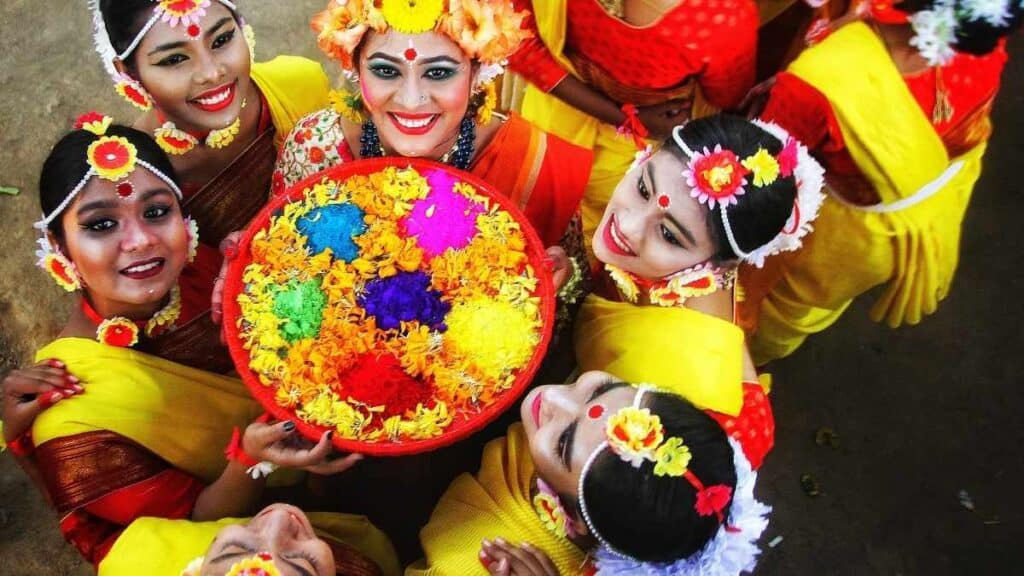
In West Bengal, Prabhat Pheri (dawn processions) with dance troupes and Tagore songs fill the streets. Businesses open fresh ledgers with the Haal Khata ritual. Cultural fairs, poetry recitations, and performances mark the day. The traditional red-and-white colour palette — women in red-bordered saris with flowers in their hair, men in embroidered kurtas — is central to the visual identity of the celebrations.
In Tripura, the day begins with temple prayers and distribution of sweets, followed by folk performances and cultural events throughout the state.
In Assam’s Bengali communities (Barak Valley and Goalpara), Pohela Boishakh is celebrated with processions, community feasts, and cultural programmes. The season overlaps with Bohag Bihu — the broader Assamese New Year — creating a dual celebration atmosphere.
In Jharkhand and major cities like Delhi and Mumbai, Bengali cultural associations organise Pohela Boishakh melas featuring food stalls, music, folk art, and community events.
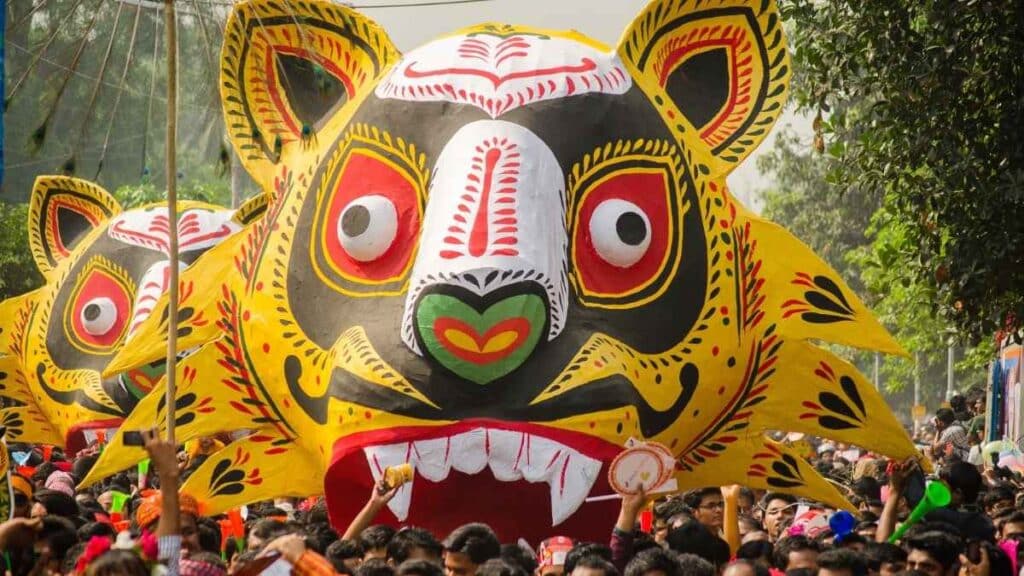
In Bangladesh’s Chittagong, the festival includes Boli Khela (wrestling), Nouka Baich (boat racing), bull racing, and two-day cultural programmes alongside the Mangal Shobhajatra procession.
Participation Across Religions in India
One of Pohela Boishakh’s most remarkable qualities is its ability to unite people of different faiths under a shared linguistic and cultural identity. In Bangladesh — a Muslim-majority nation — the festival is celebrated with equal enthusiasm by both the Muslim majority and the Hindu minority. In West Bengal, the celebration is embraced by Hindus, Muslims, and Christians alike.
The festival’s secular character was deliberately cultivated. The Mangal Shobhajatra movement, which began in Jessore in 1985 and was formalised in Dhaka in 1989, was consciously framed as an expression of Bengali cultural identity — not Hindu identity — to ensure it remained welcoming for all.
How Pohela Boishakh Is Celebrated Outside India
The Bengali diaspora carries Pohela Boishakh celebrations far beyond South Asia.
In the United Kingdom, London’s Brick Lane hosts one of the world’s most vibrant Boishakhi Melas, attracting hundreds of thousands of visitors with food, music, and cultural performances.
In the USA and Canada, Bengali associations across New York, New Jersey, Houston, Toronto, and Calgary organise community dinners and cultural fairs, typically held on the weekend nearest to April 14–15.
In Australia, the Bangabandhu Council of Australia hosts a Pohela Boishakh event at Sydney Olympic Park. In the UAE, women’s associations and community groups in Dubai and Abu Dhabi organise cultural gatherings. Bengali associations in Germany and Singapore hold New Year events featuring Tagore music, folk performances, and traditional cuisine.
Pohela Boishakh Gifting Traditions
Gifting on Pohela Boishakh is warm and rooted in the spirit of new beginnings.
Mishti (sweets) are the quintessential gift — boxes of rasgolla, sandesh, and mishti doi exchanged between families and businesses. The Haal Khata tradition involves shopkeepers gifting sweets to loyal customers.
Clothing — particularly red-and-white saris, kurtas, and salwar kameez with traditional motifs — are gifted within families, especially to women and children.
Books and stationery are traditional gifts reflecting Bengal’s deep literary culture.
In contemporary celebrations, particularly among diaspora communities, gifts have evolved to include handcrafted Bengali art, curated boxes of Bengali food products, Tagore’s collected works, and digital gift cards to Bengali businesses.
Pohela Boishakh Foods and Culinary Traditions
Food is at the heart of Pohela Boishakh. The most iconic festive meal combines Panta Bhat (fermented watered rice) with Ilish Bhaji (fried Hilsa fish) — a pairing that has become synonymous with the festival, especially in Bangladesh. Other essential dishes include:
- Shorshe Ilish — Hilsa cooked in mustard sauce
- Bharta — mashed vegetable or fish pastes eaten with panta bhat
- Mishti Doi — sweetened yoghurt, a Bengali staple at every celebration
- Sandesh and Rasgolla — delicate Bengali sweets shared with guests
- Jilipi, Khoi, and Batasha — crispy spiralled sweets and sugar candies sold at Boishakhi fairs
To protect the dwindling Hilsa population, fishing bans are typically enforced around this period, framing a culinary tradition as also an environmental commitment.
Music, Art, and Cultural Expression
Music is the soul of Pohela Boishakh. Rabindranath Tagore’s compositions — Rabindra Sangeet — form the emotional backbone of the festival. His song Esho he Boishakh is sung at dawn celebrations across Dhaka and Kolkata and is the festival’s most recognised musical symbol.
Folk music forms — Baul (mystic folk songs), Bhatiali (river songs), and Jari gaan — are performed at Boishakhi Melas. Classical Jatra (folk theatre) is a traditional entertainment form during the festival.
Visual art plays a significant role through the Mangal Shobhajatra, where students from Dhaka University’s Faculty of Fine Arts create elaborate papier-mâché masks, giant puppets, and thematic floats. The motifs — owls (wisdom), tigers (courage), fish (prosperity) — are drawn from Bengali folk art traditions. Alpana (floor art in white paste) is a traditional decorative art form practised in Bengali homes on the occasion.
Modern Observance and Evolving Practices
Pohela Boishakh continues to evolve while holding onto its cultural core. Social media has given the festival a vibrant digital presence, with Shubho Noboborsho trending across platforms on April 14–15 each year. Diaspora families use video calls to celebrate across time zones, and many community events are live-streamed globally.
Environmental awareness has also shaped modern celebrations — eco-friendly decorations, reduced plastic use at Boishakhi Melas, and the Hilsa fishing ban reflect a growing consciousness around sustainability.
How to wish someone on Pohela Boishakh: The traditional greeting is শুভ নববর্ষ — Shubho Noboborsho (“Auspicious New Year”). In English-speaking contexts, “Happy Pohela Boishakh” or “Happy Bengali New Year” is widely used.
Traditional dress: Women wear red-bordered white or red-and-white saris with flowers in their hair; men wear white or red kurtas with traditional embroidery — a palette said to originate from the red-covered, white-paged Haal Khata ledgers.
Cultural Reflection
Pohela Boishakh is more than a date on the calendar. It is the annual reaffirmation of a civilisation — of the Bengali people’s love for their language, music, food, and each other. For millions of Bengalis living outside South Asia, the festival is a moment to bridge distance — to cook a Bengali meal in a foreign kitchen, play Tagore on a speaker, and remember that cultural roots are not lost, only carried forward.
As Bengali Year 1433 begins on April 15, 2026, the greeting rings out across continents:
শুভ নববর্ষ ১৪৩৩ — Shubho Noboborsho 1433. May the new year bring joy, prosperity, and togetherness to all.