
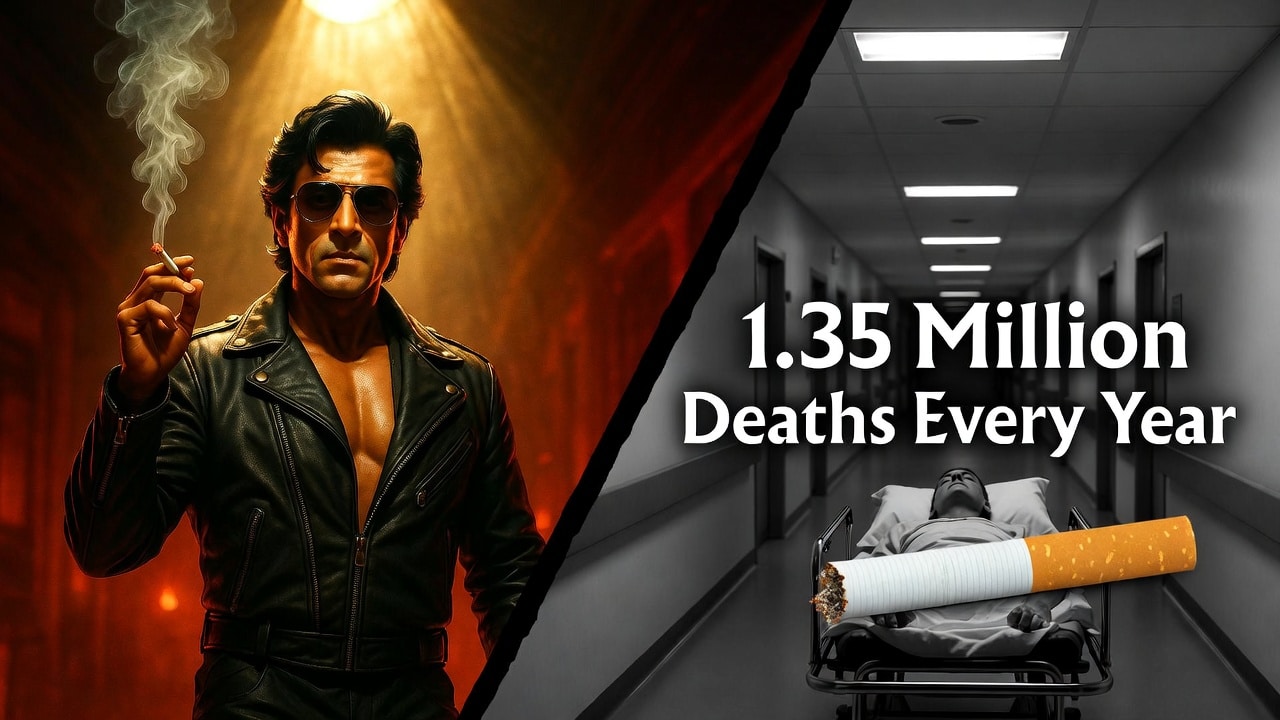
India’s tobacco industry is in structural decline. Youth tobacco use has dropped 42% since 2009.[58] Cigarette volumes have been shrinking for over a decade.[70] The young generation is saying no to tobacco. Faced with a dwindling customer base, the tobacco industry — unable to advertise directly since 2003 — has doubled down on the one channel that remains open: the silver screen.[73][76] This report argues that the systematic glamorization of smoking by A-list heroes in India’s biggest recent blockbusters is not artistic expression. It is disguised marketing, funded or incentivized by a desperate industry targeting the next generation of consumers. The report documents the evidence, identifies the root causes, and makes the case for treating movies that glamorize tobacco exactly like tobacco products themselves — with equivalent tax liability.
Section 1: India’s Biggest Films (2023-2025) and the Hero Smoking Pattern
India’s theatrical box office generated approximately Rs.11,500 crore in 2024 and Rs.10,453 crore net in 2025, with the top ten films accounting for roughly 33-41% of total collections.[61][65] The highest-grossing films of the last three years are dominated by mass-action blockbusters, and in film after film, the hero smokes — and is made to look powerful, dangerous, and cool while doing it.[23][21]
2023: The Year Bollywood Made Smoking Aspirational Again. The three biggest Hindi blockbusters of 2023 — Jawan (Rs.1,148 crore), Pathaan (Rs.1,050+ crore), and Animal (Rs.900+ crore) — all featured India’s biggest male stars with tobacco imagery front and centre. Shah Rukh Khan’s Jawan featured the star fighting with a cigarette in his mouth in widely-circulated action sequences.[23] In the same year, Pathaan was accompanied by a pan masala brand endorsement by Khan — a product whose only commercial function is as a surrogate for tobacco. Animal went furthest: Ranbir Kapoor smoked extensively throughout the film, with his hairstylist later confirming the actor smoked real cigarettes onset to stay in character.[21][27]
2024: Telugu Cinema Doubles Down. The biggest Indian film of 2024 — and one of the highest-grossing Indian films ever made — was Pushpa 2: The Rule, earning approximately Rs.1,800 crore worldwide.[116] Allu Arjun’s portrayal of the smuggler Pushpa Raj is built on an outlaw persona inseparable from cigar imagery — scenes of the hero lighting up circulated virally across social media as emblems of swagger and defiance. Kalki 2898 AD (Rs.776 crore) and Stree 2 (Rs.698 crore) rounded out the top films of the year. Notably, Bhool Bhulaiyaa 3 (Rs.313 crore) is a significant outlier: Kartik Aaryan’s hero does not smoke, and the film was a major commercial success — disproving any argument that hero smoking is commercially necessary.
2025: The Pattern Continues. India’s major 2025 release Dhurandhar (Ranveer Singh) has maintained the action-hero smoking spectacle formula that has come to define the post-pandemic Indian blockbuster. The convergence of a shrinking theatrical market — footfalls projected at 780 million versus a pre-pandemic 1.03 billion[59] — and the need for high-octane visual spectacle to drive audiences to cinemas has reinforced the casting of alpha, rule-breaking, tobacco-using heroes as a commercial template.
The pattern is unmistakable: India’s top-grossing films consistently use cigarettes, cigars, and bidis as shorthand for masculine authority, outlaw cool, and unbreakable resolve.[23][21][25]
Section 2: India’s Tobacco Industry — A Sector in Structural Decline
2.1 Declining Prevalence
India’s adult tobacco use fell by 17% between GATS 2009-10 and 2016-17.[109] Cigarette smoking among men declined from 9.4% to 7.7% over this period.[68] More recent NFHS data shows tobacco use continuing to fall — down 4.7 percentage points among men and 2.8 points among women.[52] Most critically: youth are leading this retreat. Among school-going children aged 13-15, current tobacco use has fallen by 42% since 2009.[58][60]
2.2 Volume Contraction
The legal cigarette industry recorded a compound annual volume decline of 3.3% between FY2012 and FY2019.[70] The Union Budget 2026 raised excise duties by 22-28%, triggering a 5% volume drop in March 2026 alone and a projected 6-8% contraction for the full financial year.[46][115] ITC shares fell 10%, wiping out approximately US$7 billion in market value.[124][119]
2.3 Revenue Contradiction
Despite falling volumes, revenue remains high due to price increases — not more smokers. ITC’s cigarette EBIT for FY25 was Rs.21,091 crore (+5.1% YoY), but volume growth was only 2-3%.[75][78] The industry is squeezing more rupees from a shrinking pool of smokers, not recruiting new ones through normal commercial means. Films are how it recruits the next generation, and it has been doing so deliberately since the 1990s.[76][104]
Key Tobacco Trend Indicators
| Indicator | Data | Trend |
|---|---|---|
| Adult tobacco use prevalence | Down 17% (2009-2017) | Falling |
| Youth (13-15) tobacco use | Down 42% since 2009 | Falling sharply |
| Cigarette industry volumes | -3.3% CAGR FY12-FY19 | Contracting |
| March 2026 cigarette sales | -5% volume | Accelerating decline |
| Youth exposed to tobacco in movies | 37.3% in past 30 days | High and persistent |
| Legal cigarette tax revenue | Rs.72,788 cr (2022-23) | Revenue still high |
| Illicit cigarette trade | ~1/3 of legal sales | Rising with tax hikes |
Section 3: The Link Between Film Smoking and Industry Strategy
3.1 A Calculated Response to an Advertising Ban
India’s COTPA 2003 banned all direct tobacco advertising.[86] Research published in BMJ Global Health documents what happened next: tobacco imagery in Indian films and television increased after the advertising ban came into force.[73] This is not coincidence. It is strategy. WHO’s own study on Bollywood documented that international tobacco companies paid film stars to smoke on screen.[104] Pan masala brands spent an estimated Rs.1,200 crore annually on advertising by 2023.[103] In Q1 2022, over 2,000 instances of tobacco surrogate marketing were recorded on social media platforms alone.[74]
3.2 A-List Stars Are the Delivery Mechanism
Suniel Shetty turned down a Rs.40 crore offer from a tobacco advertiser.[108][110] Anil Kapoor refused a Rs.10 crore pan masala deal.[102][103] These rejections are newsworthy precisely because many others said yes. Shah Rukh Khan, Amitabh Bachchan, Salman Khan, Akshay Kumar, Ranveer Singh, and Hrithik Roshan have all endorsed pan masala brands at various points.[103] Amitabh Bachchan eventually terminated his Kamla Pasand contract after an oncologist publicly called him out.[100]
3.3 Youth as the Primary Target
WHO explicitly stated in 2024 that the tobacco industry is targeting youth to replace declining adult consumers.[101] Nearly 40% of current smokers initiated tobacco use before age 18.[62] There are approximately 4.4 million underage daily tobacco users (ages 15-17) in India, spending Rs.287 million annually on tobacco products.[62] Among Indian youth aged 13-15, 37.3% reported exposure to tobacco imagery in movies in the past 30 days.[58]
Section 4: The Policy Failure — Warnings That Don’t Deter
India’s 2012 Film Rules require a 20-second audiovisual disclaimer, a 30-second anti-tobacco health spot, and a static health warning every time tobacco appears.[79][15] These rules were extended to OTT platforms in 2023.[32][40] Yet these rules have not stopped the glamorization. The fundamental problems:
- The rules regulate the display of tobacco, not its narrative framing. A hero can smoke surrounded by three health disclaimers — the disclaimers interrupt; the imagery seduces.
- Editorial justification is essentially unenforced. CBFC lacks a formal, binding process to evaluate whether tobacco depiction meets the ‘substantial artistic justification’ standard.[38]
- Penalties are absurdly low. COTPA’s maximum penalty for advertising violations is Rs.10,000 — a rounding error for a Rs.100 crore film.[89]
- The Ministry of Information and Broadcasting historically sided with the film industry against health regulations.[73]
- Despite collecting Rs.72,788 crore in tobacco tax revenue in 2022-23, the government allocates less than 0.07% to the National Tobacco Control Programme.[122]
Section 5: The Case for Tobacco-Equivalent Taxation on Films
The argument that movies where the hero smokes should pay the same tax as tobacco products is grounded in a simple principle: if a product functions as tobacco advertising, it should face tobacco tax liability.[93][99] A 10% price increase leads to approximately a 5% reduction in tobacco use.[99] Films deliver the equivalent of brand advertising — without a price tag. Taxing that mechanism at tobacco rates closes the subsidy loop.
Proposed Policy Framework for Lawmakers
- Tobacco Content Grading: CBFC to formally grade films by level of tobacco glamorization (incidental vs. hero-central/aspirational), with third-party public health verification.
- Sin Tax on Glamorized Tobacco Films: Films where the hero’s tobacco use is glamorized to attract an additional GST surcharge equivalent to the current tobacco GST rate (28% + cess). Revenue ringfenced for the National Tobacco Control Programme.
- Production-Level Liability: Producers and directors held jointly liable, with fines tied to box office collections — not fixed rupee amounts — creating genuine deterrence.
- Surrogate Advertising Closure: Pan masala and tobacco-surrogate brands barred from film integration deals, brand placement, and celebrity tie-ins.
- Brand Placement Disclosure: Any film receiving payment from tobacco or tobacco-surrogate companies to mandatorily disclose this in opening credits and to CBFC.
- NTCP Funding Floor: Mandate minimum 2% of tobacco tax revenue to enforcement, cinema monitoring, and youth anti-tobacco programmes.[122]
Section 6: The Box Office Decline — A Desperate Industry
India’s film industry itself is under pressure. Theatre revenues fell 13% in 2025.[59] Hindi language film collections dropped 13% in 2024.[63] Theatrical footfalls have declined from 1.03 billion pre-pandemic to a projected 780 million.[59] 86% of surveyed audiences say Bollywood content quality has declined.[63] A declining film industry and a declining tobacco industry have converged around a shared solution: spectacle-driven blockbusters featuring A-list heroes as aspirational, rebellious, tobacco-using anti-heroes are good for ticket sales and good for tobacco recruitment simultaneously.
Section 7: Global Lessons — Countries With the Lowest Tobacco Rates
The countries with the lowest tobacco smoking rates did not get there by accident. Their film industries are legally prohibited from glamorizing tobacco, or have adopted explicit tobacco-free content policies.[126][132]
| Country | Smoking Rate | Film/Media Tobacco Policy |
|---|---|---|
| Sweden | 5.5% | Tobacco product placement in TV/films banned by law (SFS 2018:2088)[141][144] |
| Iceland | ~6% | FCTC Article 13 framework; strict advertising ban covers media[132] |
| Australia | ~11% | Tobacco placement in movies illegal — Tobacco Advertising Prohibition Act 1992[142][145][151] |
| New Zealand | 8.9% | Tobacco product placement in films illegal; classification reform ongoing[149] |
| Norway | ~9-12% | Comprehensive advertising ban including entertainment media[129][131] |
| Finland | ~12% | Nordic tobacco control; de-normalization of smoking in public culture[129] |
| India | 3.8% smoked / 28.6% all tobacco | Disclaimer warnings only; glamorization not penalized; weak enforcement[89] |
Sweden: The Smoke-Free Nation Model
Sweden is on the verge of becoming Europe’s first clinically smoke-free country — under 5.6% daily smokers today, down from nearly 20% twenty years ago.[147] This was achieved through a complete ban on tobacco advertising including entertainment media product placement,[141][144] smoke-free public spaces since 2019, progressive tax policy, and a free national Quitline since 1998.[129]
Australia: The Strictest Film Tobacco Law in the World
Under the Tobacco Advertising Prohibition Act 1992 (as amended), product placement of tobacco products in movies is illegal in Australia.[142][145][151] Any film that functions as a tobacco advertisement is prohibited from cinema and TV broadcast. Australia’s smoking rate fell from approximately 24% in 1995 to 11% today.[151][154]
The United States: The Surgeon General’s Verdict
The US Surgeon General formally concluded there is a causal relationship between depictions of smoking in movies and youth smoking initiation.[158][161] Giving movies with tobacco scenes an R rating would reduce teen smokers by 18%, potentially preventing up to 1 million deaths.[161] 37% of new youth smoking initiation in the US is attributable to exposure to smoking in movies.[167]
Netflix’s Global Tobacco Policy
In 2019, Netflix committed to a formal tobacco-free content policy: no smoking or e-cigarette use in TV-14 or below / PG-13 or below content, except for historical or factual accuracy.[157][160] This established the global precedent that heroes do not need to smoke to be compelling.
| Policy Lever | Sweden/Nordic | Australia | India (Current) |
|---|---|---|---|
| Tobacco placement in films | Banned by law | Banned by law | Not banned — disclaimers only |
| Film rating tied to tobacco | Cultural norm | Under discussion | Not linked |
| Penalty for violation | Advertising law fines | Criminal/civil liability | Max Rs.10,000 (COTPA) |
| Streaming obligation | FCTC-based | FCTC-based | OTT disclaimers only (2023) |
| Youth smoking trend | Lowest in EU, still falling | Consistent decline | 42% decline; gains at risk |
Section 8: Tobacco Deaths and Disease Burden in India
Tobacco kills more Indians every year than any other preventable cause.[55][109][172]
| Metric | Statistic |
|---|---|
| Annual tobacco-related deaths in India | 1.35 million per year |
| Share of all deaths caused by tobacco | 11.72% (men: 16.18%, women: 6.71%) |
| Deaths per day from tobacco | 3,700 Indians — equivalent to 10 fully loaded jumbo jets crashing daily |
| Cancer patients in India (2022) | 1.41 million new cases — India ranks 3rd globally |
| India’s oral cancer rank | 2nd highest rate in the world — driven by smokeless tobacco |
| Total tobacco users in India | ~267 million adults (28.6% of all adults) |
| Underage daily tobacco users (15-17) | ~4.4 million |
Tobacco is India’s single largest risk factor for non-communicable diseases. Tobacco-linked cancers account for the majority of India’s cancer burden.[172] Tobacco is also a primary driver of heart attacks, strokes, COPD, and Type 2 diabetes. An average Indian smoker spends 8.43% of GDP per capita on cigarettes alone, directly displacing food, education, and healthcare spending in low-income households.[48]
Section 9: India Can Thrive Without Tobacco — The Economic Case for Politicians
The tobacco industry’s lobbying argument — ‘you can’t afford to lose our taxes and jobs’ — is demolished by WHO’s own economic analysis:[64][170]
“For every Rs.100 received as excise taxes from tobacco products, the Indian economy loses Rs.816 in costs.”
| Economic Indicator | Value |
|---|---|
| Total annual economic cost of tobacco | Rs.1,77,340 crore (US$27.5 billion) |
| As % of GDP | 1.04% of GDP |
| Direct healthcare costs of tobacco diseases | 5.3% of all India’s health expenditure |
| Government tax revenue from tobacco | Rs.76,000-87,000 crore annually |
| Amount allocated to tobacco control (NTCP) | Less than Rs.50 crore — under 0.07% of tobacco tax collected |
| Net loss ratio | Every Rs.100 earned = Rs.816 lost |
Tobacco Tax Is Not Irreplaceable
Tobacco contributes just 2.2% of India’s gross tax revenue as of FY2023-24.[180] Total GST collections in 2024-25 hit a record Rs.22.08 lakh crore, growing at 9.4% year on year.[190] Even a 1% improvement in GST compliance would more than offset the entire tobacco tax contribution. The government simultaneously spends far more treating tobacco diseases than it earns in tobacco taxes — a net drain of over Rs.90,000 crore per year.[64]
Eliminating Tobacco Is a Net Job Creator
A peer-reviewed study in Tobacco Control (BMJ, 2024), commissioned by WHO and World Bank, found that reducing tobacco consumption produces — after accounting for averted premature deaths — a net result of: +0.22% increase in GDP, +1.36 million net new jobs (0.29% of the labour force), and an additional US$2.77 billion in tax revenues.[185][191][192]
The 45 Million Jobs Argument — Why It Collapses
The tobacco industry cites 45 million jobs as a reason politicians cannot act aggressively.[187] This argument has three critical flaws: First, 7 million bidi rollers — overwhelmingly women — earn as little as Rs.50-200 per day while the industry profits enormously. Second, tobacco farming is replaceable — diversification programmes already exist in India’s tobacco-growing states.[187] Third, the WHO-commissioned model shows 1.36 million more jobs are created in the broader economy when tobacco consumption falls, because money redirected from tobacco flows into food, clothing, education, and entertainment.[185][191]
Section 10: The Politician’s Brief — Five Facts That Demand Action
- 1.35 million Indians die from tobacco every year — 3,700 per day. This is a preventable massacre.[55][109]
- For every Rs.100 collected in tobacco taxes, Rs.816 is lost in healthcare and productivity costs. The government is running a catastrophically losing trade.[64][170]
- Tobacco represents only 2.2% of India’s gross tax revenue — replaceable many times over through existing tax system growth.[180][190]
- Eliminating tobacco creates 1.36 million net new jobs and increases GDP by +0.22% over five years, per WHO-commissioned modelling.[185][191]
- India’s young generation is already rejecting tobacco — youth use is down 42%. What is needed is political will to protect those gains — including stopping Bollywood from glamorizing smoking in blockbusters watched by hundreds of millions.[58][60]
The argument for inaction has no mathematical basis. The argument for action is overwhelming. India does not need tobacco. Tobacco needs India — and that dependence is precisely what must end. If a Rs.1,800 crore film functions as a tobacco advertisement, it should pay tobacco taxes.
Sources: WHO India; Global Adult Tobacco Survey; NFHS-4 and NFHS-5; Global Youth Tobacco Survey 2019; BMJ Global Health; Tobacco Control (BMJ 2024); ITC Annual Report FY25; COTPA 2003; Vital Strategies; Campaign for Tobacco-Free Kids; Truth Initiative; Tobacco Atlas; CDC; OECD Health at a Glance 2025; LA Times; BBC; Ormax Media; Economic Times.
