
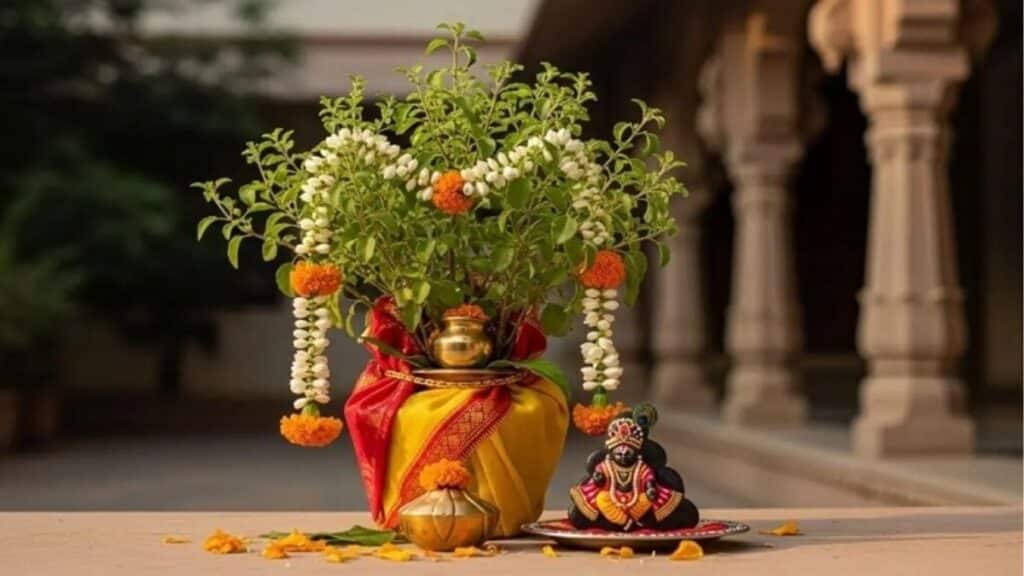
Tulasi Vivah is one of Hinduism’s most beloved ritual observances — a ceremonial wedding between the Tulasi plant, revered as Goddess Vrinda (a form of Lakshmi), and Lord Vishnu, represented by the Shaligrama stone or an amla branch. The festival marks the formal end of the monsoon season and the opening of the Hindu wedding season. Observed primarily by Vaishnava Hindus, it is celebrated across India and in Hindu diaspora communities worldwide — performed with the full ceremony of a traditional Hindu wedding, complete with mantras, garlands, and sacred rites. The day also concludes the spiritually significant month of Kartika, making it a time of awakening and renewal of devotional life.
When Is Tulasi Vivah in 2026?
Tulasi Vivah 2026 falls on Saturday, 21 November.
Tulasi Vivah in India 2026: Tulasi Vivah will be celebrated on Saturday, November 21, 2026 in India.
Dwadashi Tithi Begins: 6:31 AM on November 21, 2026
Dwadashi Tithi Ends: 4:56 AM on November 22, 2026
Puja is recommended in the evening hours of November 21, 2026 (IST).
Table of Contents
Tulasi Vivah In USA, Canada, Australia, New Zealand, UK, UAE, Singapore 2026 Dates
Tulasi Vivah on Saturday, November 21, 2026
- Dwadashi Tithi Begins – 08:01 PM on Nov 20, 2026
- Dwadashi Tithi Ends – 06:26 PM on Nov 21, 2026
Tulasi Vivah on Saturday, November 21, 2026
- Dwadashi Tithi Begins – 08:01 PM on Nov 20, 2026
- Dwadashi Tithi Ends – 06:26 PM on Nov 21, 2026
Tulasi Vivah on Sunday, November 22, 2026
- Dwadashi Tithi Begins – 12:01 PM on Nov 21, 2026
- Dwadashi Tithi Ends – 10:26 AM on Nov 22, 2026
Tulasi Vivah on Saturday, November 21, 2026
- Dwadashi Tithi Begins – 01:01 AM on Nov 21, 2026
- Dwadashi Tithi Ends – 11:26 PM on Nov 21, 2026
Tulasi Vivah on Saturday, November 21, 2026
- Dwadashi Tithi Begins – 05:01 AM on Nov 21, 2026
- Dwadashi Tithi Ends – 03:26 AM on Nov 22, 2026
Tulasi Vivah on Sunday, November 22, 2026
- Dwadashi Tithi Begins – 09:01 AM on Nov 21, 2026
- Dwadashi Tithi Ends – 07:26 AM on Nov 22, 2026
Why Tulasi Vivah Dates Change Every Year
Tulasi Vivah follows the Hindu lunisolar calendar. It is observed on Kartika Shukla Dvadashi — the 12th day of the bright fortnight of the month of Kartika — the day after Prabodhini Ekadashi, which marks Lord Vishnu’s awakening from his four-month cosmic rest. Because the Hindu lunar calendar does not align with the Gregorian calendar, the date shifts each year by approximately 10–11 days, periodically corrected by an intercalary month. The ceremony may be observed on any day from Prabodhini Ekadashi to Kartika Purnima, with regional variation in specific day observed.
Tulasi Vivah Other Names and Regional Identities
Tulasi Vivah is known by several names across Indian languages, each reflecting the sacred marriage at its heart.
| Language / Region | Name | Script |
|---|---|---|
| Sanskrit / Hindi | Tulasi Vivaha | तुलसी विवाह |
| Marathi | Tuḷśīca Lagna | तुळशीचं लग्न |
| Gujarati | Tulasi Vivah | તુલસી વિવાહ |
| Telugu | Tulasi Kaḷyāṇaṁ | తులసి కళ్యాణం |
| Kannada | Tulasi Maduve | ತುಳಸಿ ಮದುವೆ |
| Malayalam | Tuḷasi Kalyaṇam | തുളസി കല്യാണം |
| Tamil | Tulasi Kaḷyaṇam | துளசி கல்யாணம் |
In diaspora communities across the USA, UK, Canada, UAE, and Australia, the festival is widely referred to as Tulsi Vivah. In South Indian communities, it is commonly called Tulasi Kalyanam, where kalyanam means auspicious wedding.
The Origins, History, and Legends of Tulasi Vivah
Tulasi Vivah is rooted in the ancient story of Vrinda, a devoted Vishnu bhakta whose husband Jalandhara was an invincible demon king. The tale appears in the Skanda Purana, Padma Purana, and Shiva Purana.
Jalandhara was born from Shiva’s cosmic energy cast into the ocean and raised as a fearsome demon. He married Vrinda, daughter of the demon king Kalanemi. Vrinda’s unshakeable fidelity to her husband formed a divine shield — no deity could defeat Jalandhara as long as her chastity remained intact. Emboldened, Jalandhara challenged the gods and even attempted to abduct Goddess Parvati. To break Vrinda’s protective power, Lord Vishnu disguised himself as a sage, then took the form of Jalandhara and deceived Vrinda. Her chastity broken, Jalandhara lost his divine protection and was slain by Shiva.
When Vrinda discovered the deception, she cursed Vishnu to become a lifeless stone — which is why Vishnu came to be represented by the Shaligrama stone. She then immolated herself. From her ashes grew the Tulasi plant. Vishnu, moved by her devotion, declared: “O Vrinda, because of your fidelity, you are dearer to me than Lakshmi herself. You shall remain by my side forever in the form of Tulasi.” Honoring his promise, Vishnu married Vrinda — reborn as Tulasi — on Kartika Dvadashi. This union is commemorated each year as Tulasi Vivah.
A Vaishnava tradition also connects Tulasi to the Samudra Manthana (churning of the cosmic ocean). When Dhanvantari emerged with the amrita (elixir of immortality), Vishnu — filled with joy — shed a happy tear that fell into the amrita and became Tulasi, whom he then married.
Cultural and Spiritual Significance
Tulasi Vivah is more than a ritual ceremony — it is a statement about devotion, fidelity, and the sacred bond between the divine masculine and feminine. The Tulasi plant is considered a living manifestation of Lakshmi, and her marriage to Vishnu (Shaligrama) reunites the divine couple in every home where Tulasi grows. The festival signals the end of the four-month chaturmas period, the formal opening of the Hindu wedding season, and the return of Vishnu to active cosmic governance.
For families performing the kanyadaan (symbolic giving away of Tulasi as a daughter), for couples seeking blessings for their own marriages, and for devotees expressing daily gratitude to a plant they water at dawn — Tulasi Vivah offers personal, communal, and spiritual meaning in equal measure.
Prayers and Religious Observances
Devotees observe a full-day fast on Tulasi Vivah, breaking it only after the evening ceremony. The Tulasi plant, planted in a special brick pedestal called the Tulasi Vrindavana, is dressed as a bride — in a sari, adorned with ornaments, a bindi, and a nose ring. A Shaligrama stone or image of Vishnu or Krishna is dressed as the groom. Both are bathed, garlanded, and connected with a sacred cotton thread (mala). The Mangal Ashtaka mantras are recited and rice mixed with vermilion is showered at the conclusion.
Tulasi Mool Mantra / Pranam Mantra
- Hindi: महाप्रसाद जननी सर्व सौभाग्यवर्धिनी, आधि व्याधि हरा नित्यं तुलसी त्वं नमोस्तुते।
- Hinglish: Maha prasad janani, sarva saubhagya vardhini, Aadhi vyadhi hara nityam, Tulasi tvam namostute.
Tulasi Namaashtaka (Recite during the wedding ceremony)
- Hindi: वृन्दा वृन्दावनी विश्वपूजिता विश्वपावनी। पुष्पसारा नन्दनी च तुलसी कृष्ण जीवनी।।
- Hinglish: Vrinda Vrindavani Vishwapujita Vishwapavani, Pushpasara Nandini cha Tulasi Krishna Jeevani.
Tulasi Vivah Mantra (for auspicious marriage blessings)
- Hindi: ॐ सृष्टिकर्ता मम विवाह कुरु कुरु स्वाहा।
- Hinglish: Om Srishtikartra mam vivah kuru kuru swaha.
Shaligram Pujan Mantra
- Hindi: ॐ नमो भगवते वासुदेवाय।
- Hinglish: Om Namo Bhagavate Vasudevaya.
Tulasi Vivah Vrat Katha
In Hindi:
एक बार शिव ने अपने तेज को समुद्र में फैंक दिया। उससे एक महातेजस्वी बालक ने जन्म लिया जो आगे चलकर जालंधर नाम का दैत्य राजा बना। दैत्यराज कालनेमी की कन्या वृंदा का विवाह जालंधर से हुआ। वृंदा अत्यन्त पतिव्रता स्त्री थी। उसी के पतिव्रत धर्म की शक्ति से जालंधर अजेय था।
जालंधर का नाश करने के लिए भगवान विष्णु ने ऋषि का वेश धारण कर माया से जालंधर का रूप लिया और वृंदा को धोखा दिया। वृंदा का सतीत्व भंग होते ही जालंधर युद्ध में हार गया और शिव ने उसका वध किया।
सच जानने पर वृंदा ने क्रोध में भगवान विष्णु को शिला बनने का श्राप दिया। विष्णु ने वह श्राप स्वीकार किया और शालिग्राम रूप धारण किया। वृंदा ने स्वयं को अग्नि को समर्पित कर दिया। जहाँ वृंदा भस्म हुईं, वहाँ तुलसी का पौधा उगा।
तब भगवान विष्णु ने कहा — “हे वृंदा, तुम अपने सतीत्व के कारण मुझे लक्ष्मी से भी अधिक प्रिय हो। अब तुम तुलसी के रूप में सदा मेरे साथ रहोगी।” तब से हर वर्ष कार्तिक शुक्ल द्वादशी को तुलसी विवाह का पर्व मनाया जाता है।
In English:
Once, Shiva cast his divine energy into the ocean, from which was born a mighty child who grew to become the fearsome demon king Jalandhara. He married Vrinda, the devoted daughter of Kalanemi. Vrinda’s absolute fidelity formed a divine shield — as long as her chastity was intact, no god or weapon could defeat Jalandhara.
To destroy him, Lord Vishnu disguised himself as a sage, then assumed Jalandhara’s form and deceived Vrinda. Her chastity broken, Jalandhara’s shield fell and Shiva slew him.
When Vrinda learned the truth, she cursed Vishnu to become a lifeless stone — the Shaligrama. She then immolated herself. From her ashes grew the Tulasi plant. Lord Vishnu declared: “O Vrinda, because of your fidelity, you are dearer to me than Lakshmi herself. You shall remain by my side forever as Tulasi.” Since that day, the wedding of Tulasi and Vishnu is celebrated on Kartika Shukla Dvadashi every year.
In Hinglish:
Ek baar Shivji ne apna tej samudra mein daala. Uss tej se ek balak paida hua jo aage chalkar Jalandhara naam ka daity raja bana. Uski patni Vrinda ek param pativrata stri thi — uske pativrat dharma ki shakti se Jalandhara ko koi maar nahi sakta tha.
Jalandhara ka naash karne ke liye Bhagwan Vishnu ne maya se uska roop lekar Vrinda ko dhoka diya. Vrinda ka satitva bhang hua aur Jalandhara yuddh mein haar gaya. Shivji ne uska vadh kar diya.
Sach jaanne par Vrinda ne krodh mein Vishnu ko Shaligram ban jaane ka shrap diya. Vishnu ne woh shrap sweekar kiya. Vrinda ne khud ko agni ko samarpit kar diya. Jahan woh bhasma hui, wahan Tulasi ka paudha ugaa.
Tab Bhagwan Vishnu bole — “He Vrinda, apne satitva ke karan tum mujhe Lakshmi se bhi zyada priya ho. Ab tum Tulasi roop mein sada mere saath rahogi.” Tab se har saal Kartik Shukla Dvadashi ko Tulasi Vivah manaya jaata hai.
Tulasi Mata Ki Aarti
In Hindi:
जय जय तुलसी माता, मैय्या जय तुलसी माता।
सब जग की सुख दाता, सबकी वर माता।। — मैय्या जय तुलसी माता।।
सब योगों से ऊपर, सब रोगों से ऊपर।
रज से रक्ष करके, सबकी भव त्राता। — मैय्या जय तुलसी माता।।
बटु पुत्री है श्यामा, सूर बल्ली है ग्राम्या।
विष्णुप्रिय जो नर तुमको सेवे, सो नर तर जाता। — मैय्या जय तुलसी माता।।
हरि के शीश विराजत, त्रिभुवन से हो वंदित।
पतित जनों की तारिणी, तुम हो विख्याता। — मैय्या जय तुलसी माता।।
लेकर जन्म विजन में, आई दिव्य भवन में।
मानव लोक तुम्हीं से, सुख-संपति पाता। — मैय्या जय तुलसी माता।।
हरि को तुम अति प्यारी, श्याम वर्ण सुकुमारी।
हमारी विपद हरो तुम, कृपा करो माता। — मैय्या जय तुलसी माता।।
How Tulasi Vivah Is Celebrated Across India
While the essence of Tulasi Vivah is consistent — a wedding ceremony between Tulasi and Vishnu — its expressions vary vividly across regions.
In Bihar, at Prabhu Dham in Saunja village, the entire community celebrates together over three days from Ekadashi to Trayodashi. Day one features group recitation of the Ramcharitmanas or Ramayana. Day two is a grand Shobha Yatra (procession). Day three is dedicated to the Tilak ceremony and the divine wedding. The village jointly prepares Chhappan Bhog — 56 types of offerings — distributed to all devotees as prasada.
In Maharashtra, the ceremony is central to household life. A white cloth is held between Tulasi (the bride) and the Shaligrama (the groom) while the priest recites Mangal Ashtaka mantras. At the word “Savadhan,” rice mixed with vermilion is showered on the couple and the cloth is lifted. Vishnu receives a sacred thread and sandalwood paste; Tulasi receives a sari, turmeric, vermilion, and a Mangalsutra. The ceremony is predominantly led by women. Prasada includes sugarcane, coconut chips, fruits, and groundnuts.
In Gujarat, particularly in Saurashtra, two Rama temples enact an elaborate wedding procession. A formal invitation is sent from the bride’s temple to the groom’s. Lalji (Vishnu’s image) sets out in a palanquin barat accompanied by singing and dancing devotees. The ceremony is held at the bride’s temple, with kanyadaan performed by devotees seeking the blessing of children. Bhajans continue through the night.
In Andhra Pradesh and Telangana, Tulasi Kalyaṇam is observed on Ksheerabdhi Dvadashi. Here, Vishnu is represented by an amla branch placed in the Tulasi Vrindavana. Tulasi is decorated as a full bride, and Shodashopachara (16-step) puja is performed.
In Vrindavan and the Braj region, Tulasi Vivah is celebrated with exceptional grandeur. All customary wedding rituals — Haldi, Mehendi, Jaimala, Phera, and Baraat — are observed in full. Every major Krishna temple maintains a Tulasi enclosure (Tulasi Ghera), and no offering is made to the deity without Tulasi leaves.
Participation Across Religions in India
Tulasi Vivah is primarily a Vaishnava Hindu observance. However, in culturally syncretic communities across rural Maharashtra, Gujarat, and the Braj region, neighbours of other faiths often participate informally — sharing prasada and joining the festive atmosphere of what is, at its heart, a wedding celebration. The joyful sounds of bhajans, the illumination of lamps, and the distribution of sweets naturally create inclusive community spaces where the spirit of the occasion transcends religious lines.
Global and Diaspora Celebrations
Hindu communities worldwide observe Tulasi Vivah wherever a Vishnu or Krishna temple stands. The festival carries special resonance for diaspora families — a Tulasi plant grown in a pot on a balcony becomes a tangible thread connecting them to home and devotion.
In the USA and Canada, temple communities in Houston, New Jersey, Toronto, Vancouver, Chicago, and the San Francisco Bay Area organize Tulasi Vivah ceremonies. Where Dvadashi falls on a weekday, communities often schedule public celebrations on the nearest weekend.
In the UK, ISKCON temples in London, Birmingham, and Leicester conduct elaborate Tulasi Vivah ceremonies. Community mandirs across the Midlands and Greater London also host bhajan evenings and prasada distribution.
In the UAE, Indian temples in Dubai and Abu Dhabi organize evening pujas, with working families observing the ceremony at home. Online puja platforms and video calls with priests in India allow diaspora devotees to participate virtually.
In Australia, New Zealand, Germany, and Singapore, Hindu cultural societies and temples host Tulasi Vivah programs — often on the nearest weekend when the festival falls mid-week.
Gifting Traditions
Traditional Tulasi Vivah gifts reflect the wedding theme of the festival. Families gift Tulasi plants in decorated pots to newlyweds and young households — believed to bring prosperity and divine blessing to any home. Shaligrama stones, puja thalis, religious books, and gifts of sugarcane (a key prasada of the festival) are popular traditional choices.
In diaspora communities, potted Tulasi plants, puja kits, devotional playlists, handmade diyas, and decorative Tulasi Vrindavana pots are common gifts. Gifting a daughter-less couple the opportunity to perform kanyadaan — the symbolic giving away of Tulasi as their daughter — is considered one of the most auspicious acts of this festival.
Tulasi Vivah Foods and Culinary Traditions
The prasada and festive foods of Tulasi Vivah mirror those of a traditional Hindu wedding. In Maharashtra, sweets and dishes prepared for real weddings are cooked for this ceremony too. Prasada distributed to devotees typically includes sugarcane pieces, coconut chips, seasonal fruits, and groundnuts — a combination specific to this festival and called “tirtha” in Marathi households.
In Bihar, the Chhappan Bhog (56-item feast) is prepared collectively — sweets, fried snacks, seasonal vegetables, fruits, rice preparations, and dairy-based dishes. In Andhra Pradesh and Telangana, naivedyam includes payasam, pongal, fruits, and coconut, with amla featuring prominently given its role in the ceremony. For devotees observing the fast, foods after the ceremony include sabudana khichdi, fruits, milk-based dishes, and sendha namak preparations — standard Vaishnava fasting foods of the Kartika season.
Music, Art, and Cultural Expression
Bhajans and kirtans dedicated to Tulasi Mata and Lord Vishnu are at the heart of Tulasi Vivah. The Tulasi Mata Ki Aarti is sung in households and temples across India and the diaspora. The recitation of Mangal Ashtaka mantras — the same verses used at human weddings — fills the ceremony with joyous, musical energy. In Vrindavan, overnight bhajan sessions accompany the celebration. In Saurashtra, the barat procession is accompanied by singing and dancing devotees, creating a festive community spectacle. Artistic expressions include elaborate rangoli around the Tulasi Vrindavana, hand-painted terracotta pots for the Tulasi plant, and decorative mandapam construction in courtyards and temples.
Modern Observance and Evolving Practices
In contemporary India and among diaspora communities, Tulasi Vivah retains its traditional core while adapting to modern life. Urban families without courtyards plant Tulasi in pots on balconies or windowsills, and the ceremony takes place wherever the plant grows. Online puja kits and virtual ceremonies led by priests over video call have made the ritual accessible to those far from home.
Sustainability aligns naturally with this festival — the Tulasi plant itself is a medicinal, aromatic herb with documented air-purifying qualities, and many families now gift Tulasi saplings as eco-friendly alternatives to synthetic gifts. On social media, decorated Tulasi plants and home ceremony videos circulate widely on Tulasi Vivah. Common wishes include: “Shubh Tulasi Vivah,” “May Goddess Tulasi bless your home with peace and prosperity,” and “Jai Tulasi Mata.”
Cultural Reflection
Tulasi Vivah is a festival of devotion made intimate and joyful — where the sacred becomes domestic, and a plant on a courtyard pedestal becomes a bride, a goddess, a beloved. It teaches that divinity is not distant but present in the most everyday things: a leaf on a prayer plate, a plant watered at dawn, a ritual passed down through generations of mothers and daughters. For Hindu families across India and the diaspora, Tulasi Vivah marks both an end and a beginning — the close of the monsoon, the opening of the wedding season, and a quiet daily reminder that a home with devotion and a Tulasi plant is never truly without grace.