


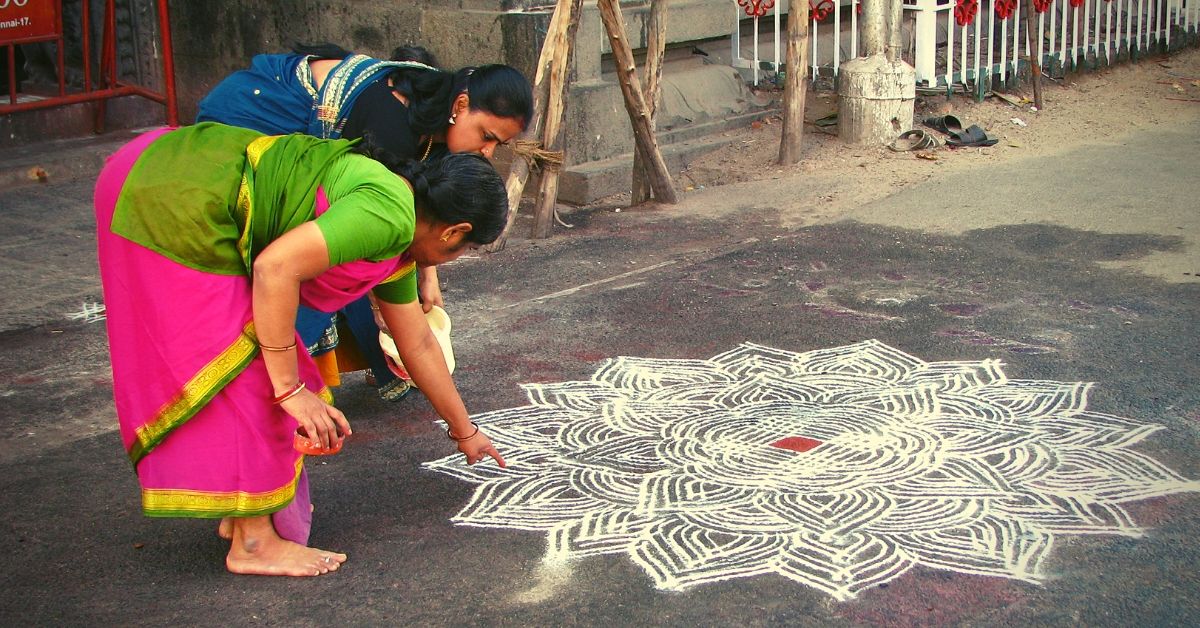
If you’ve ever passed by a traditional Indian home at dawn, especially in South India, you may have noticed intricate white patterns outside the front entrance — delicate, symmetrical drawings made with rice flour.
Table of contents
These beautiful designs, known by many names — kolam, rangoli, alpana, or muggu — are more than aesthetic expressions. They carry layers of cultural, environmental, spiritual, and philosophical depth.
So, why did our ancestors use rice flour specifically, and why outside the house?
This seemingly simple tradition is a profound example of how daily rituals once reflected holistic living — a union of beauty, duty, science, and soul.
Let’s explore the deeper meanings.
1. An Act of Compassion: Feeding the Smallest Lives
At its core, sprinkling rice flour on the ground was an offering — not just to deities, but to the earth and its tiniest creatures.
Rice flour, being pure, natural, and edible, attracted ants, birds, insects, and even microbes in the soil.
This was our ancestors’ quiet way of saying:
“Even the smallest lives matter.”
It wasn’t random kindness — it was built into daily life, reminding people to live harmoniously with nature. Instead of pesticide-laced surroundings, they chose to nourish life, not kill it.
This created a symbiotic ecosystem:
- Ants were fed, reducing their intrusion into food storage inside the home.
- Birds and squirrels visited, creating a natural rhythm of life around the household.
- Children learned compassion, watching these creatures be fed daily.
This practice embodied the Vedic concept of “Sarve Bhavantu Sukhinah” — may all beings be happy.
2. Energy Fields and Sacred Thresholds
According to Vastu Shastra and Ayurveda, the entrance to your home is not just a physical door — it’s a portal of energy.
Rice flour patterns, drawn at the doorway, act like sacred seals that regulate what kind of energy can enter the space.
Every pattern — whether a circle, lotus, or star — is designed with geometric precision, believed to:
- Absorb positive vibrations
- Ward off negative influences
- Attract abundance and spiritual harmony
Some cultures even created new kolams daily to reset and purify the energy field — like sweeping away energetic dust and replacing it with renewed intention.
In fact, many of these patterns are rooted in yantras — visual mantras used in meditative practices. The act of drawing them becomes a moving meditation, balancing the home’s energy and the mind of the person creating it
3. Celebrating Abundance Through Gratitude
Rice, in many ancient civilizations, symbolized life, wealth, and prosperity. By using rice flour as art, people made a daily symbolic offering of their harvest back to the divine.
“What we receive, we give back — that is the rhythm of abundance.”
Using this everyday staple for sacred purposes reminded people to remain humble and grateful. It was an everyday ritual of:
- Thankfulness for food
- Hope for future harvests
- Connection with the Earth as a provider
Rather than hoarding resources, this gentle offering became a practice of gratitude, both spiritual and practical.
4. Early Environmental Consciousness
Before “zero waste” and “eco-living” became modern hashtags, our ancestors practiced it naturally.
- Rice flour is biodegradable and non-toxic
- It returns to the soil, nourishing microbes and plants
- It leaves no pollution or synthetic residue
Unlike today’s chemical rangoli powders or plastic decorations, rice flour dissolves with rain, eaten by ants or scattered by the wind — leaving no footprint behind.
Even the act of cleaning the area before drawing helped maintain clean thresholds, discourage pests, and reduce dust — combining hygiene with art.
It’s a model for how tradition can be:
- Beautiful
- Practical
- Planet-friendly
5. Enhancing Mental Focus and Discipline
Drawing kolams is not mindless art — it’s an act that requires calm, patience, and concentration. In many households, young girls were encouraged to learn and practice these designs daily as part of their routine.
This wasn’t merely for beauty — it was to instill:
- Mindfulness and steady hand control
- Visual-spatial reasoning
- Personal discipline and mental clarity
In today’s terms, it’s akin to daily meditation combined with creativity. Studies have shown that repetitive, symmetrical design creation (like mandalas or kolams) can reduce anxiety and enhance mental focus.
For women in traditional households, this 15-minute quiet ritual could become a sacred moment of self-expression and inner peace before a busy day.
6. A Silent Form of Social Expression
In many Indian communities, rice flour designs became a non-verbal form of social communication.
During festivals, marriages, or spiritual occasions, kolam designs would change — becoming more elaborate, using colored powders, flowers, or turmeric.
Passersby could tell:
- A house had a newborn (special kolam types were drawn)
- A wedding was underway
- It was a new moon or full moon day
- Someone had passed away (often no kolam would be drawn)
In essence, the rice flour outside the door acted like a community message board, quietly expressing joy, grief, reverence, or celebration.
7. Microbiological and Scientific Logic
From a scientific standpoint, placing edible substances like rice flour outside serves a practical microbial purpose.
Rice flour acts as a:
- Prebiotic substrate — it feeds beneficial bacteria in soil
- Micro-insect control — providing food outside helps keep ants from entering kitchens
- Soil enricher — the flour enhances the fertility of the land around the home
Some researchers even speculate that regular kolam drawing helped encourage microbial diversity near homes — a natural, sustainable, microbial equilibrium that modern urban living disrupts.
What appears to be a small, simple white line at your doorstep is in truth a legacy of incredible wisdom.
It reflects a world where:
- Art was everyday spirituality
- Design was energy work
- Food was shared, not hoarded
- Environmental care was woven into custom
- And mindfulness was practiced in motion
Reviving or respecting this tradition today isn’t about nostalgia — it’s about realigning with sustainable, mindful living in a noisy, fast-paced world.
