


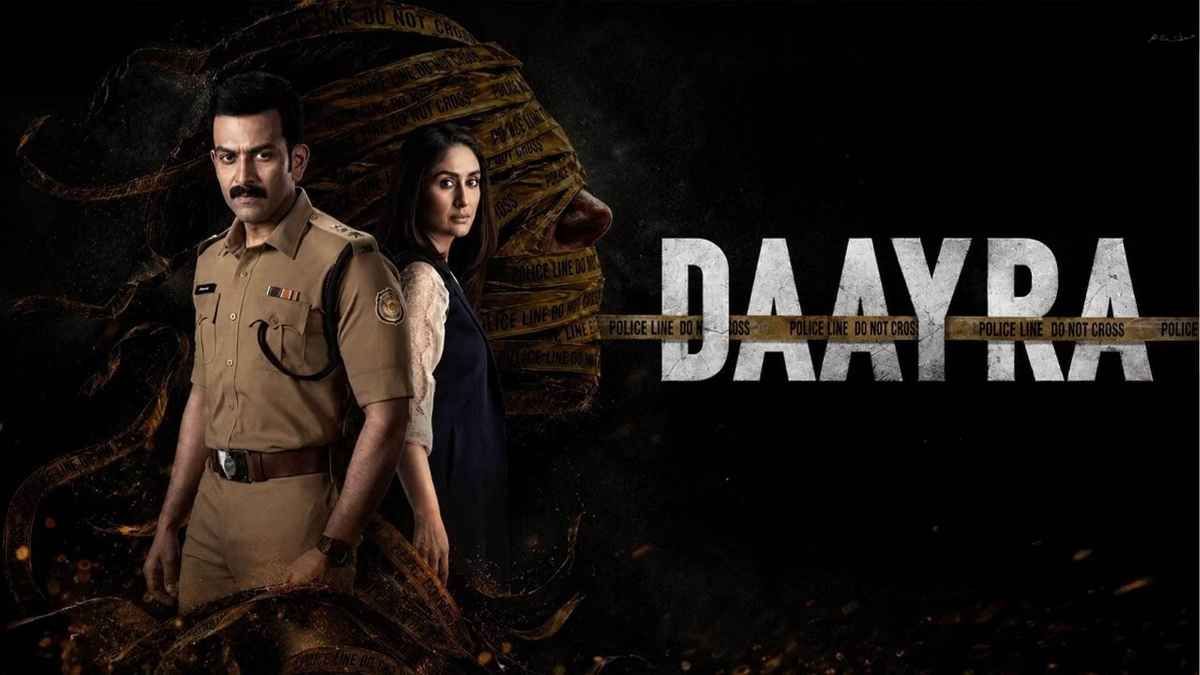
Meghna Gulzar returns with yet another powerhouse crime drama, and Daayra proves once again why she is one of Hindi cinema’s sharpest storytellers. Pitting Kareena Kapoor Khan against Prithviraj Sukumaran in their first-ever on-screen pairing, this gripping police procedural doesn’t just tell a story — it forces audiences to confront uncomfortable questions about law, morality, and justice in modern India. Backed by Junglee Pictures and Pen Studios, and inspired by true events, Daayra is easily one of 2026’s most thought-provoking theatrical releases.
Daayra is a slow-burn police procedural that trades the usual cops-versus-criminals formula for something far more compelling — two honest officers on opposite sides of the same moral line. When a police encounter involving the accused in a horrific gang-rape and murder case splits public opinion, DCP Ajooni Kohli (Kareena Kapoor Khan) and DCP Raman Kumar (Prithviraj Sukumaran) find themselves investigating each other, each convinced they are serving true justice. Meghna Gulzar crafts a gripping, morally layered thriller that refuses to hand audiences easy answers, elevated by a career-best performance from Prithviraj and a strong supporting cast. It’s intense, timely, and impossible to look away from.
Cast & Crew
| Role | Name |
|---|---|
| Director | Meghna Gulzar |
| Writers | Yash Keswani, Sima Agarwal, Meghna Gulzar |
| Producers | Junglee Pictures, Pen Studios |
| Casting Director | Taran Bajaj |
| DCP Ajooni Kohli | Kareena Kapoor Khan |
| DCP Raman Kumar | Prithviraj Sukumaran |
| Supporting Cast | Jitendra Joshi, Trupti Khamkar, Kshitee Jog |
| Runtime | 2 hrs 23 mins |
| Certificate | A |
| Language | Hindi |
| Genre | Drama, Thriller, Crime |
Plot Summary
Daayra opens with a police encounter that kills four men accused of a young girl’s gang-rape and murder. To the public, it’s instant justice. To the Special Investigation Team led by DCP Ajooni Kohli, it looks like a carefully orchestrated extrajudicial killing engineered by DCP Raman Kumar and his squad. As Ajooni digs deeper, the film becomes less a whodunit and more a battle of ideologies: Ajooni insists that the police must operate strictly within the “daayra” (circle/boundary) of the law, while Raman is driven by a fierce, personal sense of duty toward victims failed by a slow system. The film also weaves in the real-world debate around juvenile justice, echoing conversations sparked by the Nirbhaya case, and asks whether rehabilitation should outweigh the severity of a crime. Gulzar never tells the audience who is right — she simply lays out both sides and lets the moral discomfort linger.
Actor Performances
Kareena Kapoor Khan brings quiet conviction and screen presence to DCP Ajooni Kohli, anchoring the film’s moral compass with a performance that carries real emotional weight, especially in the investigation’s tensest confrontations.
Prithviraj Sukumaran is the film’s beating heart — his portrayal of Raman Kumar is intense, controlled, and magnetic, using a deceptively calm exterior to mask simmering rage. It’s the kind of performance that makes you understand a man’s conviction even as you question his methods, and it firmly announces his arrival as a major force in Hindi cinema.
Jitendra Joshi is pitch-perfect as part of Raman’s special squad, bringing grit and authenticity to every scene he’s in.
Trupti Khamkar delivers a standout turn, headlining a thrilling and brutally staged chase sequence that ranks among the film’s finest set pieces.
Kshitee Jog rounds out the ensemble with an equally effective, grounded performance that adds further texture to the investigation.
Technical Analysis
Direction
Meghna Gulzar is in complete command here, crafting a procedural that resists easy binaries. Her signature restraint — seen earlier in Talvar and Raazi — gives Daayra its gravity, forcing viewers to sit with uncomfortable questions rather than handing them a clean resolution.
Cinematography
The film’s visual language leans into a gritty, realistic tone that suits its morally murky world, keeping the focus on faces and confrontations rather than spectacle. (Official cinematography credits to be updated.)
Music/Score
The background score works quietly in service of the tension, amplifying the film’s simmering conflicts without ever overwhelming the drama. (Official music credits to be updated.)
Editing
The pacing supports the slow-burn structure well, with the chase sequence featuring Trupti Khamkar standing out as a masterfully cut, high-adrenaline highlight.
Also Read: Chumbak Review: Neena Gupta’s Warm Netflix Sitcom Is 2026’s Most Heartfelt Comedy Comfort Watch
Strengths and Weaknesses
Strengths:
- A refreshingly original premise that avoids the standard cops-vs-criminals template
- Prithviraj Sukumaran’s magnetic, career-defining performance
- Bold, timely engagement with real social debates around justice and juvenile crime
- A genuinely thrilling, brilliantly executed chase sequence
- Strong, believable supporting cast across the board
Weaknesses:
- Ajooni’s argument could have been written with slightly more intellectual force to fully match Raman’s emotional pull
- The screenplay occasionally lets one side’s perspective dominate the debate
Final Verdict: ⭐⭐⭐⭐⭐5/5 stars
Daayra is a bold, urgent, and beautifully performed thriller that dares to ask what justice really means in a country running out of patience. Meghna Gulzar delivers another triumph, Prithviraj Sukumaran gives one of the year’s best performances, and Kareena Kapoor Khan proves once again why she remains one of Hindi cinema’s most reliable leading ladies. A must-watch.
What is the certification rating of Daayra?
Daayra is certified ‘A’ (Adults Only) by the CBFC, owing to its intense and mature themes involving crime and violence.
Is Daayra suitable for children or family viewing?
No. Given its ‘A’ certificate and graphic themes surrounding sexual violence, juvenile crime, and police encounters, Daayra is not recommended for children or family audiences.
Is Daayra based on a true story?
Yes, Daayra is described by its makers as “inspired by true events,” drawing on real debates around police encounters, justice, and juvenile crime in India.
