



There are certain foods that don’t just feed you — they mark the day. Foods where the making itself is part of the ritual, where the smell from the kitchen tells everyone in the house that something meaningful is happening. Hot Cross Buns are exactly that kind of recipe. Soft, gently spiced, filled with plump raisins, and marked with a cross that carries centuries of meaning — these buns have been part of Good Friday morning in Christian homes for longer than most traditions most of us know.
For Indian Christian families — whether in Kerala, Goa, Tamil Nadu, or scattered across the diaspora from Dubai to Toronto — Easter is the most sacred celebration of the year. And while every home has its own way of marking it, the kitchen is almost always involved. Hot Cross Buns fit naturally into that rhythm. They’re not difficult once you understand the dough. They fill the house with the smell of cinnamon and warm bread. And they bring everyone to the table before the day even properly begins.
This recipe blends the best elements of the classic versions — brown sugar for depth, cinnamon, nutmeg and allspice for warmth, a flour cross baked right into the top, and a bright orange icing drizzled on while the buns are still warm. The result sits somewhere between a soft dinner roll and a cinnamon roll. Dense enough to feel substantial, sweet enough to feel festive, and spiced in a way that feels like it belongs to the season.
Hot Cross Buns are soft, spiced Easter yeast buns filled with raisins, marked with a flour cross, and finished with orange icing — traditionally eaten on Good Friday. This recipe uses brown sugar, cinnamon, nutmeg, and allspice for deep flavor. Two critical techniques: soak raisins in boiling water before adding (plumper, softer texture), and respect both rise times fully — cinnamon slows yeast, don’t rush it. Bake at 350°F for 20–25 minutes until golden. Orange icing goes on warm, not hot.
In this Article
What Makes Hot Cross Buns Special
Hot Cross Buns carry history in a way that most recipes don’t. They date back to the 12th century — originally a Saxon tradition, later woven into Christian Easter observance as a food specifically eaten on Good Friday. The cross on top is not decoration. It represents the crucifixion, making these buns one of the most quietly devotional foods in the Christian tradition. You eat them, and the symbolism is right there in your hands.
What makes them work as a recipe — beyond the meaning — is the combination of textures and flavors. Brown sugar brings molasses depth. The trio of cinnamon, nutmeg, and allspice gives warmth without being overwhelming. Plump raisins add little pockets of sweetness through the crumb. The flour cross baked on top gives slight chew. And the orange icing at the end is what ties everything together — citrus and spice, sticky and warm. Unlike a plain sweet roll, every component of a proper Hot Cross Bun is doing something.
Recipe Overview
| Detail | Information |
|---|---|
| Prep Time | 25 minutes active |
| Rising Time | 2.5 to 3 hours (two rises) |
| Cook Time | 20–25 minutes |
| Total Time | ~3 hours 45 minutes |
| Yield | 14–16 buns |
| Cuisine | British / Easter tradition |
| Course | Breakfast, Brunch, Festival bread |
| Diet | Vegetarian |
| Difficulty Level | Easy-Medium |
| Calories per Bun | ~262 kcal |
| Festival | Good Friday / Easter |
Why Hot Cross Buns Belong on a Good Friday Table
Good Friday has a particular quality to it — quieter than Easter Sunday, more reflective, still carrying the weight of what the day means before the celebration of the morning after. The fast of the day, the church service, and then the breaking of that fast with something warm and homemade — that sequence is what gives Hot Cross Buns their place.
The cross on each bun makes the theology visible. You’re not just eating bread. You’re acknowledging what Good Friday is actually about — the crucifixion, the sacrifice, the story that Easter Sunday answers. In many Indian Christian households, particularly in Kerala and Goa where Easter traditions run deep and deliberate, baking these buns on Good Friday morning has become its own small observance. The kitchen becomes part of the liturgy.
Beyond symbolism, the timing is practical. Hot Cross Buns are best eaten warm, in the morning, with tea or coffee. Good Friday morning — after church, before the day’s reflection settles in — is exactly right. They’re generous enough to feed a household, simple enough that children can help with shaping, and significant enough that everyone remembers them.
The Two Critical Techniques: Soaking the Raisins and Managing the Rise
Before the step-by-step, there are two techniques that determine whether your Hot Cross Buns are pillowy and flavorful or dense and disappointing.
1. Soak Your Raisins in Boiling Water Before Using
Raw raisins going directly into bread dough stay hard and chewy — they don’t integrate well and can pull moisture from the surrounding dough. Soaking them in boiling hot water for 10 minutes before draining and patting dry changes everything. They plump up, soften completely, and then melt into the crumb as the buns bake. Every bite that hits a raisin becomes something better. This step takes almost no effort and makes a real difference to the final texture.
2. Respect Both Rise Times — and Understand What Cinnamon Does
Most people know that yeast bread needs one rise. What catches people off guard with this recipe is that cinnamon — one of the main flavor agents here — actually inhibits yeast activity. This is baking science. It means your Hot Cross Buns will be slightly denser than a standard dinner roll, and both rise times need to run their full course without shortcuts. Don’t rush the first rise to less than 90 minutes, and give the shaped rolls a full hour for their second rise. If you want a fluffier result, reduce the cinnamon to ½ teaspoon. If you want full spiced depth — keep it as written, and be patient.
Ingredients
For the Dough
| Ingredient | Quantity | Notes |
|---|---|---|
| Whole milk, warmed to 110°F | ¾ cup (180ml) | 2% works; whole milk gives best richness |
| Active dry yeast or instant yeast | 2¼ tsp (1 standard packet) | Check expiry before using |
| Granulated sugar | 1 tsp | For proofing the yeast |
| Light or dark brown sugar | ½ cup (100g) | Adds molasses depth |
| Unsalted butter, softened | 5 tbsp (71g) | Room temperature, not melted |
| Pure vanilla extract | ½ tsp | |
| Large eggs, room temperature | 2 | Cold eggs can seize the butter |
| Salt | 1 tsp | |
| Ground cinnamon | 1¼ tsp | Reduce to ½ tsp for fluffier buns |
| Ground nutmeg | ½ tsp | |
| Ground allspice | ½ tsp | |
| All-purpose flour | 3½ cups (438g) | Bread flour gives chewier texture |
| Raisins or craisins, soaked & drained | 1 cup (140g) | Soak in boiling water 10 min first |
For the Flour Cross
| Ingredient | Quantity | Notes |
|---|---|---|
| All-purpose flour | ½ cup (63g) | |
| Water | 6–8 tbsp | Add gradually for thick paste |
For the Orange Icing
| Ingredient | Quantity | Notes |
|---|---|---|
| Powdered / icing sugar | 1 cup (120g) | |
| Fresh orange juice | 3 tbsp (45ml) | Bottled works; fresh is better |
Step-by-Step Instructions: Making Perfect Hot Cross Buns
Step 1: Soak the Raisins and Proof the Yeast (10 minutes)
Start by placing your raisins or craisins in a small bowl and covering them with 1 cup of boiling hot water. Set aside to soak for 10 minutes, then drain well and pat dry with paper towels.
Meanwhile, in your stand mixer bowl, whisk together the warm milk, yeast, and 1 tsp granulated sugar. Leave uncovered for 5 minutes until foamy on top. If nothing happens after 5 minutes, your yeast is likely expired — start over with a fresh packet. This step is non-negotiable.


Step 2: Build the Dough (5 minutes)
To the yeast mixture, add the brown sugar, softened butter, vanilla extract, both eggs, salt, cinnamon, nutmeg, allspice, and 1 cup of flour. Using the dough hook or a wooden spoon, mix on low for 30 seconds and scrape down the sides. Add the remaining flour and the drained raisins. Beat on low until the dough comes together and pulls away from the bowl sides — about 2 minutes. The dough should be slightly sticky and soft. If it’s too wet and not pulling away, add flour 1 tablespoon at a time.
Step 3: Knead the Dough (5 minutes)
Keep the dough in the mixer and knead on medium-low for a full 5 minutes using the dough hook. If kneading by hand, turn out onto a lightly floured surface and knead for 5 minutes. You want a smooth, slightly tacky dough that slowly bounces back when you poke it. Do not over-flour — a dry dough makes tough buns. Less flour, more patience.
Step 4: First Rise (1½ to 2 hours)
Transfer dough to a lightly greased large bowl, turn to coat all sides, and cover with a clean kitchen towel or cling film. Leave in a warm, draft-free spot until doubled in size — 1½ to 2 hours at room temperature. Don’t rush this. The flavor develops here.
Step 5: Shape the Rolls (15 minutes)
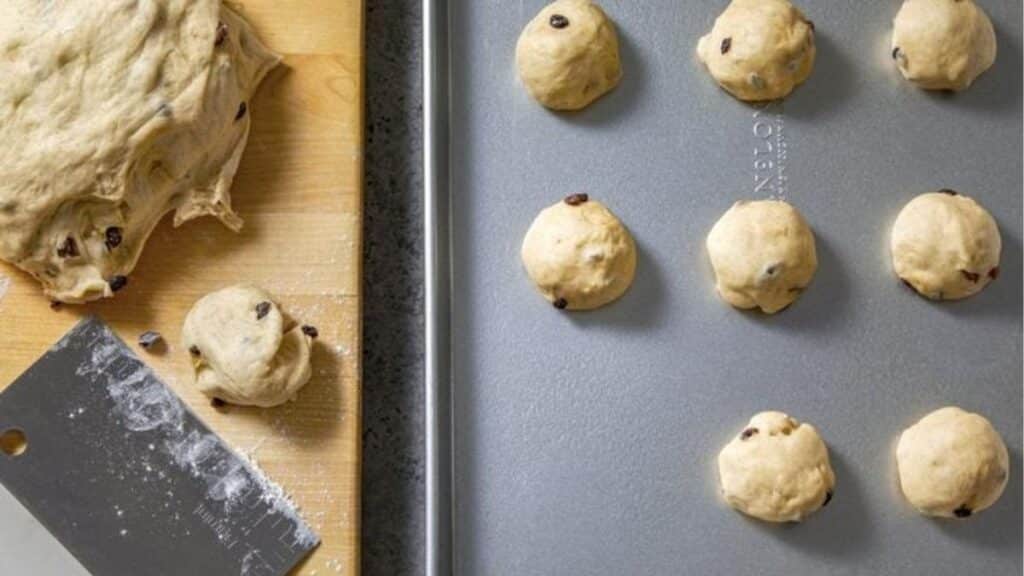
Punch the dough down firmly to release the air. Divide into 14–16 equal pieces — eyeballing is fine. Shape each piece by stretching the top of the dough and pinching firmly at the bottom to create a smooth ball. Arrange in a greased 9×13 inch baking pan, sitting close to each other but not squished.
Step 6: Second Rise (1 hour)
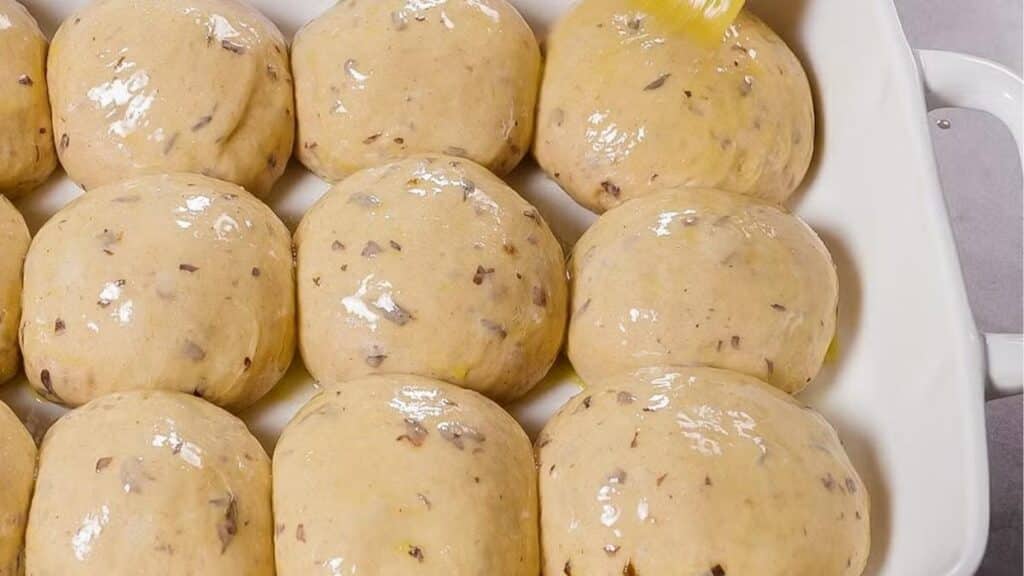
Cover the shaped rolls with a kitchen towel and leave to rise until visibly puffy — about 1 hour. While they’re rising, preheat your oven to 350°F / 177°C.
Step 7: Pipe the Crosses
Whisk the flour and water together to form a thick paste — start with 6 tablespoons of water and add more if needed. It should be thick enough to hold shape when piped but fluid enough to move through the bag. Transfer to a piping bag or zip-lock bag with a small corner snipped off. Pipe a continuous line down the center of each row of buns, then repeat in the other direction to form crosses over every bun.

Step 8: Bake (20–25 minutes)
Bake for 20–25 minutes until golden brown on top, rotating the pan halfway through. If the tops are browning too quickly, loosely tent the pan with aluminium foil. Remove from the oven and allow to cool for a few minutes before icing.
Step 9: Add the Orange Icing and Serve
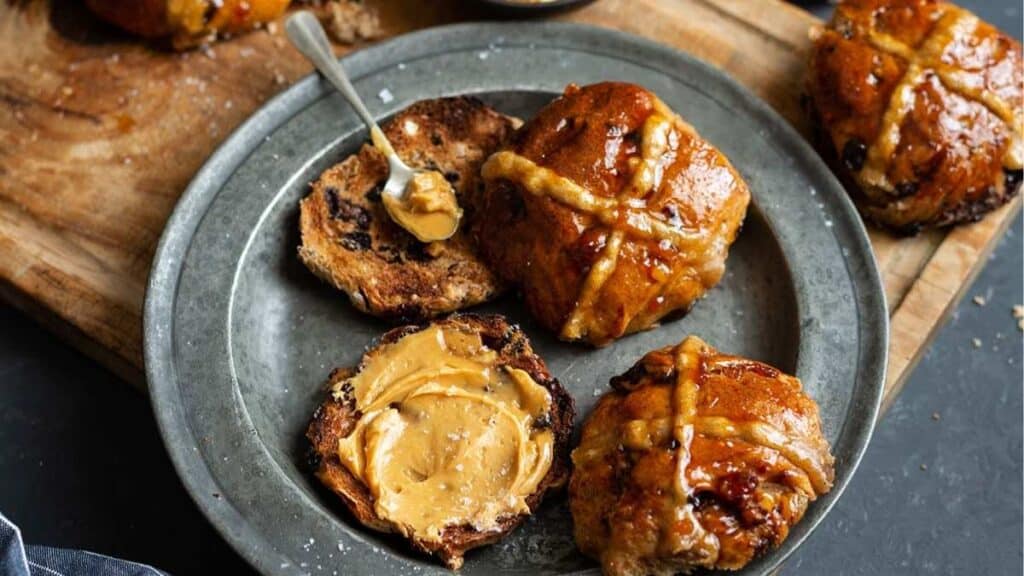
Whisk together the icing sugar and orange juice until smooth and pourable. Drizzle or brush generously over the warm buns while they’re still in the pan. Serve immediately — warm, fragrant, and glossy. This is the moment.
Expert Tips for Perfect Hot Cross Buns
- Milk temperature matters more than people think. At 110°F it feels warm on the inside of your wrist without burning. Too hot and it kills the yeast. Too cool and the yeast won’t activate. If you don’t have a thermometer, err on the side of slightly cooler rather than hotter.
- Room temperature eggs are not optional. Cold eggs cause the butter to seize and create uneven dough. Take them out of the fridge 30 minutes before you start baking.
- Bread flour produces a chewier bun. All-purpose flour works perfectly, but if you have bread flour available, the higher protein content gives the buns more structure and a more satisfying bite.
- Create a warm proofing environment if your kitchen is cold. Place the covered dough bowl in an oven with just the light switched on. That residual warmth is enough to create the ideal proofing environment without overheating.
- Orange icing goes on warm, not hot. Let the buns cool for 3–4 minutes out of the oven before drizzling. Too hot and the icing runs off completely. Just warm and it soaks in slightly while still looking glossy.
Regional Variations and Adaptations
In Goan Christian homes, you’ll sometimes find buns made with a small amount of toddy — fermented palm wine — as part of the leavening, giving the dough a subtle sourness that is entirely its own thing. Kerala bakers often add a pinch of cardamom (about ¼ tsp) alongside the cinnamon, a habit carried over from local spice traditions that works beautifully with the nutmeg and allspice already in the dough.
For a contemporary variation, dried cranberries in place of raisins pair particularly well with the orange icing — the tartness plays off the citrus rather than competing with it. A small amount of orange zest kneaded into the dough itself takes that pairing even further.
Vegan adaptation: Replace butter with coconut oil, eggs with flax eggs (1 tbsp ground flaxseed + 3 tbsp water per egg), and milk with full-fat oat milk or coconut milk. The texture changes slightly but remains good.
Make-Ahead Strategy for Easter
- Two Days Before: Prepare the dough through the first rise. Punch it down, cover tightly, and refrigerate. Cold fermentation over 12 hours actually deepens the flavor considerably.
- The Night Before: Shape the rolls and arrange in the greased pan. Cover tightly with cling film and refrigerate overnight for up to 15 hours. This is the most practical option — the hard work is done the evening before.
- Good Friday Morning: Remove the pan from the refrigerator at least 2–3 hours before you want to bake. Keep covered and allow the rolls to come to room temperature and complete their second rise on the counter. Then bake, ice, and serve.
- Freezing baked buns: Cool completely, then freeze without icing for up to 3 months. Thaw at room temperature or in the refrigerator, reheat in a low oven, and add fresh icing just before serving.
- Leftovers: Slice a leftover bun in half and toast it, or pan-fry in a little butter over medium heat until the cut sides are golden. Eat warm with morning chai. It’s genuinely one of the better things you can do with day-old bread.
Serving Suggestions and Presentation
Good Friday morning is the traditional moment — after church or morning prayer, when the fast is being broken and the family gathers around the table. Serve the buns warm from the oven, still on the pan, with the orange icing glistening. Strong filter coffee, chai, or even a glass of warm milk alongside makes it complete.
For Easter Sunday brunch, arrange the buns on a large plate or board with boiled eggs, fresh fruit, and whatever else your family traditionally eats. The buns hold their own as the centerpiece. For larger gatherings, the recipe scales easily — double the quantities and use two pans.
For an interactive moment at the table, set out a small bowl of the orange icing with a spoon and let everyone drizzle their own. Children especially love this. It turns serving into a small celebration of its own.
Why This Recipe Still Matters
Baking on Good Friday is its own kind of quiet observance. You’re not doing something elaborate — you’re making bread. But the cross on each bun, the warmth of the kitchen, the smell of cinnamon and orange filling the house while the morning is still early and the day still carries its particular weight — all of that adds up to something that a store-bought box simply cannot replicate. These buns take a morning of preparation and twenty-five minutes in the oven, and they’ll be what people in your family remember about this Easter. Some traditions earn their place not through grand gesture but through repetition, through care, through the simple act of showing up in the kitchen and making something with your hands.
Why do we eat Hot Cross Buns on Good Friday?
Hot Cross Buns are traditionally associated with Good Friday in Christian observance. The cross marked on each bun represents the crucifixion of Jesus Christ.
Why didn’t my Hot Cross Buns rise properly?
Three common reasons: expired yeast (always check the date and look for foam after proofing), milk that was too hot and killed the yeast (aim for 110°F — warm on your wrist, not burning), or a cold kitchen that slowed the rise. For cold kitchens, place the covered dough bowl in an oven with just the light switched on.
Can I make Hot Cross Buns without a stand mixer?
Yes. Mix the dough by hand using a wooden spoon or silicone spatula, then knead on a lightly floured surface for a full 5 minutes.
Can I use instant yeast instead of active dry yeast?
Yes. With instant yeast, skip the proofing step and add it directly with the dry ingredients. Rise times will be slightly shorter.


